You are standing over a saucepan with a spoon in your hand, waiting as sugar and water appear to do… absolutely nothing. The mixture is cloudy, stubbornly still and seemingly ready to turn into a gritty mass rather than the clear amber caramel you admired on Instagram. The recipe promised “simple syrup, then cook until golden”. Straightforward, surely? Instead, the top resembles frosted glass and you can already picture the scrubbing needed to clean the sticky pan.
Then you remember an older piece of advice: from a parent, grandparent or perhaps a pastry chef on YouTube. “Add a few drops of lemon.” You pause. Acid in sugar? Surely that will spoil the sweetness? But you squeeze some in, stir, and wait.
Something unexpectedly refined begins to unfold.
The little lemon juice trick that quietly transforms your caramel
The first time lemon juice is added to sugar syrup, it can seem completely wrong. Citrus belongs with fish or in cocktails, not in the foundation of a crème caramel, does it? In fact, that sharp little addition is exactly what can give caramel its clear appearance and smooth, silky consistency. Just a few drops alter the way sugar behaves in the pan, rather like a director settling an unruly cast.
At a microscopic level, sugar is drawn to itself. It readily forms crystals, sticks around the edge of the pan and can turn a beautiful sauce into a crunchy failure. Lemon juice acts as a discreet mediator. It disrupts the sugar's orderly structure just enough that the contents of the saucepan begin to look and behave differently.
Imagine a friend making flan for the first time, proudly equipped with special ramekins, fresh eggs and quality vanilla. The caramel is the one part they fail to take seriously enough. Initially, it seems to be going well. Then, as the syrup thickens, a white crust begins to climb the pan's sides. Tiny grains drift through the liquid like snow.
The flavour is acceptable, but the caramel looks dull and almost sandy. When the flans are turned out, their bases are unevenly brown rather than displaying the glossy amber disc everyone hopes for. On the next attempt, somebody recommends adding a teaspoon of lemon juice to the sugar and water from the beginning. Same saucepan, same sugar, same hob. This time, the syrup remains transparent, the bubbles are uniform and the finished caramel gleams almost like stained glass.
There is a simple piece of kitchen chemistry behind this small action. Sugar is largely sucrose, a neat and regular crystal. Acid causes some sucrose to divide into glucose and fructose. Known as inversion, this process introduces sugar molecules with different shapes into the mixture. It then becomes far more difficult for the sugar to reform into orderly crystals.
That is why confectioners speak so appreciatively about acids, including cream of tartar and lemon juice. Their role is not merely flavour. They work like traffic controllers, preventing the syrup from building into a jam and carefully steering it towards a smooth caramel that stays clear on the spoon and glassy over your dessert.
How to add lemon juice to syrup without spoiling the recipe
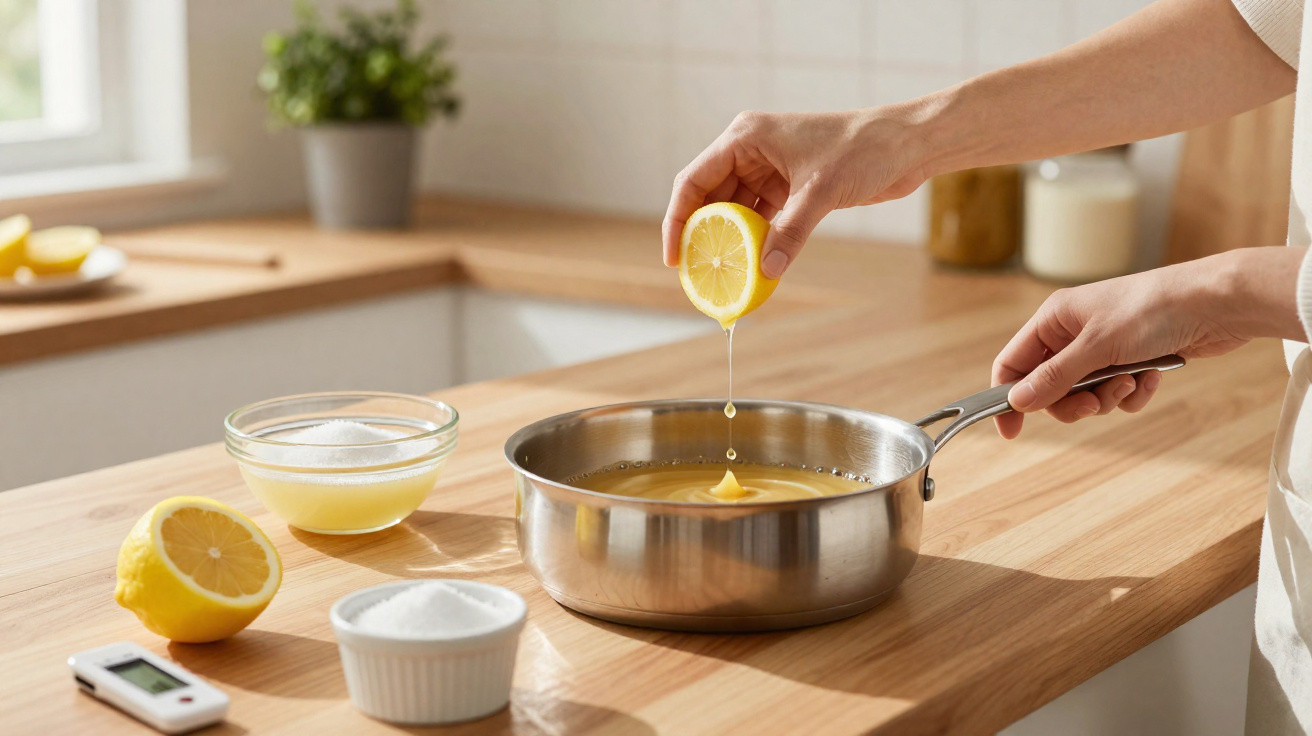
The method itself could hardly be easier. Combine the sugar and water in your saucepan as normal, with the heat off. For every 200 g of sugar (about 1 cup), add approximately 1 teaspoon of fresh lemon juice. Stir only until combined. At this point, it will still resemble cloudy water with sugar crystals resting at the base. That is entirely normal.
Put the pan over a medium heat and allow the syrup to reach a gentle simmer without stirring it. While the temperature rises, the acid is already quietly splitting some of the sucrose into smaller sugars. The bubbles will become bigger and slower as the syrup thickens, while its colour slowly changes from pale straw to rich amber. You should find that the pan sides remain cleaner and the surface looks more glass-like.
This is the stage at which most people go wrong. We interfere. We stir. We scrape down the edges as though making soup. Then the caramel responds with crystals. Lemon juice gives you slightly more room for error, but it is not an infallible safeguard. Stirring forcefully after the syrup has begun to boil can still return partly dissolved crystals to the pan.
A better method is to leave it alone once the sugar has dissolved and the syrup begins simmering. If the colour needs evening out, carefully swirl the pan by its handle. Should sugar cling to the sides, use a damp pastry brush to wash it down early in the process. Realistically, hardly anyone does this every single day. However, paired with the gentle effect of lemon, this light-handed approach makes caramel feel less like a battle and more like a gradual reveal.
Sometimes, all it takes is one small, almost secret step to turn a “hope this works” recipe into a quiet kitchen ritual you trust every single time.
- How much lemon?
About 1 teaspoon for each cup of sugar provides clarity without adding a sour flavour. - When should it be added?
Add it at the very start with the sugar and water, allowing it to work evenly throughout. - Will it make the caramel taste of lemon?
At such a small quantity, the flavour is almost undetectable once the caramel has darkened. - What happens if I add too much?
Excess acid can leave sweets or sauces so soft that they do not set correctly. - Can vinegar replace lemon juice?
Yes. A mild, colourless vinegar will work, although its aroma is less subtle than citrus.
Why this small caramel habit can change your kitchen confidence
The lemon juice trick is the kind of detail that can easily pass unnoticed unless somebody shows it to you. It is often tucked between the lines of old cookbooks and only partly explained recipes. Once you have watched what it does to syrup, it is difficult to abandon it. A saucepan that once seemed unpredictable begins to act like a scene you have already rehearsed. The bubbles are more settled, and the shift from clear syrup to amber caramel feels less alarming.
You may notice another difference as well. When clearer caramel coats pears, apples, flans or popcorn, it does more than improve the appearance. It adheres differently. On a crème brûlée, it breaks with a cleaner snap. It covers nuts in a transparent gloss rather than a cloudy coating. The lemon doesn’t steal the spotlight; it sharpens it.
There is a subtle emotional change, too. The first time a batch of caramel behaves just as you wanted, progressing from syrup to shine, it affects how you tackle the next recipe. Suddenly, preparing a tarte Tatin for friends at dinner seems less hazardous. You begin to see a pan of hot sugar not as a bomb about to explode, but as a process you genuinely understand. We have all had that moment when one small tip makes you ask, “Why didn’t anyone tell me this sooner?” It is a minor adjustment, yet it quietly changes the entire picture.
| Key point | Detail | Value for the reader |
|---|---|---|
| Use lemon juice in syrup | About 1 tsp per cup of sugar, added at the start | Reduces the risk of cloudy, grainy caramel |
| Do not stir once boiling | Allow the acid to work while the syrup cooks without disturbance | Helps maintain a smooth, glassy texture |
| Watch the colour, not the clock | From pale gold to deep amber, take it off the heat when the shade is right | Greater flavour control, from light and delicate to dark and bitter |

















Comments
No comments yet. Be the first to comment!
Leave a Comment