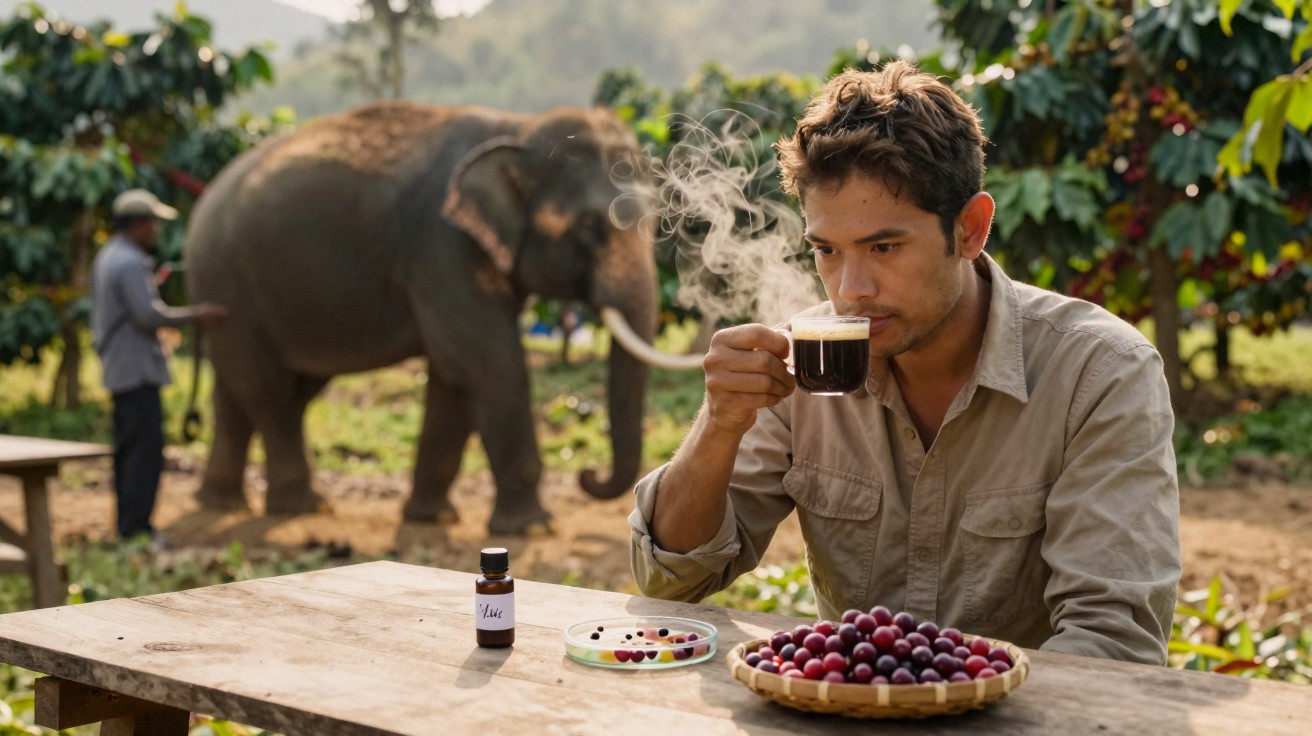
Black Ivory coffee and the elephant gut microbiome
The je ne sais quoi behind Black Ivory coffee’s velvety, chocolate-like taste may originate far inside the digestive systems of the world’s biggest land mammals.
A new investigation of the microbes inhabiting Asian elephants’ (Elephas maximus) intestines has identified bacterial groups that probably break down compounds which would otherwise leave coffee tasting bitter.
"Our previous study revealed that Gluconobacter was the dominant genus in the gut of civet cats, and it may produce volatile compounds from the coffee beans, suggesting that microbial metabolism contributes to the coffee aroma," says genomicist Takuji Yamada of the Institute of Science Tokyo in Japan.
"These findings raised the question of whether the gut microbiome of elephants similarly influences the flavor of Black Ivory coffee."
Black Ivory coffee ranks among the world’s priciest coffees, surpassing kopi luwak – coffee processed through civets, which are not actually cats.
It is produced at just one elephant sanctuary in Thailand. There, selected elephants receive unprocessed coffee cherries, and sanctuary staff subsequently retrieve the digested beans from their dung before washing and roasting them for people to drink.
The coffee is celebrated for a flavour that is frequently considered superior.
Having found that civet gut bacteria could contribute to the taste of kopi luwak, Yamada and his team set out to establish whether a comparable process might be shaping Black Ivory coffee’s flavour profile.
How coffee cherries affect elephant gut bacteria
Rather than testing the coffee beans, the researchers examined elephant dung directly to survey its gut microbes. They collected samples from six sanctuary elephants: three that had consumed coffee cherries and three that had not, forming the control group.
The animals’ diets differed only in an extra snack given to the coffee-consuming elephants, made up of bananas, coffee cherries and rice bran. Any variation in their gut microbiomes was therefore most likely linked to this additional food.
Coffee’s bitterness partly stems from pectin, a compound within plant cell walls, and from cellulose. When coffee is roasted, both pectin and cellulose are converted into bitter-tasting compounds.
After sequencing the dung samples, the team discovered that elephants digesting coffee had a far greater share of gut microbes associated with breaking down pectin and cellulose. Certain bacterial species were entirely absent from the control animals.
The researchers also used previously published findings to compare the microbiomes of the coffee-consuming elephants with those of cattle, pigs and chickens, looking for other animals that might potentially digest coffee.
Although some relevant bacterial species appeared in these other animals, only elephant guts contained the complete set of tools needed to break down pectins and cellulose.
A study from 2018 showed that Black Ivory coffee contains substantially less 2-furfuryl furan than ordinary coffee beans. This is among the bitter compounds generated when pectin breaks down during roasting.
The latest elephant microbiome analysis indicates that partly digesting the coffee cherries removes components of the beans that would become bitter during roasting, producing a considerably more enjoyable flavour profile.
The researchers’ next task would be to investigate the beans themselves.
"Our findings may highlight a potential molecular mechanism by which the gut microbiota of Black Ivory coffee elephants contributes to the flavor of Black Ivory coffee," Yamada says.
"Further experimental validation is required to test this hypothesis, such as a biochemical analysis of coffee bean components before and after passage through the elephant's digestive tract."
The study has been published in Scientific Reports.

















Comments
No comments yet. Be the first to comment!
Leave a Comment