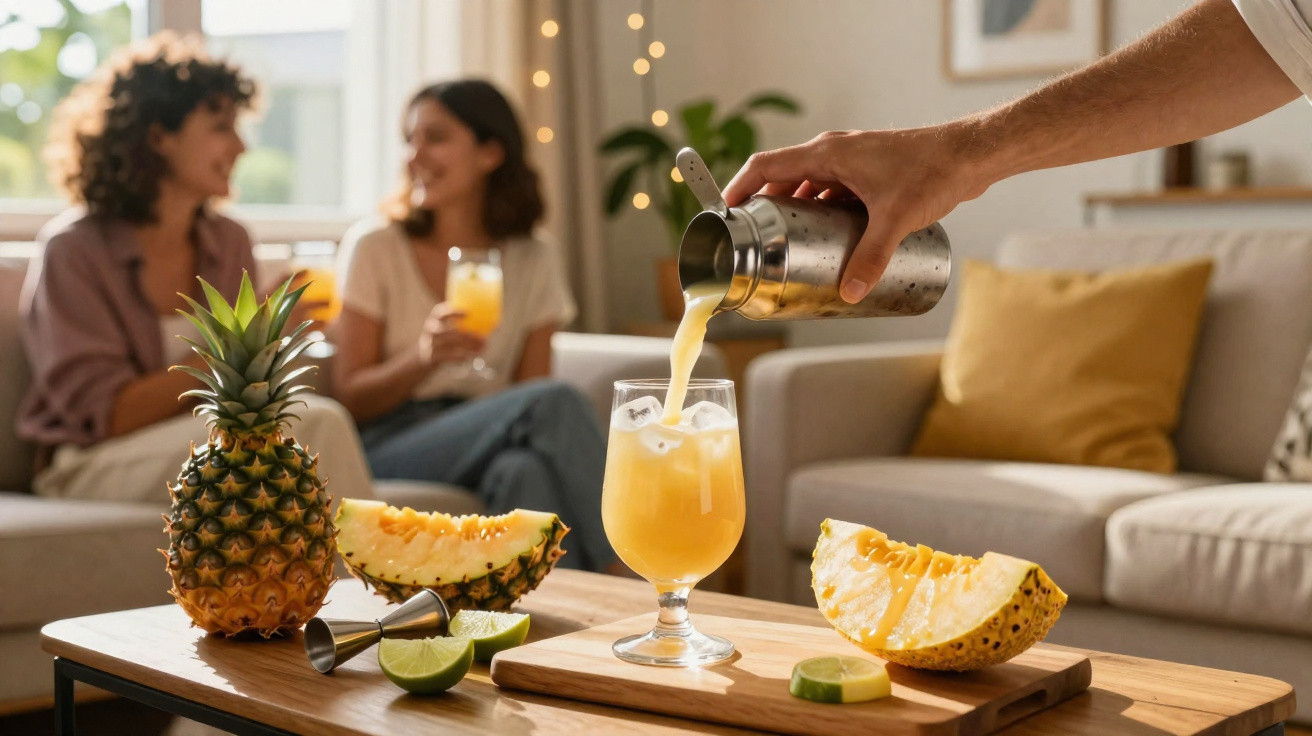
A muggy evening, friends gathered around the table, and that dangerous silence of “something’s missing”.
That was when the right drink appeared.
It was neither a caipirinha nor the familiar piña colada. What poured from the jug was a golden-yellow, fragrant cocktail: part tropical, part unexpected. Pineapple and melon, a touch of lime and just enough alcohol. The sort of drink that gets the conversation moving again and makes everyone ask, “what exactly is in this?”.
The birth of a tropical twist in the living room
The story began like many others: a fridge full of ripe fruit, little desire to make the same drinks yet again, and demanding guests. The original plan was to make piña coladas, but there was not enough coconut milk. What was left over was a huge yellow melon, sweet and almost past its best.
Out of that slightly lazy necessity came the pairing that changed the direction of the gathering. Pineapple, already a cocktail classic, met yellow melon, which is subtler and more floral. Lime was added afterwards to stop the whole thing becoming an overly sweet poolside juice.
The real surprise was not the individual flavour of each fruit, but the way the melon “held” the pineapple and made the cocktail rounder, without that harsh acidity.
The result was a drink that feels related to a piña colada while retaining its own identity. It is lighter, fresher and finishes with the impression of a summer dessert on the terrace.
The science behind the pineapple and melon pairing
There is sound culinary logic behind the improvisation. Pineapple and melon are not often used together in recipes, yet technically they create a very well-balanced pair.
Why pineapple takes over the first sip
Pineapple is bold, aromatic and packed with acidity. It immediately fills both the nose and palate. In cocktails, it provides an aromatic, refreshing base. It also contains bromelain, an enzyme that breaks down proteins and creates that slightly prickly feeling on the tongue, which works particularly well in iced drinks.
The quiet role of yellow melon
Yellow melon, meanwhile, acts as the mediator. Its sweetness is gentle and almost floral, while its texture is more velvety. Once blended, it adds body without making the drink heavy. Rather than competing with the pineapple, it softens its sharper edges. The lime acidity becomes more elegant, the alcohol is less obvious, and the overall result seems more sophisticated than it really is.
Melon acts as a “filter” for the pineapple: it keeps the freshness, reduces the harshness and extends the flavour on the palate.
Lime: the small detail that makes it all work
Without lime, the mixture can become too sweet. With too much of it, it turns strident. The balance comes down to a few extra drops, or a few fewer. It brings brightness, lifts the aromas and preserves the impression of a light drink, even when its alcohol content is respectable.
The pineapple and melon cocktail recipe that impresses guests
The version that won over the table was straightforward: no ready-made syrup and no complicated method. Just fruit, ice and a little care.
- 480 ml fresh pineapple, cut into cubes
- 240 ml very ripe yellow melon, deseeded
- 80 ml white rum or mild white cachaça
- 30 ml freshly squeezed lime juice
- Ice cubes, enough to fill half the blender
- Mint leaves, to finish
Suggested method:
- Blend the pineapple, melon and lime until they form a smooth mixture.
- Add the ice and pulse, leaving a few small pieces of fruit intact.
- Add the alcohol last, blending briefly only until combined.
- Serve in tall glasses with mint and, if desired, a thin slice of melon on the rim.
Texture: where many people go wrong without noticing
What most caught the guests’ attention was not just the flavour, but the texture. It was neither thin juice nor a heavy smoothie, but something in between.
How to achieve a consistency “between juice and dessert”
- Choose fruit that is very ripe, almost at the point where it needs using.
- Blend in stages rather than allowing the ice to turn into fine snow.
- Adjust the ice at the end: add a little more for an almost slushy result, or use a little less for a more fluid cocktail.
When the drink runs slowly through the glass but still goes down easily, you have reached the right point.
Alcohol, lighter versions and the pitfalls of overdoing it
White rum is the recommended spirit, as it is neutral enough not to clash with the fruit. Yet the reality of home kitchens is different: whatever is in the cupboard tends to end up in the glass.
Spirits that pair well with pineapple and melon
| Spirit | Profile | When to use it |
|---|---|---|
| White rum | Smooth, slightly sweet | The classic version, a pool party |
| White cachaça | More rustic, vegetal | A barbecue, a distinctly Brazilian feel |
| Vodka | Neutral | When you do not want to affect the flavour |
| Gin | Herbal, aromatic | For a more sophisticated cocktail |
An alcohol-free version that does not feel like a “children’s drink”
For non-drinkers, the combination works perfectly without a spirit. Some alternatives include:
- Replace the alcohol with very cold sparkling water.
- Use a neutral iced tea, such as white tea or weak green tea.
- Top up with coconut water for a gentler result.
The key is not to overdo the sugar. The fruit itself already fulfils that role. A balanced mocktail follows the same principles as an alcoholic cocktail: acidity, sweetness, freshness and aroma in harmony.
How to serve it impressively without spending much
That evening, there were no crystal glasses or unusually shaped ice cubes. Even so, the cocktail became a talking point. A few simple touches make a difference.
Small gestures that change a guest’s perception
- Chill the glasses in the fridge for 15 minutes before serving.
- “Wake up” a mint leaf by gently twisting it between your fingers.
- Add a very thin lime slice inside the glass, purely for fragrance.
A guest may not be able to explain why they liked the drink so much, but they notice the feeling of care in every detail.
Risks, excesses and combinations that do not work so well
Like any pleasant, easy-drinking beverage, this cocktail has an obvious danger: a false impression of lightness. Its smooth flavour conceals the alcohol content.
Serving it in smaller glasses, alternating it with water and warning people that “it goes down far too easily” can make a difference. Hosts also need to monitor their own pace of drinking, since being the host requires a degree of clarity until the end of the evening.
Another trap is adding too much extra sugar. Syrup, honey and sweetener can quickly make the mixture sickly. If the fruit is good, its natural sugars are almost always enough, with lime providing the counterbalance.
When the combination becomes a starting point for new experiments
After the first evening, the pineapple and melon cocktail stopped being an exception and became something of a laboratory. At later get-togethers, variations emerged: a little grated ginger for heat, crushed pink peppercorns at the bottom of the glass, or tonic water instead of sparkling water.
One familiar scene began to repeat itself: someone tastes it, pauses, then says the words every host likes to hear: “I thought I knew fruit cocktails, but this one was different”. It is not the genius of an award-winning bar. It simply proves that two apparently ordinary fruits, treated with care, can transform the mood of an entire evening.

















Comments
No comments yet. Be the first to comment!
Leave a Comment