Introduction.
A former Top Chef contestant has discovered how to turn something most people throw away into a wonderfully fragrant kitchen staple.
Rather than sending citrus skins directly to the food-waste caddy, this French chef transforms them into punchy, aromatic seasonings that brighten ordinary meals. The technique is easy, uses little energy and helps reduce food waste, without requiring professional-level cooking skills.
From TV cooking show to a zero-waste flavour enhancer
Thibaut Spiwack, recognised in France through the television competition Top Chef and now the chef-owner of Anona in Paris, has made sustainable cuisine central to his work. His restaurant holds a Michelin Green Star for its environmentally conscious practices, as well as a conventional Michelin star for its cooking.
In his restaurant kitchen, lemons, oranges and other citrus fruits are used to the fullest extent. Their juice and zest are only the starting point. The peel that many home cooks discard or compost is instead valued as an ingredient with real culinary power.
For Spiwack, citrus peel is not rubbish: it is a flavour reservoir that can work every day in a home kitchen.
The approach brings together two ideas increasingly influencing contemporary cooking: reducing food waste and building stronger flavour without artificial additives.
Why citrus peels are worth saving
Lemon and orange juice provide instant acidity and freshness, while zest delivers fragrant essential oils. However, the thicker outer peel - particularly from organic fruit - still contains considerable aroma and cooking potential.
Much of this scent sits within tiny oil pockets beneath the coloured surface. Slow, gentle drying concentrates those oils. When combined with salt or sugar, the mixture can keep for months, releasing its fragrance whenever it is used in cooking.
- Reduced waste: the whole fruit is put to use, which is especially worthwhile when you buy organic produce.
- Greater flavour: peel contributes a complexity that juice on its own cannot achieve.
- Lower expense: once used fully, a bag of lemons can flavour dozens of dishes.
- Less packaging: homemade seasonings can take the place of bought flavoured salts and sugars.
For anyone mindful of both household spending and sustainability, the principle is simple: after juicing the fruit, make use of the remainder.
The Top Chef method: turning peel into citrus salt
Across his social media accounts, Spiwack shares a process that is straightforward enough for home cooks while still carrying a chef’s approval. Begin as soon as you have squeezed your lemons or oranges.
Step 1: keep and prepare the peels
Do not throw away the squeezed halves. Give them a quick rinse if they are sticky or still coated in pulp. Next, turn your attention to the inner layer known as the “pith”, or “ziste” in French.
This soft, white, spongy layer contains much of the fruit’s bitterness. A little bitterness can work well, but too much can mask the finer citrus aromas.
Spiwack recommends removing as much of the white layer as possible with a teaspoon or small knife, leaving mostly the coloured outer peel behind.
Removing the white pith significantly softens the harsh bitterness and lets the floral side of the fruit come forward.
Step 2: dry slowly at a low heat
After trimming, arrange the peels in one even layer on a baking tray or large dish. Avoid overlapping them, as they will steam rather than dehydrate.
Put them into an oven set to approximately 60°C. This is a very gentle temperature, closer to dehydrating than baking. Leave the peels until they are entirely dry and nearly brittle. Depending on the oven, peel thickness and how full the tray is, this may take several hours.
A dehydrator can be used if you have one. The important thing is to dry the peel gradually, retaining its aroma without scorching the oils.
Step 3: blend with salt to make a versatile seasoning
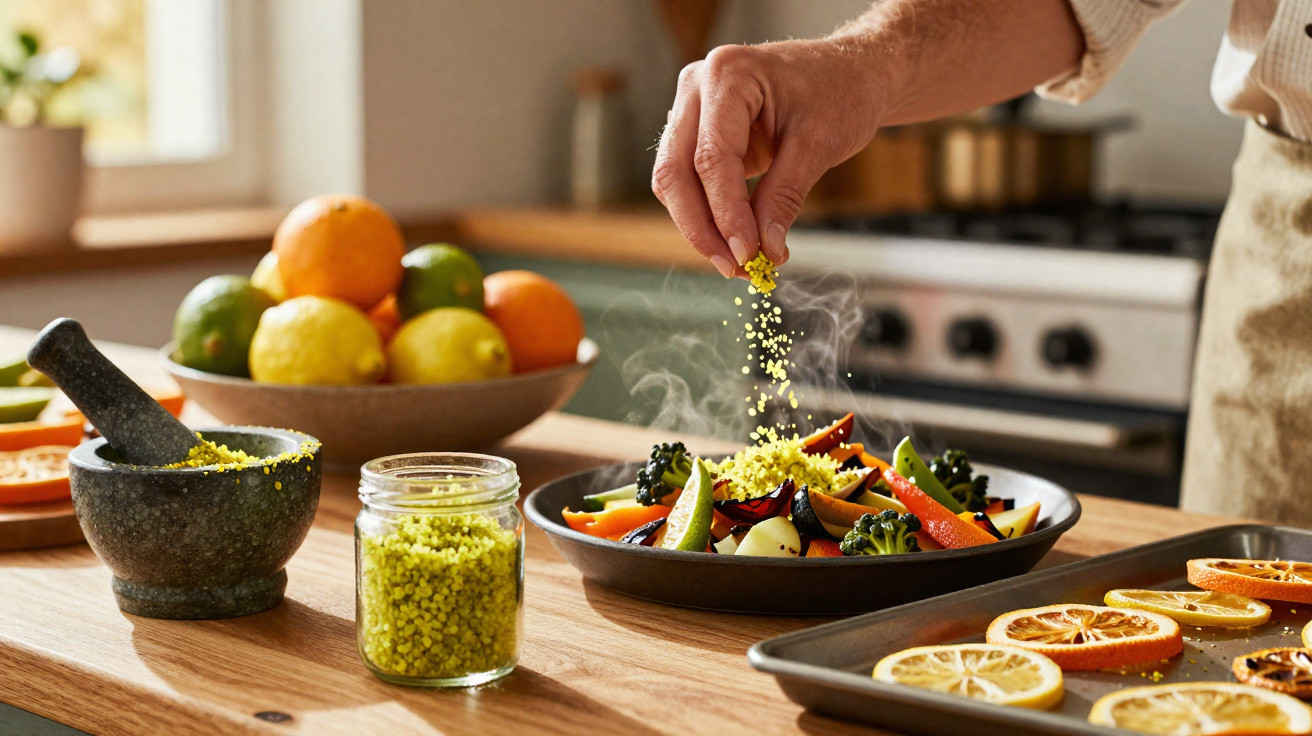
When the peels are completely dry and have cooled, put them into a blender or spice grinder. Add either fine or coarse salt, then blend until the mixture is a fragrant powder or a more textured seasoning, according to your preference.
You will have a citrus-infused salt with a distinctive flavour: lively and gently floral, with a rounded richness that ordinary lemon juice cannot offer.
Citrus salt is a natural partner for fish, but it also wakes up vegetables, roasted chicken and even simple fried eggs.
Using citrus salt in everyday dishes
Home cooks can often find it difficult to use up jars of specialist condiments. Citrus salt is more practical because it works with meals you probably make already.
| Dish | How to use citrus salt |
|---|---|
| Grilled fish or seafood | Add a sprinkling at the end of cooking or immediately before serving, so its aroma is not lost. |
| Roast chicken | Massage it beneath the skin with a little oil or butter, then add another pinch after cooking. |
| Roasted vegetables | Coat with olive oil and citrus salt before roasting, then finish with another small pinch. |
| Simple salads | Stir it into vinaigrette in place of standard salt for an instant fresh note. |
| Weeknight pasta | Complete a garlic-and-oil pasta with parsley, chilli flakes and citrus salt. |
As the salt is already flavoured, it can help prevent over-seasoning: flavour and seasoning are added together, which generally means less is needed overall.
Turning citrus peels into a dessert ingredient
People responding to Spiwack’s tip also suggested a sweeter variation: use sugar instead of salt. The process remains much the same, with only a minor change.
Dry the peel thoroughly, then blend it with white sugar until the mixture has a powerful lemon or orange fragrance. This citrus sugar can be used like ordinary sugar, but delivers extra aroma without adding liquid.
A spoonful of citrus sugar in cake batter, pancake mix or yoghurt brings a bakery-style fragrance with almost no effort.
Try it around the rim of cocktail glasses, in shortbread, scattered over fruit salad or folded into whipped cream. As the flavour is held within the sugar crystals, acidity remains easy to control while the citrus character stays pronounced.
Important terms and small risks
This technique often involves two terms: zest and pith. Zest is the thin, coloured outer part of the peel, which is packed with oils and flavour. Pith is the thicker, soft white layer beneath it. In effect, this method turns dried zest into a seasoning that keeps well.
A few details are worth bearing in mind:
- Fruit treatment: non-organic citrus fruits are frequently waxed or treated after harvesting. Wash them carefully, or select unwaxed organic fruit if you intend to eat the peel.
- Thorough drying: peels that are not fully dry may cause the mixture to clump and can, at worst, develop mould. When unsure, continue drying them.
- Storage: store citrus salt or sugar in a sealed jar away from heat and light, using only a clean, dry spoon.
- Salt quantity: it remains salt. Anyone monitoring their sodium consumption can increase the proportion of peel to salt, lowering the sodium content per teaspoon.
Pairing citrus with other flavours
Once you have learnt the basic citrus salt method, it can serve as a flexible starting point. Dried lemon or orange peel can be blended with chilli flakes to make a bold rub, while dried thyme, rosemary or oregano creates a Mediterranean-style seasoning.
For a barbecue blend, combine citrus salt with garlic powder and smoked paprika. To make a gentler version for seafood, pair it with white pepper and fennel seeds. In every variation, citrus links the flavours together, brightening the other ingredients and adding a fresh top note.
This is what makes Spiwack’s method feel especially current: one uncomplicated zero-waste habit can lead to a range of adaptable recipes. Using a low oven and a few lemons or oranges, home cooks can create their own collection of seasonings, suited to their taste and ready to make speedy weekday meals far more distinctive.

















Comments
No comments yet. Be the first to comment!
Leave a Comment