At ground level in Shenzhen’s business district, the lunchtime scene is instantly recognisable: scooters thread through traffic, while riders in fluorescent jackets carry bags of hot noodles and milk tea. Look upwards, though, and the picture becomes something quite different. Beyond the vehicles and LED displays, towers rise relentlessly, level after level, their balconies fading into the mist. On the 70th, 80th or 100th floor, a phone vibrates with a message: “Your meal is on the way.”
But the rider is still outside.
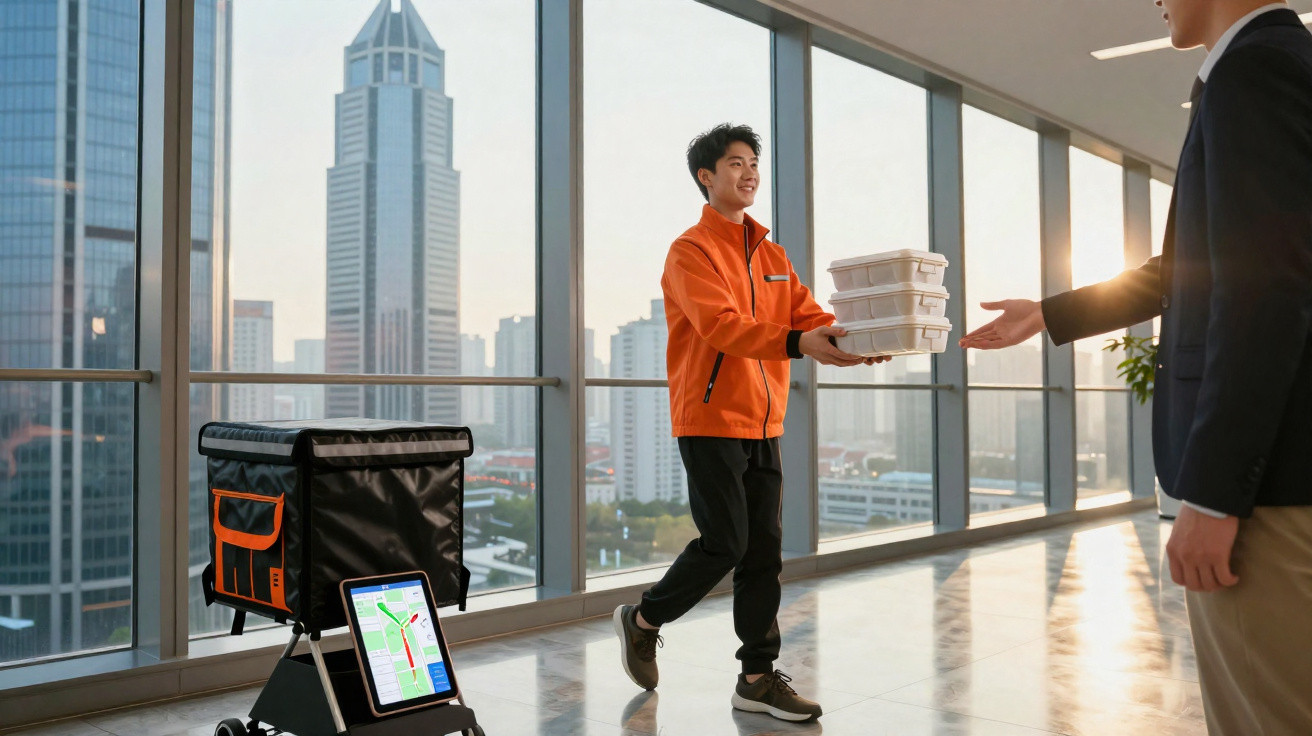
They pass the order to someone waiting in the lobby, dressed in the same platform branding but wearing no helmet-only running shoes, a smartwatch and an elevator access card. This person is a “high-rise runner”, the newest connection between street-side food and offices in the sky.
Getting upstairs is their work.
And they are always racing the clock.
Skyscrapers so tall they required a new job title
The first striking thing about accompanying a high-rise runner during a shift is the quietness of the vertical world. At street level, the city is filled with engines and horns. Within the tower, there are carpets, mirrored walls and elevator bells.
Liu, 27, taps his access card and checks his phone: 27 orders across 9 towers, some more than 300 metres tall. He is not on a scooter today. His race is against gravity.
Every Chinese delivery app now includes a “super high-rise” option, with a worker such as Liu assigned to those upper levels. Towers have become so high and concentrated that the final 200 metres of a meal’s trip has turned into a distinct occupation.
During a wet Wednesday in Guangzhou, bubble tea reaches the 86th floor of a glass office tower in less than 18 minutes. When the customer opens her door, she is surprised. Rather than an exhausted helmeted rider, she sees a young man in a polo shirt, scarcely short of breath, who greets her by name.
It is already his third visit to that floor that day.
At a nearby tower, another runner records more than 20,000 steps during one lunchtime rush without stepping outdoors. These buildings function as compact vertical cities, stacking banks, technology start-ups, gyms and clinics on top of one another. Conventional couriers waste too much time waiting for lifts and scanning QR codes, prompting platforms to create a role that operates entirely within the skyscraper environment.
The reasoning behind splitting the work is straightforward. Chinese delivery platforms are engaged in an intense battle for speed, while late orders result in penalties for both couriers and companies. Extremely tall towers create bottlenecks: a delayed lift or a security checkpoint can send average delivery times soaring. As a result, the job was divided.
Street riders take care of the horizontal dash from restaurant to lobby. High-rise runners focus on the vertical sprint.
The higher cities rise, the greater the need for someone who knows each elevator bank, access code and shortcut along the corridors. The role involves more than transporting food; it requires understanding how to cut 30 seconds from a journey that no algorithm can yet fully grasp.
The hidden skill of navigating a vertical city
A morning spent with a runner makes clear that the work is part logistics and part choreography. They do not simply travel “up and down”. They group orders by elevator zone, remember which lifts bypass particular floors, and schedule their journeys to avoid the busiest office periods.
One rule is to avoid boarding an almost full lift when travelling to one of the top floors. More passengers mean more stops, more small talk and more opportunities for an idle passenger to hold the doors open.
The quickest runners use light trainers, compact insulated bags and carry as little as possible. Hauling a heavy backpack through a 60-storey sprint is an unnecessary burden.
New runners most often go wrong by attempting to be heroes. They sprint, climb stairs two at a time, skip drinking water and act as though tiredness will never catch them. It invariably does.
By mid-afternoon, it shows in the way they stand: shoulders sag, knees ache and concentration weakens. Then they knock on the wrong door, select the wrong floor and watch a flawless route fall apart.
We have all experienced that point when the body says “slow down” while the screen warns “late order – penalty coming.” Seasoned workers understand that they are not machines. They plan tiny pauses into each route: drinking water in the lift, stretching while a QR code loads, or taking a deep breath before rushing along another seemingly endless corridor.
On a bench beside the sky lobby on the 50th floor in Shanghai, one runner put it plainly:
“People think I just press buttons and carry bags, but my whole day is about reading buildings. Elevators have moods. Security guards have rhythms. Ten minutes here is not the same as ten minutes in the street.”
He then listed his rules for getting through the day, sounding like notes from a vertical frontline:
- Never trust the “express” elevator at noon – it stops everywhere.
- Always group orders by wing, not by floor number.
- Talk to reception once; they’ll save you five future headaches.
- Keep one hand free – doors, badges, phones all compete for attention.
- Remember that the customer on the 92nd floor waited longest; deliver to them first.
These small choices are what keep a hot meal warm after it has travelled 500 metres directly upwards.
When a lunch break becomes a reflection of the future
Following lunch through these towers makes a takeaway order feel like a snapshot of the present age. A designer on the 73rd floor taps her phone twice, and within 20 minutes a hidden chain has gone into motion: a kitchen stove is switched on, a scooter threads through traffic, and a runner squeezes into a lift alongside lawyers.
All so that she can remain in her ergonomic chair.
In truth, hardly anyone considers the human legs that make an “estimated arrival time” real. Yet those same legs, travelling the same stairs and corridors throughout the day, are quietly redefining the meaning of the “last mile” in a vertical country.
As Chinese cities continue to build upwards, more roles like this emerge in the space between architecture and technology. Algorithms can allocate routes, and apps can issue alerts. Yet only somebody on the 66th floor knows that the close-door button in one lift does not work, or that a particular security guard demands every box be scanned.
That knowledge exists in habits and bodies rather than code. In these towers, the future of work appears unexpectedly traditional: physical, repetitive and intensely local. At the same time, it is surrounded by smartphones, live ratings and digital bonuses. Each runner’s performance is measured to the second, while their map is covered with icons like a video game.
A quiet question sits behind this pursuit of speed. As cities climb higher and delivery times get shorter, what becomes of the people between the screen and the skyline? For some runners, the job is a stepping stone-a temporary hustle before something “better”. Others regard themselves as pioneers in a new speciality: people who understand skyscrapers from within, not as buildings but as everyday terrain.
Their work lies between convenience and dependence. Once you have watched someone power-walk from a lobby to a cloud-level floor three times an hour throughout an entire shift, every “Your order has arrived” alert feels different.
| Key point | Detail | Value for the reader |
|---|---|---|
| - | China’s tallest office towers now need dedicated “high-rise runners” to manage only the vertical stage of food delivery. | Helps you see how urban expansion is quite literally creating new micro-jobs within buildings. |
| - | These runners depend on their understanding of buildings: lift patterns, security routines and floor plans. | Demonstrates why human expertise remains important even in highly digital, app-led systems. |
| - | The role highlights a wider pattern: as cities become taller and denser, ordinary services are divided into specialised jobs. | Encourages you to view your own “simple” deliveries-and the people behind them-differently. |
FAQ:
- Question 1 Are high-rise meal runners officially recognised jobs in China? Yes, on major delivery platforms they are a defined role, often with separate pay scales and training because they work almost entirely within particular buildings or business districts.
- Question 2 How much do these runners typically earn? Pay differs by city, tower and platform, but many receive a base amount per order alongside time-based speed bonuses, with leading workers in major cities earning competitive urban wages.
- Question 3 Why can’t robots or drones handle these deliveries instead? Skyscraper interiors contain access controls, unpredictable human traffic and unusual layouts, so for now a person with a badge and common sense still outperforms most machines.
- Question 4 Do runners face safety or health issues from so much walking and climbing? Yes, lengthy shifts can bring joint strain, fatigue and sometimes stress caused by time pressure, which is why experienced workers manage their pace and learn efficient routes.
- Question 5 Could this type of job spread beyond China? As more cities around the world construct super-tall towers and demand instant delivery, comparable specialist roles are likely to emerge wherever lifts become everyday bottlenecks.

















Comments
No comments yet. Be the first to comment!
Leave a Comment