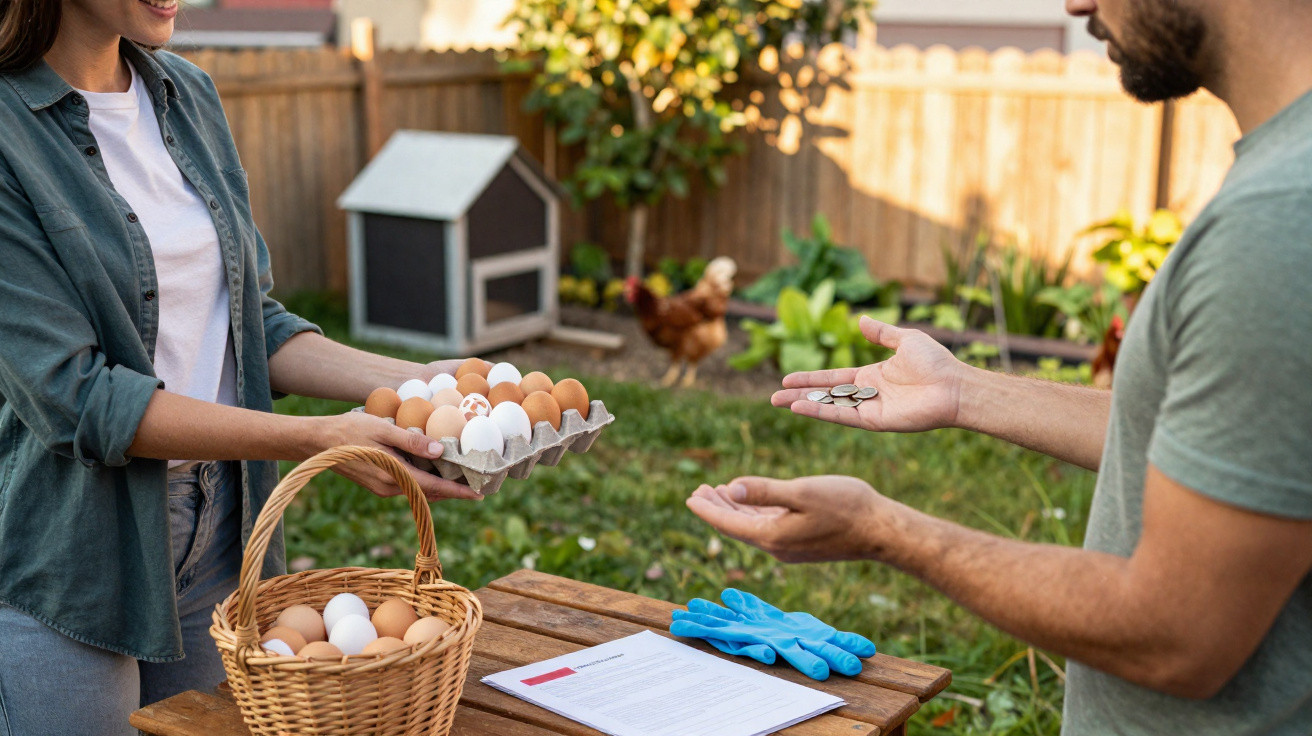
You may assume that passing a few eggs to a neighbour in exchange for a couple of pounds is harmless - perhaps even a neighbourly gesture. However, as soon as payment is involved, you may be operating within a closely regulated food business system, governed by requirements that many small-scale chicken keepers do not know exist.
The rise of backyard chickens
Throughout Europe and North America, increasing numbers of households are converting part of their garden into a tiny smallholding. In France, surveys indicate that about 5% of homes now keep chickens, while comparable patterns can be seen in suburban areas of the UK and the US.
Higher food costs, animal-welfare concerns and a longing for “simpler” food have all encouraged people to keep hens. A small flock can turn kitchen scraps into eggs, peck at pests and add a touch of countryside life at the same time.
From a financial perspective, hens may seem worthwhile. They consume plenty of food leftovers, cut household waste and, during productive laying periods, can produce almost one egg daily. Three or four birds can therefore soon lay more eggs than one household can use.
Backyard owners often move from “too many eggs” to “maybe I should sell a few” without realising they’ve just entered the food trade.
Why selling your eggs is not as simple as it looks
The significant legal change occurs when eggs are no longer a private excess but are offered to the public as a product. In most countries, that means they are subject to regulation in the same way as other food sold to consumers.
The original French guidance notes that only professionally registered farmers may commercially sell animal products. Comparable systems operate in the UK, the US and much of Europe: local hobby keepers can generally give away eggs, whereas selling them is regulated or limited.
From pet owner to food business
Eggs are regarded by public bodies as a “sensitive” food. They can transmit salmonella and other pathogens, deteriorate when incorrectly stored, and need to be traceable should an outbreak occur.
Once you sell eggs, authorities expect traceability, hygiene controls and, in many cases, registration as a food business or farm.
In practice, this can involve:
- Registering with the relevant local authority or agricultural service
- Marking eggs so that their source can be traced
- Complying with storage, transport and use-by-date requirements
- In some cases, using an approved packing centre for the eggs
Such requirements were designed around professional farms rather than a semi-detached home with a small run and four rescue hens. Nevertheless, the rules remain in force, and failing to follow them does not remove them.
What French rules reveal about the hidden risks
France’s Ministry of Agriculture states that eggs placed on the market must be graded, stamped and packed at approved centres. Smaller producers wishing to sell directly to consumers - from the farm or at local markets, for example - must at minimum formally declare their activity.
The central point is that a straightforward “cash for eggs” arrangement is not legally neutral. If your activity is viewed as trading, you are expected to meet food-regulation requirements, even when operating on a small scale.
| Situation | Often allowed? | Typical conditions |
|---|---|---|
| Giving eggs to friends, family or neighbours | Yes | No payment, informal sharing only |
| Occasional egg sales to neighbours from home | Sometimes | May require registration and basic hygiene standards |
| Regular egg stall at market or online sales | Only as registered producer | Formal registration, traceability, often stamping and record-keeping |
The French example is helpful because it clearly explains the underlying order: traceability comes first, followed by business registration. Many English-speaking countries apply similar principles, although their precise paperwork may vary.
Local rules, global logic
Whether you are in London, Lyon or a small Ohio town, laws concerning backyard eggs commonly focus on three areas: health, traceability and zoning.
Health and hygiene duties
Authorities seek to reduce the likelihood of food poisoning. For people selling eggs, this commonly involves:
- Keeping hens in clean, properly maintained accommodation
- Preventing rodents and wild birds from accessing feed
- Storing eggs correctly and avoiding washing methods that harm the shell
- Separating unwell birds from the flock and contacting vets where necessary
Once money is accepted, you could face civil liability - and in some cases criminal penalties - if somebody becomes ill and attributes it to the eggs. Your legal position can become especially weak without registration or basic records.
Traceability and egg marking
Traceability is the ability to track a food item through the supply chain back to where it originated. Commercial eggs normally bear a code identifying the farm, the production method - free-range, organic, caged and so on - and sometimes the packing centre.
From the regulator’s perspective, every egg on sale must have a “story” that can be reconstructed if something goes wrong.
People keeping hens at home rarely stamp their eggs. That is acceptable when eggs are given away, but it does not meet normal regulatory expectations once they are marketed as a product. This is why some small farms buy stamping equipment and maintain logbooks.
Why even friendly cash deals can backfire
A common situation is easy to picture. A neighbour calls at the door, notices a tray of eggs on the worktop and offers a few coins for a dozen. You agree, perhaps feeling pleased with your small-scale farm.
But an issue may then arise: a health inspector notices a social-media post, a neighbour reports smells, or someone becomes ill and tells their doctor they ate your eggs. The friendly exchange can quickly be seen as undeclared trading.
You could then encounter:
- Warnings or fines for selling food without registration
- Orders to stop every sale until you meet regulatory requirements
- Insurance difficulties if an illness-related claim is brought
- Back-tax concerns if the sales income was never declared
For most backyard chicken keepers, the income earned from eggs is very small compared with the possible cost of becoming involved in a complaint or investigation.
Keeping hens legally at home
The sale of eggs is not the only regulated aspect of chicken keeping. Councils and local authorities may cap flock sizes, limit roosters due to noise, or require minimum distances between chicken housing and neighbouring land or buildings.
Animal welfare is also a concern for authorities. Hens need access to outdoor space, protection from poor weather, sufficient food and clean water. Neglect may result in inspections or prohibitions on keeping animals.
In many areas, contacting the local council or town hall before constructing a coop or increasing flock numbers is the safest approach. They can explain planning or zoning rules, noise limits and any permit obligations.
What about selling garden vegetables instead?
Plant-based produce is usually subject to less demanding rules. In some countries, France among them, private gardeners may sell surplus vegetables under certain conditions. Hygiene standards may apply, particular products may require labels and, once sales become regular, registration as a small agricultural or food business may be necessary.
Here too, the dividing line appears when irregular sharing develops into an organised commercial activity. Selling a few tomatoes at the gate several times a year seldom attracts attention. Regularly advertised weekly vegetable boxes are more likely to prompt scrutiny.
Two real-life scenarios that change everything
The casual keeper
Emma lives in a UK suburb with four hens and a small wooden coop. She gives eggs to close neighbours and relatives, declines payment, but will accept the occasional bottle of wine or jar of homemade jam.
In most jurisdictions, Emma remains on the safer side of the line: there is no payment, advertising or substantial volume. She treats the arrangement as sharing rather than trade. Her key responsibilities are animal welfare, sensible noise levels and maintaining good neighbourly relations.
The “mini-farm” that becomes a business
Consider Alex instead. Alex keeps a dozen hens, produces labels, promotes the activity on social media and regularly sells eggs and vegetables from a Saturday stall. The turnover is limited, but the operation is plainly organised.
Legally, this is more likely to resemble a small farm or food business. Authorities may require Alex to:
- Register as a food business or agricultural producer
- Maintain basic records of production and sales
- Comply with egg marking and traceability requirements
- Meet health, safety and tax responsibilities
Once the activity is visible, the transition from “few coins in a jar” to “official producer” can happen suddenly.
Key terms backyard keepers should know
Traceability means being able to follow food from farm to fork. In relation to eggs, it involves knowing their origin, when they were laid and how they travelled through the supply chain.
Food business operator is a label regulators often use for anyone producing, processing or selling food to the public, including those working on a small scale. Many backyard keepers do not realise that selling eggs may place them within this category.
Direct sale generally means a sale made directly by the producer to the consumer, such as at the farm or a local market. Certain countries offer simplified direct-sale rules, but these almost always still require at least a declaration to the relevant authorities.
Practical ways to handle surplus eggs safely
For existing hen keepers facing the “too many eggs” issue, there are options that carry less risk than selling eggs to neighbours.
- Give the eggs away as gifts and clearly decline payment
- Exchange eggs for other homemade items without fixing prices
- Preserve eggs for personal use through approved methods and within safe time limits
- Keep fewer hens so output better matches household consumption
These options keep the arrangement within informal sharing instead of regulated trade, while allowing hens to support household food supplies and community connections.

















Comments
No comments yet. Be the first to comment!
Leave a Comment