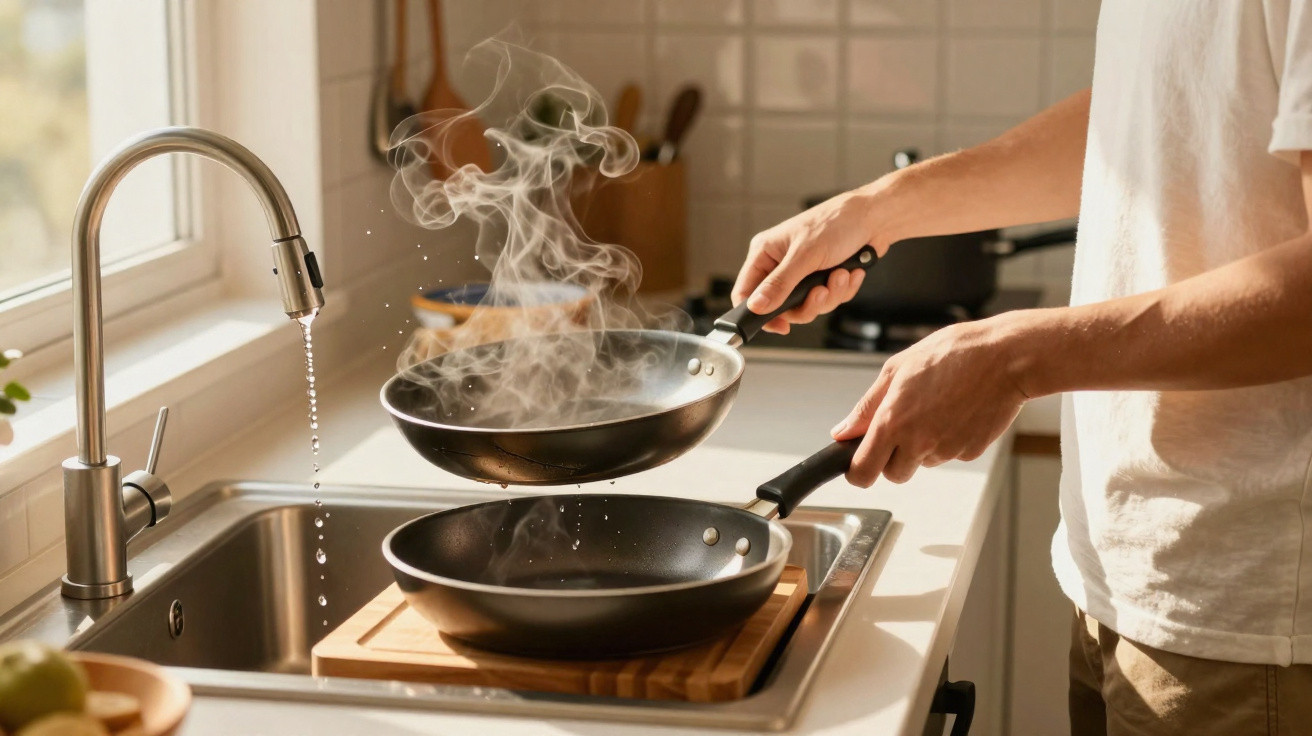
The hob is not to blame; the sink is. One careless, hurried habit can warp pan bases, ruin non-stick surfaces and leave you asking why a pan bought last year now cooks like a flimsy tin plate.
Saturday’s fry-up had run perfectly: bacon crisping gently, eggs gliding through a buttery sheen and tomatoes sizzling around the edges. Still radiating heat, the pan was put in the sink to clear space for wiping the board and bringing in the plates. The tap thundered on for a fast rinse of the browned residue, creating a kettle-like shriek and a plume of steam in the afternoon sun. In the seconds it took to mutter an expletive, the base changed from flat to faintly unstable; by Monday, an omelette was sticking in the middle, revealing a new hotspot you could locate blindfolded. A brief shortcut, followed by a major regret. You might blame the heat, but not this time.
The real pan killer: cold water on hot metal
Do not run cold tap water over a hot pan. That one action warps metal more quickly than an hour at maximum heat. Metal reacts badly to sudden temperature shifts, and coatings fare even worse. The shock passes through the base like an electric jolt, causing uneven contraction and turning a formerly level pan into something like a cymbal: it rings with every stir and behaves unpredictably on the hob.
Imagine a hectic family kitchen at 7 pm: the pasta has been drained, the sauce is ready, and a non-stick frying pan goes directly from the flame into a sink full of plates. The tap is turned fully on to wash away the fond, saving a second through a habit that can cost you the pan. Commercial kitchens even display training notices stating “No cold water on hot pans”, because repair shops encounter this same issue every day, while most non-stick warranties discreetly exclude “thermal shock” for good reason. We have all found that sink-side sizzle oddly satisfying, like a small win. It is not.
The unglamorous science is simple: metal expands as it heats up and contracts as it cools down, but rapid cooling from one side prevents this from happening evenly. Multi-layer pans combine materials with differing expansion rates. Stainless-steel cladding, an aluminium core, a bonded disc, rivets and polymer coating all shift at different speeds; that mismatch distorts the base and places stress on the surface. The result can turn smooth non-stick into flaky grey flecks, create a spiderweb of fine cracks in cast-iron enamel, or leave stainless steel with a raised dome that sends oil rushing to the edges.
Do this instead: a calm cooldown ritual
Take the pan off the heat and set it on an unused cool ring or a trivet, then make use of its remaining warmth. While it is off the flame, swirl in a little hot water, or add water from a freshly boiled kettle and allow the fond to release while you serve up. Only afterwards should you move it to the sink and wash it with warm, soapy water using a soft sponge. Give the pan time to recover first.
Scrub gently, and resist soaking a pan while it is still screaming hot, even when caramelised residue on the base is begging to be tackled. For stainless steel, a brief and gentle deglaze while warm works wonders. With non-stick, treat it as you would a good shirt rather than a workshop floor, hand-washing it once the hissing has stopped. Honestly, nobody does that every single day.
This is not needless fussiness; it is inexpensive protection. A London cookware restorer put it bluntly:
“Thermal shock ruins more pans than careless cooks do. Give it five minutes and you’ll double the life.”
Keep this simple checklist in mind at the sink:
- Take the pan off the heat and wait for the loud sizzling to stop.
- When rapid cooling is necessary, put hot water into the pan rather than putting the pan into cold water.
- Use warm water and a soft sponge, then dry it completely before stacking.
How to spot damage and keep cooking anyway
Thermal shock leaves clues: oil gathers around the edge, pancakes brown in a ring, or the pan rocks slightly on the hob when you move the handle. If the damage has already occurred, adjust your approach: cook in the middle over a slightly lower flame, preheat for longer to even out the temperature, and reserve delicate, slippery proteins for the pan that is least warped. Thermal shock is the quiet killer of pans. Treat the sink as the slow lane, and your pans will stay reliable for longer, making Monday-night eggs taste better than they reasonably should.
| Key point | Detail | Why it matters to the reader |
|---|---|---|
| The real mistake | Plunging a hot pan under cold tap water creates thermal shock | Prevents the habit that rapidly ruins pans |
| Safe cooldown | Remove from the heat, add hot water to the pan and wash it warm after a short wait | Safeguards bases, coatings and your warranty |
| Spotting damage | Oil gathers at the edges, the base rocks and browning becomes uneven | Helps you adapt your cooking and decide when a pan should be retired |

















Comments
No comments yet. Be the first to comment!
Leave a Comment