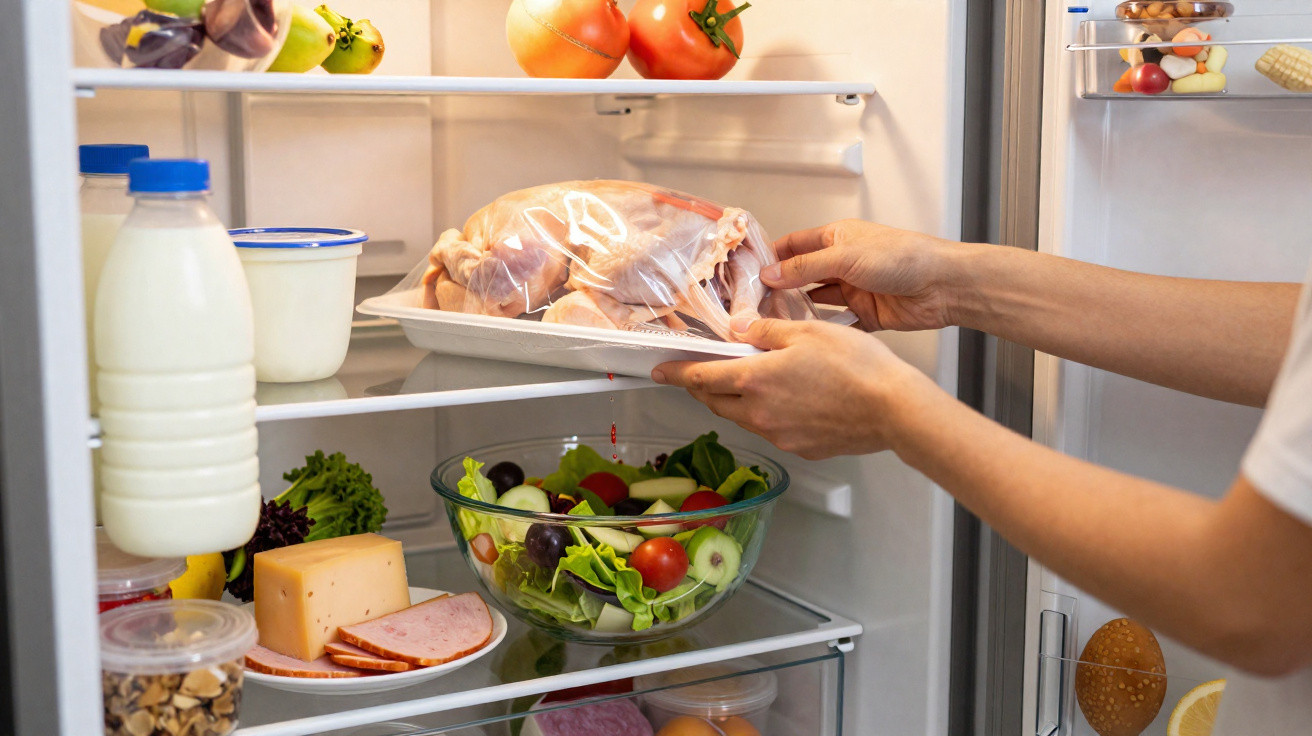
The refrigerator is often seen as a safe place: cold, clean and with everything properly wrapped. Yet that sense of security can be misleading. A single incorrectly stored pack of raw meat or fish can contaminate salad, fruit and ready-to-eat food with illness-causing bacteria, without leaving anything visible or noticeable by smell.
Why the refrigerator is not a germ-free safe
Although a modern refrigerator slows bacterial growth, it does not kill bacteria. Many germs remain surprisingly comfortable at temperatures between 0 and 4°C. These include Salmonella and certain strains of E. coli, which repeatedly cause severe diarrhoea.
Health authorities recommend setting the coldest part of the refrigerator to around 4°C. This lowers the risk, but does not eliminate it. Unless a product is cooked or thrown away, bacteria can survive there and be passed on.
“The real risk often lies not in the product itself, but in the route its bacteria take through the refrigerator.”
This is where food placement matters: if certain items are stored incorrectly, germs from raw products can quickly end up on foods eaten without cooking, and therefore directly in the body.
The common mistake: raw meat above ready-to-eat food
In many homes, the refrigerator looks much the same: a tray of raw chicken somewhere in the middle, alongside cheese, yoghurt and perhaps an uncovered pasta bake left over from the previous evening. Leafy salad, cucumbers and tomatoes are kept in the vegetable drawer below.
That arrangement creates ideal conditions for cross-contamination. If packaging leaks or meat juices escape, tiny amounts can drip downwards or smear across the glass shelf. Those juices may contain millions of bacteria.
The situation becomes even more critical when meat and vegetables are kept in the same drawer. For convenience, many people briefly put a pack of steak on top of the salad or beside the carrots. Just one trace of meat juice can contaminate raw food.
“It becomes dangerous when bacteria move from a product that will later be thoroughly heated to food that is eaten straight from the refrigerator.”
Typical high-risk items in the refrigerator include:
- raw chicken breast, turkey and minced meat
- raw fish and seafood
- defrosted frozen food from which thawing liquid leaks
- cardboard cartons or outer plastic wrapping that have already been on the shop counter
Particularly vulnerable foods, meanwhile, include:
- leafy salads, herbs and sprouts
- tomatoes, cucumbers and peppers, which are often already washed
- ready-made dishes such as pasta salad or potato salad
- sliced cold meats, cheese and desserts that will not be reheated
If meat juices drip from above onto these foods, it makes no difference that the meat is later cooked properly: the salad or dessert remains uncooked and will not be heated.
Who needs to take particular care
A Salmonella infection rarely goes unnoticed. Common symptoms include:
- severe diarrhoea
- abdominal cramps
- nausea and vomiting
- fever and circulatory problems
Anyone can be affected, but the following groups are especially likely to suffer more severely:
- babies and young children
- very elderly people
- pregnant women
- people with weakened immune systems or existing health conditions
For these groups, an apparently ordinary stomach bug can have serious consequences, including hospital treatment. This makes it all the more important that the refrigerator does not become a hidden transfer point for bacteria.
Three simple rules for a safer refrigerator
The good news is that a few everyday changes can noticeably reduce the risk. There is no need for excessive disinfecting; what matters is a clear system.
1. Separate the levels: raw food at the bottom, ready-to-eat food at the top
The basic principle is straightforward: anything that still needs cooking and spoils easily belongs on the coldest shelf at the bottom. Food that is already prepared or eaten cold should be placed above it.
| Refrigerator area | Suitable foods |
|---|---|
| lowest, coldest shelf | raw meat, poultry, raw fish, seafood, perishable sliced meat |
| middle shelves | cooked food, leftovers, bakes, yoghurt, quark, cheese |
| top shelf | ready-made desserts, opened jam, opened tinned food transferred to storage containers |
| vegetable drawer | vegetables and fruit, ideally kept separate from meat and fish |
| door shelves | drinks, sauces, ketchup, mustard, eggs depending on preference |
The key point is that raw meat and raw fish should never be stored on higher shelves, even if their packaging appears leakproof.
2. Always seal meat tightly and discard outer packaging
Many germs are found on the outside of a pack, not only inside it. A cardboard carton that has travelled along a supermarket conveyor belt may have picked up whatever was on it. Once it goes into the refrigerator, those germs can be transferred to glass shelves and other products.
“Anyone storing raw meat or fish in the refrigerator should always keep it in an additional tightly sealed container – without the cardboard carton.”
Practical steps include:
- Remove cardboard outer packaging and loose plastic wrapping as soon as you get home from the shop.
- Put meat and fish into leakproof containers before placing them in the refrigerator.
- Never keep defrosted food uncovered; store it in containers as well, so thawing liquid cannot leak out.
3. Protect vegetables and fruit
The vegetable drawer is not a neutral storage area. Leaving a pack of meat there “just for a moment” contaminates the space intended for salad and fruit. The risk is greater still if already washed food is kept there uncovered.
A better approach is to:
- keep vegetables in separate bags or containers where possible
- wash produce shortly before eating it, rather than immediately after shopping
- never temporarily store raw meat or fish in the vegetable drawer
Cleanliness without obsessive cleaning: how often to clean the refrigerator
There is no need to scrub the refrigerator every day. A realistic routine is more useful: for most households, a thorough clean once a month with warm water and a little washing-up liquid or household vinegar is enough.
It is also sensible to act quickly when visible dirt appears:
- wipe up leaked meat juices or thawing liquid thoroughly straight away
- replace cloths and sponges regularly, or wash them at a high temperature
- clean door handles and frequently touched surfaces more often
Anyone who regularly clears out their refrigerator can combine cleaning with checking best-before dates. This removes spoiled products before they become a problem.
How cross-contamination happens
The technical term “cross-contamination” describes a simple but deceptive process: bacteria pass from one food or surface to another.
This can happen, for example:
- when meat juice drips onto salad
- when someone handles raw chicken and then immediately touches cheese or fruit
- when the same knife is used for raw meat and bread
- when a chopping board is only roughly wiped down before being used for raw vegetables
The refrigerator plays a central role because foods are stored close together there, often for several days. Even very small amounts of germs can therefore have time to spread to new surfaces.
Everyday examples that may sound familiar
Some everyday habits seem harmless but significantly increase the risk. Typical situations include:
- After a barbecue, a leftover raw sausage is quickly placed beside the potato salad.
- An opened pack of meat sits overnight above an uncovered bowl of fruit.
- A bag containing thawing water from defrosted fish is left in the vegetable drawer directly next to a cucumber.
In every one of these cases, Salmonella can spread to foods later eaten cold or only lightly warmed. The real mistake is then not at the butcher’s or in the product itself, but in how it is stored at home.
Temperature, timing and healthy caution
Keeping an eye on the refrigerator temperature provides additional protection. A small thermometer inside quickly shows whether the supposed 4°C is actually being reached or whether the appliance is set too warm.
Clear time limits are helpful too: leftovers should not remain in the refrigerator for more than two to three days. After that, not only does the bacterial count rise, but the flavour usually deteriorates as well. Opened packs of sliced meat or soft cheese are best not given a second or third chance if their smell or appearance causes doubt.
A little caution is worthwhile: if something looks odd, smells strange or has very swollen packaging, it belongs in the bin, regardless of the date on the label.

















Comments
No comments yet. Be the first to comment!
Leave a Comment