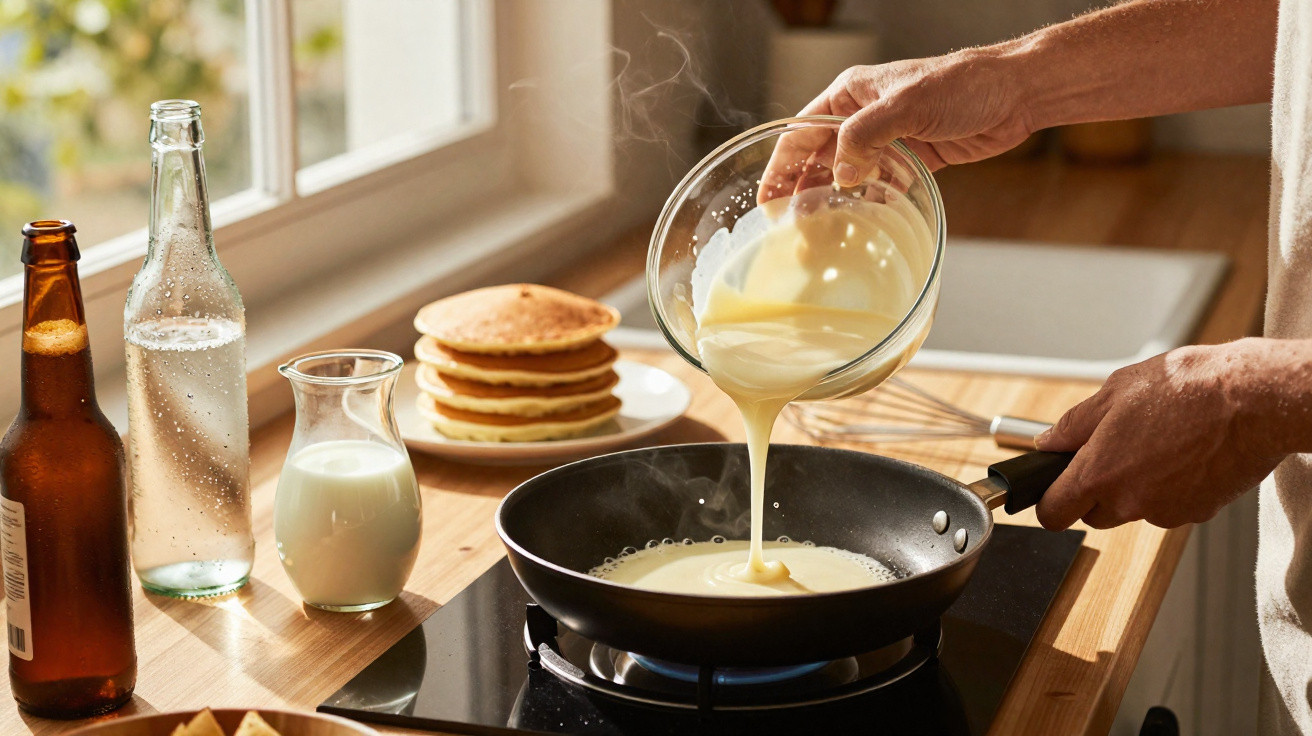
With one simple adjustment, pancake batter can be ready for the frying pan within minutes.
Anyone who has children, unexpected guests, or a sudden craving for pancakes knows the issue: most recipes say the batter must rest for an hour or more. That is usually precisely when everyone is already sitting at the table with plates and cutlery. One particular liquid addition – and, above all, its temperature – can cut the waiting time dramatically while still producing light, tender batter.
Why pancake batter is said to need resting
The traditional instruction is simple: mix the batter, leave it for at least an hour, and only then start cooking. It can seem like an unbreakable rule handed down from Grandma’s kitchen. There is, however, real chemistry behind it.
Flour contains more than starch; it also has proteins such as gliadin and glutenin. Once they come into contact with liquid, they create the network known as gluten.
“Immediately after mixing, this gluten network is still ‘agitated’ – the batter feels tough and tends to pull itself together in the pan.”
During the resting period, several things happen:
- The starch in the flour absorbs liquid.
- The gluten network gradually relaxes.
- The batter becomes smoother and spreads more easily across the pan.
- Pancakes turn out softer and are less likely to tear.
Ordinarily, all of this takes time. To avoid waiting, the process needs to be sped up – which is where a certain drink comes in.
The game-changer: chilled sparkling water
The easiest shortcut may already be in the fridge: well-chilled sparkling mineral water. Use it to replace some of the milk in the batter.
A tried-and-tested ratio is as follows:
| Ingredient | Amount |
|---|---|
| Milk | approx. 300 ml |
| Sparkling water (very cold) | approx. 200 ml |
What does this change?
- The carbon dioxide bubbles aerate the batter as soon as it is mixed.
- The cold temperature slows the gluten, making the batter less elastic and less rubbery.
- The batter can be cooked straight after mixing without producing tough pancakes.
“Sparkling water does not merely replace the waiting time; it acts like built-in aeration for the batter.”
The flavour remains largely neutral, while the pancakes become pleasantly light and airy.
The warm milk trick: 10 minutes instead of 2 hours
If there is no sparkling water at home, another approach works well: warm the milk slightly. Aim for roughly 35 to 40 degrees Celsius, around body temperature – a little warmer than lukewarm, but never hot.
A quick check is to place a drop of milk on the inside of your wrist. If it feels comfortably warm rather than hot, it is at the right temperature.
This temperature delivers two benefits:
- The flour’s starch absorbs the liquid more quickly.
- The gluten network relaxes much faster.
“Milk at around 35 to 40 degrees can virtually replace a resting time of 60 to 120 minutes.”
If a pancake craving strikes at 4 pm, warmed milk can often have you cooking by 4:10 pm rather than waiting until early evening.
Beer in pancake batter: subtly malty and extra airy
A slightly bolder but very popular option is to swap part of the liquid for a light, not overly strong beer. A mild pale beer without a strongly dominant bitter note is best.
As a guide, beer should account for no more than about one fifth of the total liquid. For example, use 400 ml milk plus 100 ml beer.
Why it works:
- The carbonation works much like sparkling water, helping to lighten the batter.
- Yeast and other components create a kind of mini fermentation in the batter – extremely brief, but noticeable in the texture.
- The alcohol evaporates in the pan, leaving behind a mild malty flavour.
The result is pancakes that are not only airy but also have a little more flavour. In households with children, many people still prefer sparkling water so that alcohol is not an issue at all, even though it mostly evaporates during cooking.
How to mix pancake batter without a resting time
Whether you use sparkling water, warm milk or a little beer, the mixing method makes a significant difference.
Step-by-step method
- Sift the flour and sugar – icing sugar works particularly well – into a bowl.
- Make a well in the centre.
- Crack the eggs into the well.
- Add around one third of the liquid, either milk or a milk-and-beer mixture.
- Whisk from the middle outwards until no lumps remain.
- Gradually whisk in the rest of the liquid.
- Finally, gently fold in the cold sparkling water so that as much carbonation as possible is retained.
- If you like, add a little cooled, lightly browned butter for nutty notes.
The batter can then go straight into the hot pan.
Cook pancakes like a professional: small details, big results
For pancakes, a quality pan and the right heat matter at least as much as the batter itself.
- Preheat the pan properly – the first pancake is often a trial run.
- Use fat very sparingly: if the batter contains butter, little or no extra fat is often needed.
- Pour in the batter promptly and immediately swirl the pan to create an even, thin layer.
- Turn the pancake when the edges begin to lift and the surface is no longer glossy.
This keeps the pancakes tender, easy to roll or fold, and still gives them a light golden colour.
A brief look at the food science
The temperature and carbonation tricks are rooted in food technology research. Tests show just how strongly temperature and air within a batter affect its structure.
“Warmer liquid speeds up starch hydration, while cold and carbonation slow the gluten and introduce air into the batter.”
Together, these effects mean pancake batter can behave just minutes after mixing as though it had spent an hour in the fridge – but with considerably more airiness.
When each pancake batter trick works best
Different situations suit different methods:
- Very short on time, with hungry children: use ice-cold sparkling water – it is quick, neutral in flavour and child-friendly.
- A little time available, but no desire to wait: use lukewarm milk, rest the batter briefly, then cook.
- An evening with friends and savoury pancakes: add some beer to the batter for extra flavour and lightness.
Those who enjoy experimenting can also combine the methods: lukewarm milk with a little sparkling water, or lukewarm milk with a small splash of beer. This makes it possible to fine-tune both texture and flavour.
Risks, pitfalls and practical tips
There are a few points worth remembering:
- Do not make the liquid too hot: excessive heat can start setting the eggs in the batter and encourage lumps.
- Do not overwhisk the batter: mixing for too long makes it tough again – stop once it is smooth.
- Add sparkling water late: whisking it vigorously from the start reduces its carbonation effect.
- Use beer sparingly: too much can taste bitter or make the batter too thin.
For sweet versions, vanilla, lemon zest or a dash of rum flavouring work well. Herbs, grated cheese or finely chopped onions suit savoury pancakes. The quick batter technique works just as effectively in either case.
In this way, the seemingly strict kitchen rule that “batter must rest” becomes more of a recommendation. With sparkling water, the right temperature and a little understanding of flour and gluten, spontaneous pancake afternoons are possible without anyone having to stare at an empty pan for an hour.

















Comments
No comments yet. Be the first to comment!
Leave a Comment