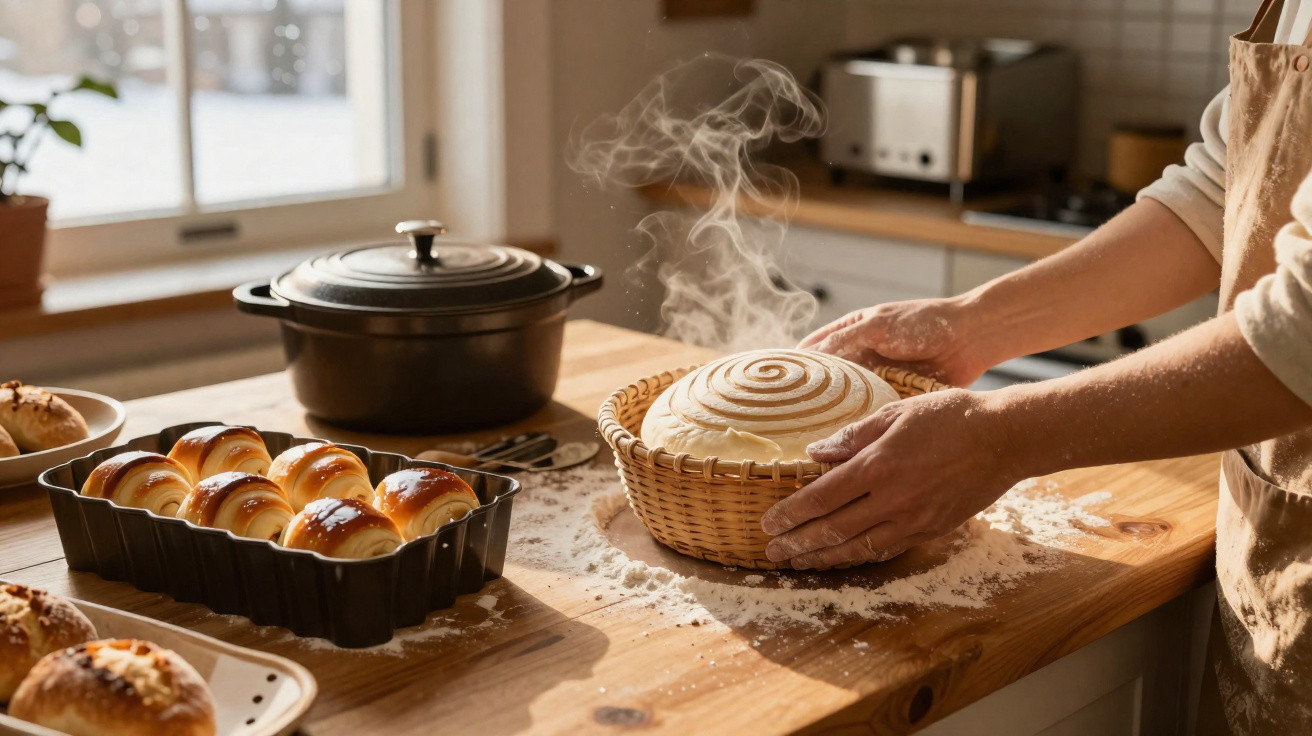
When frost takes hold outside, the kitchen becomes a stage: with the right equipment, you can make crisp bread and fluffy winter brioche at home, just like a baker’s.
The aroma of freshly baked bread, that first still-warm slice with butter, a buttery brioche with Sunday coffee – in the colder months especially, the longing for this kind of oven-baked comfort grows. The good news is that nobody needs a professional bakery to achieve it; above all, a few smart tools are needed to manage dough, heat and moisture.
Why winter is the best time for bread and brioche
As the days become short and grey, life naturally shifts further indoors. Baking suits this mood perfectly. Dough can prove at its own pace while you read, work or relax on the sofa. The oven warms the kitchen and the fragrance spreads through the whole home – it is practically hygge you can eat.
Freshly baked bread and a golden brioche bring structure, warmth and a touch of luxury to everyday winter life for very little cost.
Winter room temperatures also work in many home bakers’ favour: dough rises more slowly, develops greater flavour and is easier to control. Anyone using a long fermentation or experimenting with sourdough benefits particularly from these conditions.
The essentials: equipment that genuinely makes sense
For straightforward loaves, a bowl, an oven and a baking tray are essentially all that is required. Anyone ready to take the next step and create a small, cosy bakery at home will soon turn to several tried-and-tested helpers:
- Proofing baskets for rustic loaves that hold their shape
- Tins for brioche, loaf cakes and sandwich bread
- Baguette trays for crisp stick loaves
- A lidded cast-iron dish for bread baked in a tin
- A machine that kneads, proves and bakes when time is short
This equipment can be built up gradually. Many people begin with just one item – often a cast-iron dish – then add to it once they want to try more varieties.
Proofing baskets: the key to beautifully shaped bread
An oval proofing basket made from rattan or wood pulp supports the dough during its final rise. The basket holds soft dough in place, preventing it from spreading outwards and helping it retain a compact, slightly elongated shape. During proving, a humid microclimate forms inside, encouraging even fermentation.
Before the dough goes in, the basket should be generously dusted with flour, often a blend of wheat flour and rice flour. Once the loaf is turned out onto the baking tray or into a hot dish, it takes on the distinctive lines associated with artisan bakery bread.
Anyone working with sourdough or very soft dough can hardly do without a proofing basket – it gives structure to loaves that would otherwise flatten.
When a proofing basket is especially worthwhile
- For free-form loaves baked without a tin
- For rustic country loaves with high hydration
- When starting with sourdough or wholemeal bread
- When appearance and an even shape matter
Brioche tins: a golden crown for winter breakfast
A good brioche tin provides even heat distribution and an attractive, gently domed shape. Traditional fluted round tins are familiar from old-fashioned Sunday cakes. Dough rich in butter and eggs needs support as well as a tin that will not cause it to stick.
The material – usually metal with good heat conductivity – browns the surface evenly without leaving the centre underbaked. Thanks to a non-stick coating or careful greasing, the brioche can be turned out cleanly and reveals its distinctive, almost celebratory appearance.
Typical uses for a brioche tin
- Light Sunday brioche with butter and jam
- Sweet yeasted cakes with raisins or chocolate pieces
- Kouglof variations with almonds and dried fruit
- Savoury yeasted cakes with cheese and bacon
Loaf tins: from sandwich bread to a savoury snack
A simple non-stick loaf tin is the all-rounder of the winter kitchen. It is suitable for classic sandwich loaves, soft milk bread and sweet sponge cakes, as well as savoury versions with cheese, olives or bacon.
If you want to invest in only one tin, a sturdy loaf tin is often the best choice – it covers almost everything from breakfast bread to an evening snack.
Its straight sides make the finished bread easy to slice neatly. For beginners, it removes the pressure of having to shape a free-form loaf. The dough can also be slightly softer because the sides support it.
Baguette trays: a mini bakery in the family oven
Anyone missing the stick loaves enjoyed on holiday will sooner or later buy a perforated baguette tray. These usually curved trays hold several pieces of dough side by side. The perforations allow hot air and moisture to circulate, so the underside becomes crisp too.
It is important to roll the dough pieces tightly and score them before baking. Many home bakers also add extra steam to the oven, for instance with a bowl of water or ice cubes placed on a preheated tray. The crust then crackles audibly as it cools – a sure sign of success.
Cast-iron dish: bread like it came from a professional stone oven
The lidded cast-iron dish has generated a real buzz in recent years. It recreates the conditions of a stone oven: the heavy pot is preheated, the shaped dough is placed inside and baked with the lid on. Moisture contained in the dough initially remains in the enclosed space, allowing the loaf to expand before the crust sets.
Cast iron retains heat exceptionally well: this produces strong oven spring, a thick crust and a moist, elastic crumb – precisely what many people associate with “bread from the baker”.
There is another advantage: the dish is not only for bread. Stews, braised dishes and risotto – during winter, it is useful almost constantly. Anyone with cupboard space is investing in a genuinely versatile piece of equipment.
Professional tin sets: when the hobby gets serious
People baking several loaves each week often opt for professional tin sets. They are sturdy and frequently made from thick metal that distributes heat particularly evenly. They are especially suited to large sandwich loaves, firm sandwich bread and long, evenly shaped brioches.
| Tin type | Special feature | Typical use |
|---|---|---|
| Lightweight loaf tin | Beginner-friendly, easy to handle | First loaves, sponge cakes |
| Professional tin set | Very even heat | Uniform loaves, large quantities |
| Cast-iron dish | Excellent heat retention | Rustic loaves with a robust crust |
Anyone baking for family, friends or a sports club particularly appreciates the consistency: using the same tins produces loaf after loaf of similar size and structure.
Bread machine: when everyday life leaves no time
Not everyone wants to knead dough in the evening. This is where machines that knead, prove and bake excel – often offering more than a dozen programmes. They mix and work the dough, while automatically controlling temperature and baking time.
Depending on the model, you can select different loaf sizes, crust colours and dough types: classic white bread, wholemeal versions, sweet brioche, pizza dough or jam. A timer makes it possible to add the ingredients in the evening and wake up to the smell of fresh bread in the morning.
For busy people, such a machine is sometimes the only realistic route to regular bread without additives.
Tips for setting up your own winter bakery
Those new to baking can easily get carried away with equipment. Building your collection step by step is more sensible.
- Start with a good loaf tin and try simple recipes.
- Then buy a cast-iron dish or proofing basket once the desire for rustic loaves grows.
- Add a baguette tray and brioche tin when the basic techniques are established.
- Consider a machine if time is the limiting factor.
Flour is another important consideration: many people underestimate how strongly type, protein content and freshness affect the result. Anyone wishing to move away from industrial bread should experiment with different flours, such as combining wheat with a proportion of rye or spelt. This creates flavours reminiscent of small village bakeries.
Common mistakes that hold back home baking
Proving for too little time, using water that is too cold, adding too much yeast or incorporating too much flour while kneading can all result in dense, dry bread. Patience is especially worthwhile in winter: dough should be allowed to double, and sometimes even triple, in size. Many recipes improve when left to rest in the fridge overnight. The yeast works more slowly, flavours develop and the crumb becomes finer.
Scoring before baking also matters. Without this step, bread splits unpredictably. A sharp knife or a dedicated blade is enough to make one or two deep cuts, allowing the dough to rise in a controlled way.
Why investing in good equipment is worthwhile
When you add up the cost of good bread and brioche from the bakery, a small home-baking setup pays for itself surprisingly quickly. More importantly, you control the ingredients, amount of sugar, fats and additives yourself. People with intolerances or those choosing wholemeal gain even more.
Alongside the financial benefit comes an emotional one. Bread from your own kitchen always has a story: who kneaded the dough, who helped shape it, who tasted the first loaf? In winter especially, such rituals quickly become cherished fixtures of family life – and the kitchen turns into a bakery that constantly smells of comfort.

















Comments
No comments yet. Be the first to comment!
Leave a Comment