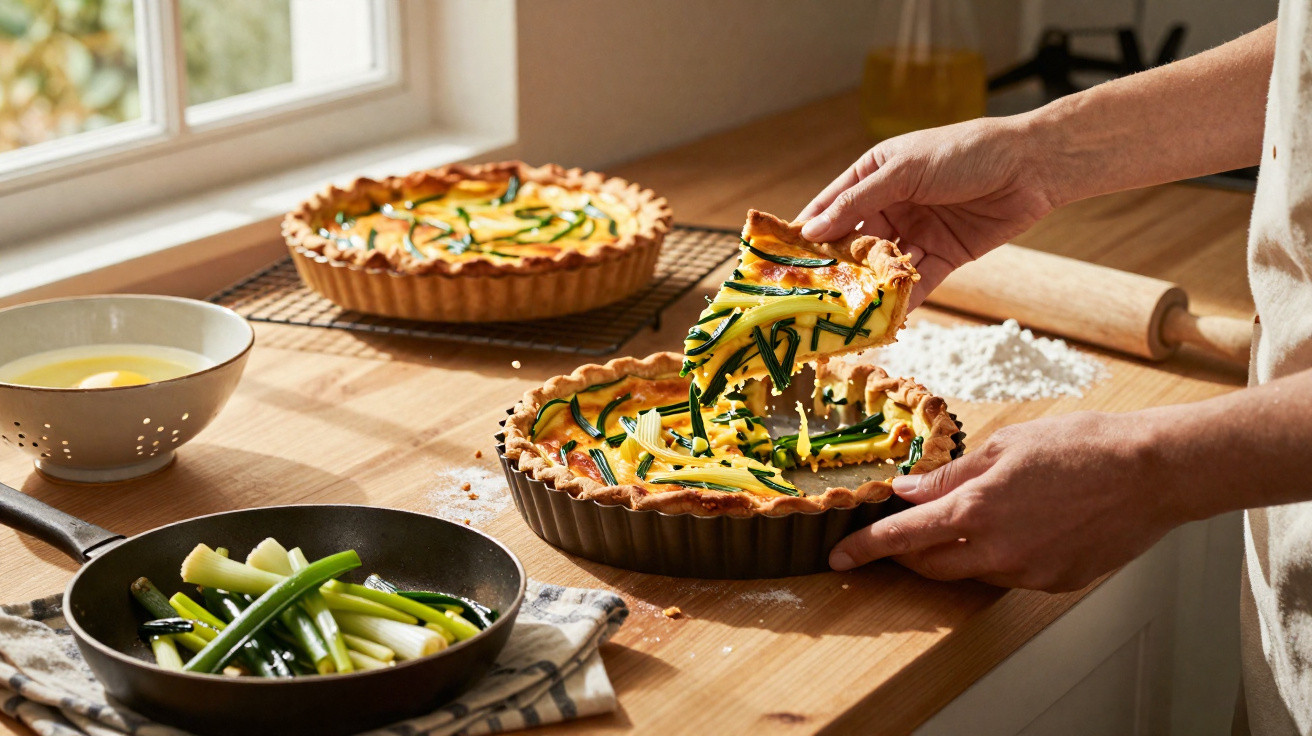
Many home cooks blame the oven or the tin. In reality, the cause is usually one ordinary mistake made when preparing the leeks. Change this one detail and the base can turn crisp rather than sticky.
The familiar result: perfect on top, doughy underneath
Almost everyone has experienced it: the leek quiche comes out of the oven smelling wonderful, with a nicely set filling and a perfect-looking crust. Then comes the disappointment when it is cut: the base tears, sticks to the knife, remains raw in the middle and has an almost rubbery texture.
For many people, this has been a recurring problem for years, often explained with comments such as “My oven doesn’t bake properly” or “The tin is no good”. Yet the reason is very specific: it lies in how the leeks are prepared and placed onto the unbaked pastry base.
The main mistake: overly wet leeks are placed directly, without protection, onto a cold raw pastry base.
Leeks are made up of roughly 90 per cent water, so they bring a considerable amount of liquid into the tin. When that moisture reaches raw pastry unchecked, the starch in the dough has to contend with a real flood of water - and loses.
Why leeks quickly make a quiche base soggy
As leeks cook in a pan, their cells rupture and the water held within the vegetable is released. This continues in the oven: heat comes from above, pastry sits underneath, and the liquid finds its way downwards.
When that liquid meets a cold, raw pastry base, this is what happens:
- The starch in the pastry swells too early and too much.
- Moisture creates a sticky layer.
- The heat takes much longer to bake the base through.
- The pastry stays raw or rubbery inside, even at 180 °C or above.
It is especially damaging when the leek mixture is still very hot while the pastry is ice-cold. The sudden transition from hot to cold produces condensation. That moisture forms a film between the topping and the pastry, meaning the base has effectively lost before the real baking time has even started.
The crucial step for leek quiche: reduce the leeks’ moisture
For a crisp base, the water in the leeks needs to be dealt with deliberately. The difference is clearly noticeable when the leek mixture is visibly drier before baking.
How to remove excess water from leeks
- Cook the leeks gently: Soften them in a little fat over a medium-low heat, without a lid. The aim is to let any visible liquid evaporate.
- Allow time for drying: Continue cooking the leeks until there is barely any liquid left on the base of the pan.
- Drain them: Transfer the leek mixture to a fine-mesh sieve and leave it to drain for at least 15 minutes.
- Let them cool: Add the leeks to the pastry only when lukewarm or almost cold, never while they are still steaming.
These measures alone remove much of the risk from the quiche. The base then has a genuine opportunity to bake through properly and become crisp in the oven.
Three protective layers that save the base
For extra certainty, do not focus solely on the leeks: build several small barriers instead. Each one helps on its own, but together they act as a protective shield for the pastry.
Protection 1: make the filling bind more firmly
A spoonful of flour or cornflour can easily be mixed into the egg-and-cream mixture, the classic custard filling. This extra starch binds surplus liquid released by the leeks as the quiche bakes.
- Mix 1 tablespoon of flour or starch thoroughly into the filling.
- Whisk carefully to remove any lumps.
- The filling will set slightly firmer and be less watery as it bakes.
This creates a more even texture and stops liquid from travelling downwards unchecked.
Protection 2: give the pastry a “seal”
A highly effective approach is to create a thin protective layer directly on the pastry base:
- Cheese option: Sprinkle the raw pastry base with a little grated hard cheese, such as Parmesan, then briefly bake it until the cheese begins to melt.
- Egg white option: Brush the base with lightly beaten egg white and prebake it for a few minutes, until the egg white has set.
Both options work like a coating: they largely seal the pastry surface, making it much harder for liquid to penetrate.
Protection 3: a “blotter” acting as an invisible sponge
Anyone who has sprinkled breadcrumbs over a fruit tart will know the principle. A very thin layer of dry ingredients absorbs juice without affecting the flavour.
Suitable options include:
- fine wheat semolina
- breadcrumbs
- ground almonds
Scatter 1 to 2 tablespoons over the raw pastry before adding the leeks and filling. The grains disappear visually into the topping, but work hard as a buffer for excess moisture.
Building the leek quiche step by step
Combining the individual measures creates a fairly reliable method. The sequence is easy to remember:
- Place the pastry in the tin and prick the base several times with a fork.
- Optionally, blind bake the base briefly so that it gains some structure and its first colour.
- Seal the pastry base with cheese or egg white, then bake that layer briefly.
- Sprinkle over a thin “blotter” layer of semolina, breadcrumbs or almonds.
- Spread the well-drained, lukewarm leeks evenly over the base.
- Pour over the egg-and-cream filling containing the added starch.
- Bake at around 180 °C until the filling has set and the edge is attractively browned.
What matters is the combination: less water in the leeks, a protective layer on the base and a filling that binds liquid.
Common mistakes that ruin the base
Anyone wondering why their own pastry base has failed so often will probably recognise themselves in this list:
- The leeks go into the tin dripping wet straight from the pan.
- The filling is still steaming hot while the pastry base is ice-cold from the fridge.
- The custard is very runny and contains no extra binding ingredient.
- The pastry is neither prebaked nor sealed.
- The quiche is removed from the oven too soon because its browned surface is misleading.
Even one or two changes are often enough to turn a soft, soggy quiche into a much sturdier version that can be sliced neatly.
Practical tips for variations and leftovers
These techniques are useful not only for leeks, but for almost any savoury tart featuring moist vegetables. Spinach, courgettes, mushrooms and tomatoes also benefit from cooking off moisture, draining and adding a protective layer.
If you like to prepare food ahead, allow the leek quiche to cool completely before putting it in the fridge. When reheating it in the oven later, the base often becomes slightly firmer if the quiche is placed on a wire rack rather than kept in a closed tin. This allows steam to escape instead of soaking back into the pastry.
The choice of pastry is another consideration. A well-baked shortcrust pastry generally copes with moisture better than very thinly rolled puff pastry. If you value a satisfying bite, roll the pastry neither too thickly nor paper-thin. It will then retain enough structure to prevent the base from breaking.
Once you understand the relationship between the vegetable’s water content, the binding power of the filling and the protection of the pastry base, the same basic ingredients can produce very different results - from a soft, juicy vegetable tart to a crisp, firm leek quiche that still holds its shape the following day.

















Comments
No comments yet. Be the first to comment!
Leave a Comment