Sunday morning: the scent of coffee, a window left slightly open, and that peaceful pause before everyone reaches for their phones. You take out the waffle maker, a modest rebellion against frozen toaster waffles. The batter sizzles, the plates shut, and minutes later there is a magazine-worthy stack: golden, light and crisp.
Ten minutes later, somebody wants another helping. You pick up the plate and find waffles that are soft, slightly miserable and nearly damp. Steam and syrup have taken away every trace of crunch. You tell yourself it is unimportant, yet it still feels like a let-down.
What people rarely mention is that the key to waffles that stay crispy is not primarily in the batter.
It lies in what happens immediately after they come out of the waffle maker.
Why waffles turn soggy so quickly
The same situation happens in kitchens everywhere. The waffle maker sits on the worktop, a plate waits beside it, and perhaps a clean tea towel is placed over the top to “keep them warm”. The first waffle emerges beautifully crisp; the second is stacked over it, followed by the third. Before anyone gets around to sitting down, the plate has effectively become a miniature sauna.
All that wonderful steam becomes trapped between the hot waffles with nowhere to go. It then returns directly to the crust you worked so hard to caramelise. The result is limp waffles.
Naturally, you begin to suspect the recipe.
I saw exactly this happen at a family brunch. My cousin had spent the week searching for the “best Belgian waffle recipe” and poured his yeasted batter with the confidence of a professional. The first waffle was shatteringly crisp. We all made the expected polite “wow” noises.
He then piled the waffles onto a dinner plate, put it in a switched-off oven “to keep warm”, and covered it with foil. After 20 minutes, the crunch had vanished. They still tasted good, but their texture was more like cake. His disappointment was almost visible when the knife failed to crack through the surface.
The explanation is straightforward. Crispness depends on water leaving the batter’s surface quickly enough for it to dry and brown. The waffle maker delivers intense heat, the moisture within becomes steam, and the exterior dries into the golden shell everyone loves.
However, the moment you stack hot waffles or seal them beneath a cover, the steam has no way out. It condenses and rehydrates the crust, much as leftover chips become limp inside a closed carton. Crispy food hates closed spaces.
So the true culprit is neither your recipe nor even the waffle maker.
It is trapped steam and a lack of airflow.
The simple trick: crisp in the waffle maker, finish in the air
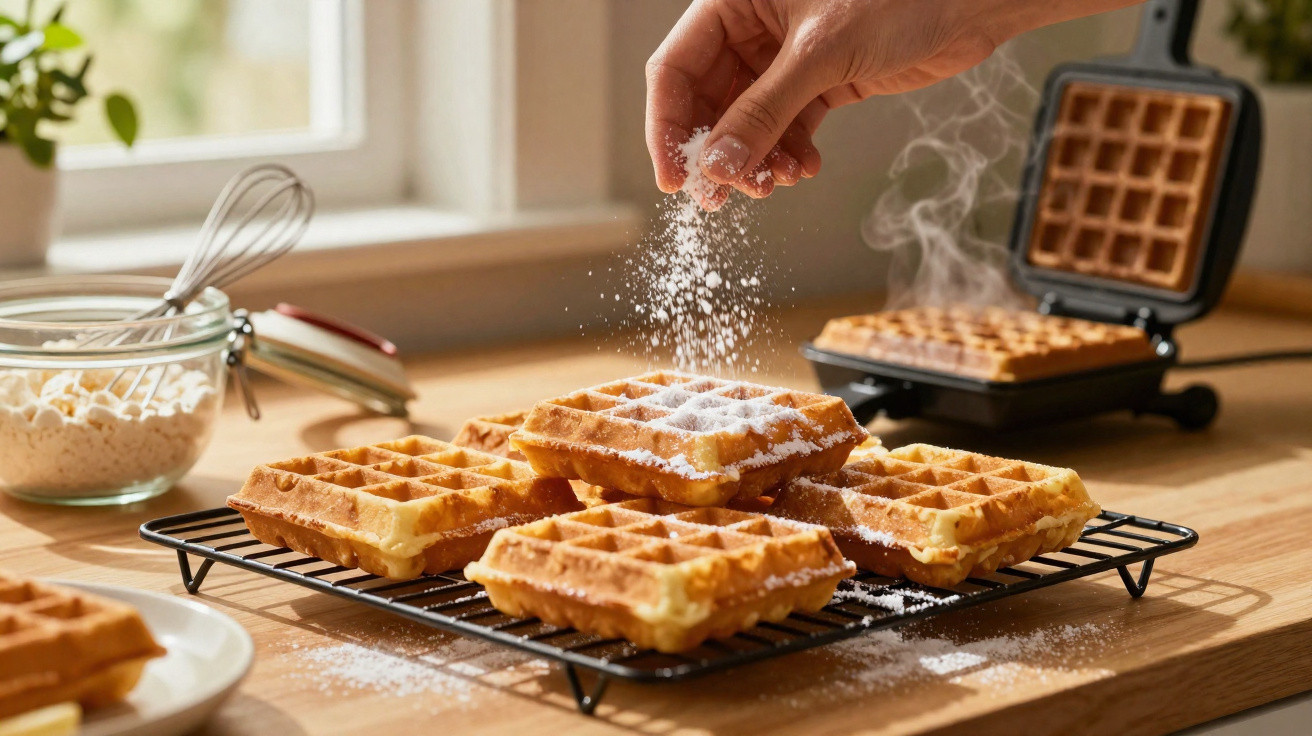
The solution sounds almost absurdly easy: allow the waffles to breathe. Keep them off a plate and out of a stack. Place them in a single layer on a wire cooling rack, exposed to the air.
The instant a waffle comes out of the maker, set it carefully on the rack. Do not overlap them or cover them with a tea towel or foil. Steam rises and escapes, while the crust continues drying for a few more minutes. If your oven has a warm setting, put the rack inside at a low temperature of roughly 90–100°C, leaving the door slightly ajar. You are not cooking the waffles again; you are simply preserving their crispness.
This small adjustment can leave homemade waffles crunchy for 20, 30 or even 40 minutes.
The challenge is not the method itself but abandoning familiar habits. Many of us were raised seeing pancakes and waffles piled high on a plate and covered to “keep them hot”. It looks comforting and generous. Yet that very tradition destroys the crunch.
Many people also set the oven far too high. They assume extra heat will create extra crispness. In fact, a hot oven can over-dry the inside, producing tough waffles rather than light ones. What you need is low heat with air circulation. Think gentle drying rather than roasting.
Realistically, hardly anyone weighs waffles or monitors the temperature with a thermometer every day.
Giving them a rack instead of a plate, though? That is manageable.
“Once I stopped stacking waffles and started treating them like cookies just out of the oven, everything changed,” laughed a home baker I met at a neighborhood market. “My kids actually complained the first time they got a soft one again at someone else’s house. That’s when I knew the trick worked.”
- Choose a metal wire rack rather than a solid tray, allowing air to reach underneath.
- Keep waffles in one layer while they cool and are kept warm.
- Use only low oven heat, with the door slightly open where possible.
- Do not cover hot waffles with foil, lids or tea towels.
- Transfer waffles from the rack to each plate, rather than serving a stacked pile at the table.
Going further: batter tweaks, freezer magic and sharing the ritual
Once you have mastered airflow, every other measure is simply an added benefit. A slightly thicker batter, a little more fat, or sparkling rather than still water can all help create a crisp shell. Some cooks replace part of the milk with buttermilk, while others mix a spoonful of cornflour into the flour for added crunch.
There is no need to overhaul your favourite recipe overnight. Next weekend, test one small change and observe how the waffles perform on the rack. Leave them for a full five minutes before serving, then listen: the faint crackle as you split one open becomes your new standard.
Then there are leftovers, those unusual survivors of a substantial breakfast. When waffles have been cooled properly on a rack, freeze them in a single layer before stacking them once solid. Reheat them straight from frozen in a toaster or a hot, dry frying pan, and they will return almost as crisp as they were when first made.
If they cooled inside a steam trap, no freezer trick can completely bring back the crunch. They can be improved, certainly, but they will never quite sing. That is the understated importance of those first five minutes after leaving the waffle maker.
We have all had that moment of realising that the small step we missed was the one that mattered most.
There is something unexpectedly intimate about making waffles. It is a leisurely breakfast that encourages people to linger in the kitchen while waiting for the next batch. Once you begin using a cooling rack, the rhythm changes subtly. People gather around, pull off a corner, take a bite, compare levels of crispness and debate toppings.
You may end up exchanging tips with a neighbour or texting a photograph of your rack full of golden squares to the sister who always says her waffles turn limp. Somewhere between the sizzle of the maker and the quiet click of the oven door, a small and very ordinary truth emerges: most everyday miracles in the kitchen come from one quiet, almost invisible gesture.
Not an expensive appliance.
Just a little air and some patience.
| Key point | Detail | Value for the reader |
|---|---|---|
| Cool on a rack | Arrange waffles in a single layer on a wire rack rather than on a plate or in a stack | Keeps the outside dry and crunchy instead of soft and steamy |
| Gentle warm oven | After placing waffles on the rack, keep them at low heat with the door slightly ajar | Lets everyone enjoy hot waffles without compromising texture |
| Think airflow first | Do not cover, wrap in foil or stack waffles while they are still steaming | An easy habit change that instantly improves any waffle recipe |

















Comments
No comments yet. Be the first to comment!
Leave a Comment