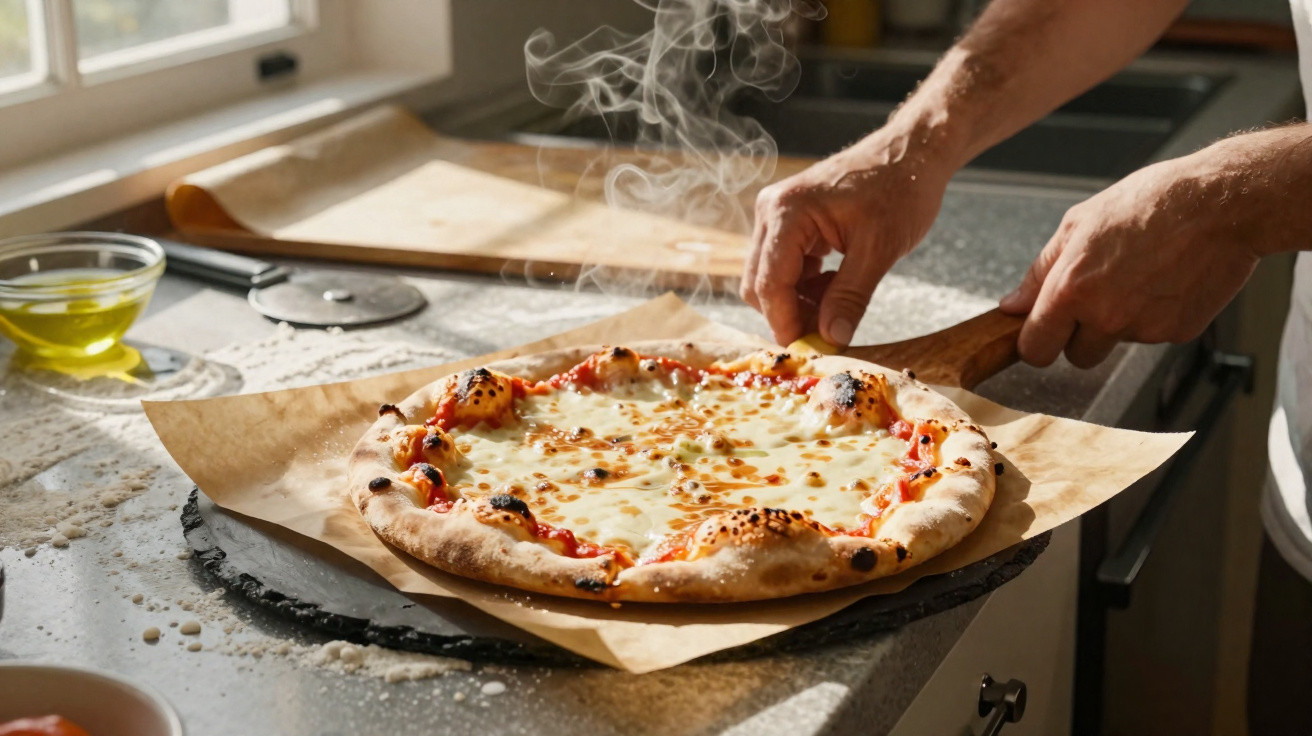
Last Tuesday evening, I saw my neighbour desperately scraping burnt pizza dough from his new pizza stone, muttering curses as he worked. It was a painful yet strangely recognisable scene: most of us have stood in the kitchen wondering whether parchment paper would have been the wiser choice. His carefully organised meal had become a sticky catastrophe. Half the base was permanently attached to the stone, while the rest looked as though it had been through a minor blast. As he attempted to rescue his homemade creation, burnt flour scented the air. From my kitchen window, I noticed his wife arranging a takeaway on her phone. The great pizza dilemma had claimed another victim.
Pizza Stone vs Parchment Paper: Two Baking Surfaces
Pizza stones offer the authentic, crisp-bottomed finish associated with proper pizzerias. Their porous ceramic or cordierite surface draws moisture from the dough, producing the sought-after crunch that makes every bite satisfying. The stone also sends heat evenly upwards, turning a soggy homemade pizza into something much closer to a professional result.
This is also where the process can become complicated - and untidy. Sarah from Portland discovered that last month while making her first pizza at home. She heated her stone correctly, stretched the dough expertly and confidently transferred it to the scorching surface. Twenty minutes later, she had produced what she now calls “the great pizza fossil of 2024” - a base so firmly fused to the stone that removing it required a chisel.
The reason behind this type of mishap is fairly simple. Pizza stones work best at extremely high temperatures - around 260°C (500°F) or higher. At that heat, moisture vanishes immediately from the bottom of the dough, generating steam that helps stop it sticking. However, if the dough is overly wet, the stone has not heated sufficiently or you miss out the cornmeal dusting, you are effectively making edible cement.
The Parchment Paper Safety Net
Using parchment paper can feel like taking a shortcut, yet it can be an excellent one. You will sacrifice a little direct heat transfer, certainly, but receive something extremely useful in exchange: the absolute certainty that your pizza will come off the pan. The paper creates a protective layer that catches escaped cheese and avoids the dreaded stuck-crust problem.
In reality, hardly anyone heats a pizza stone for a full hour every time they fancy pizza. We become hungry and impatient, then tell ourselves that 20 minutes of heating is “probably fine.” Parchment paper means these shortcuts need not become kitchen disasters. The crust may lack the ideal artisan char, but it will still taste of pizza rather than disappointment.
Professional baker Maria Rodriguez explains it perfectly:
“I tell my students to think of parchment paper like training wheels – not because you’re not good enough, but because it lets you focus on getting the flavors right without worrying about whether you’ll be eating pizza or scraping the oven.”
The main differences are as follows:
- Stone: Delivers maximum crispness but calls for faultless technique.
- Paper: Ensures easy release, although the base will be slightly softer.
- Stone: Proper preheating is essential and timing matters.
- Paper: More forgiving with temperature and more flexible on timing.
Choosing Your Pizza Stone Method
Perhaps the real issue is not which option is “better”, but which suits your real routine rather than your Instagram ambitions. On some evenings, you may want to embrace your inner pizzaiolo by carefully dusting the stone and getting every stage timed precisely. On others, you simply want guaranteed pizza without the possibility of ordering emergency takeaway. Both methods deserve a place in a kitchen used by real people.
| Key point | Detail | Value for the reader |
|---|---|---|
| Heat Transfer | A stone delivers direct, intense heat, while parchment creates a barrier. | This knowledge helps you select the right method for the texture you want. |
| Sticking Risk | A stone needs perfect technique; parchment is almost foolproof. | It gives you confidence to experiment without fearing disasters. |
| Flexibility | Parchment accommodates timing errors, whereas a stone requires precision. | It makes planning easier for busy weeknight cooking. |

















Comments
No comments yet. Be the first to comment!
Leave a Comment