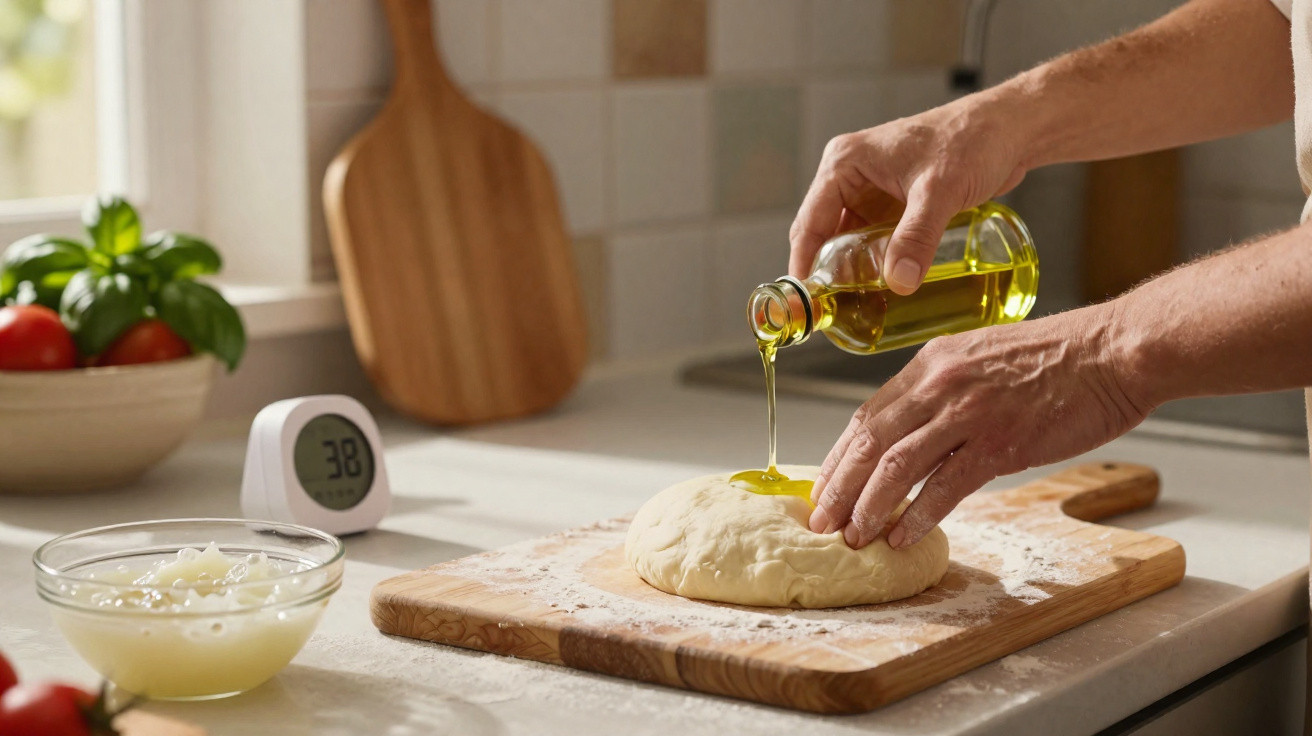
Imagine this: it is a Sunday afternoon, you are in the kitchen with flour scattered across the worktops, and you are about to make the ideal homemade pizza. You have watched YouTube videos, followed recipes and feel sure of yourself. Then you reach the all-important point of picking up the olive oil. Most home cooks believe they know precisely when to add it, yet timing is crucial in pizza dough. You tip a golden stream into the mixing bowl, but something immediately seems… wrong. The dough begins acting oddly and will not come together as it should. Your hands become messier every minute, while the smooth, elastic consistency you expected feels increasingly out of reach. What appeared to be a straightforward step has turned pizza-making into a sticky nightmare.
When Oil Meets Flour: Why Pizza Dough Turns Sticky
Putting olive oil in at the wrong stage causes what food scientists describe as “fat interference.” In effect, the oil coats the flour particles before water can hydrate them properly. As a result, the gluten proteins cannot create their vital network, and the dough resembles a lumpy paste rather than a smooth pizza base.
My neighbour Sarah discovered this the difficult way at her daughter’s birthday party last month. She put the olive oil in at the very start, combining it with the flour before she added the water. Twenty minutes later, she was urgently sending me photographs of something resembling wet sand that would not turn into dough. The guests ended up ordering a takeaway, while Sarah’s “homemade” effort remained abandoned in its bowl.
The science is actually quite simple. Flour must take in water first in order to activate its gluten proteins. If oil is introduced too soon, it forms a barrier that prevents this essential hydration from happening. It is much like trying to paint a wall already covered in grease – nothing adheres correctly.
The Right Method: Adding Olive Oil to Pizza Dough Like a Professional
Professional pizzaiolos use a set order that many home cooks overlook. Start by mixing the flour and water, giving the gluten at least 3-4 minutes to develop. Drizzle in the olive oil only afterwards, then add the salt. This allows the proteins to build their structure before the fat arrives to make the dough more tender.
We have all rushed through recipe instructions because we are hungry or keen to see the finished result. It seems like an innocent error – oil is simply oil, isn’t it? Yet pizza dough is remarkably sensitive to timing. Adding oil too soon is like breaking up a conversation that flour and water need to have before anything else.
Here is what professional bakers understand about the timing of oil:
“Oil should be the supporting actor, not the lead. Let the flour and water establish their relationship first, then introduce the oil to refine and perfect what’s already working.” – Marco Torretti, Naples-trained pizzaiolo
- Fully hydrate the flour before adding any fats.
- Use oil at room temperature so it incorporates more effectively.
- Pour in the oil slowly while mixing, rather than adding it all at once.
- Allow the dough to rest after adding oil so the moisture can redistribute.
Beyond the Error: What Pizza Dough Can Teach Us About Cooking
Errors with pizza dough highlight something more fundamental about the way we cook. We frequently handle recipes as though they are assembly guides, rather than appreciating the reason for every stage. The question of when to add oil is not truly just about oil; it is about respecting the science that allows bread to exist. Each ingredient has its proper time, and hurrying the process usually causes problems.
| Key point | Detail | Value for the reader |
|---|---|---|
| Oil timing matters | Add it after flour and water have hydrated | Avoids sticky, unworkable dough |
| Gluten needs priority | Give proteins 3-4 minutes to develop first | Produces the right dough structure |
| Temperature counts | Room-temperature oil incorporates more easily | Makes mixing smoother |

















Comments
No comments yet. Be the first to comment!
Leave a Comment