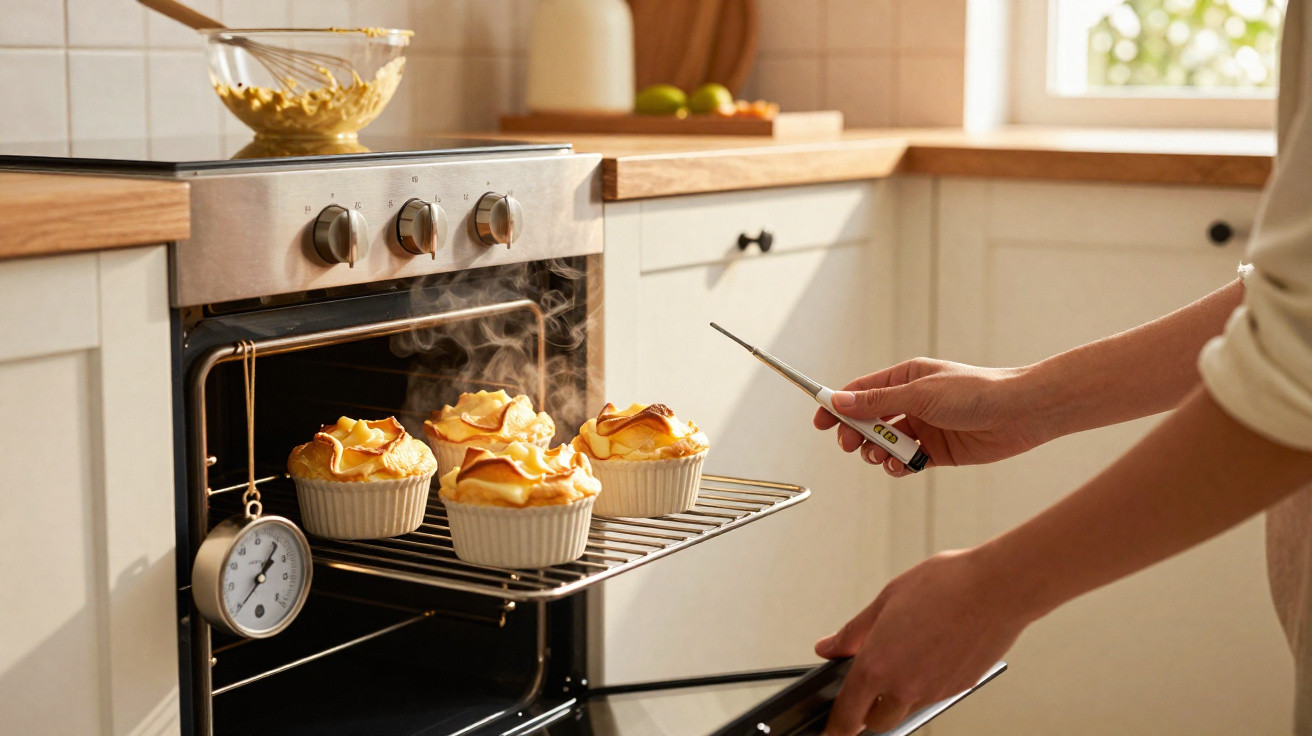
The oven door closes with a gratifying thud, and there it is: your soufflé swelling into a golden vision behind the glass. You followed the recipe precisely, whisked the egg whites until your arm protested, and folded the mixture together with a surgeon’s care. After 25 minutes, you are almost hopping with anticipation as you look through the oven door at what appears to be flawless pastry. Then comes the test: you open the oven and, within moments, your creation sinks faster than a burst balloon. We have all experienced it-that split second when a kitchen victory becomes disappointment. But what if your method is not the issue at all?
The invisible enemy in your kitchen
Temperature variation is the quiet destroyer of successful soufflés, hiding in areas that most home bakers would never think to investigate. Your oven may show 190°C on its digital display, while conditions inside are actually an unruly mix of hot and cold patches enough to make any soufflé collapse. There is a reason professional pastry kitchens regard temperature management as essential.
At Le Cordon Bleu, students are taught that a temperature change of just 14°C can separate an Instagram-worthy rise from a pancake-flat result. When chef Marie Dubois tested fifty domestic ovens across Paris, she found that 78% varied by more than 17°C over a standard baking cycle. These were not faulty appliances; they were simply ordinary household ovens behaving as they normally do.
The science behind this kitchen disappointment is unforgivingly straightforward. A soufflé rises when steam and hot air expand the fragile protein framework formed by your carefully whipped egg whites. If the temperature suddenly falls, that expanded air shrinks before the protein walls can respond. Picture a house of cards in a windstorm: impressive until the first gust arrives.
The three essential temperature rules
The first rule depends entirely on an oven thermometer-not the gauge built into the appliance, but a separate analogue thermometer placed on the oven shelf. Professional pastry chefs never, and I mean never, rely on the factory-fitted temperature display. They position a standalone thermometer in the middle of the oven, precisely where the soufflé dish will be placed.
Admittedly, few people want another kitchen accessory, but this £20 purchase can prevent countless sunken soufflés. The second rule seems almost too obvious: preheat for a complete 30 minutes, rather than the 10 or 15 minutes suggested by most recipes. Your oven needs time to reach thermal equilibrium, and hurrying it is like laying foundations on moving sand.
The third rule is remarkably simple, yet it distinguishes amateur bakers from professionals time after time.
“Temperature consistency trumps temperature accuracy every time. I’d rather bake in an oven that runs consistently at 182°C than one that swings between 177°C and 204°C,” says James Peterson, author of ‘Glorious French Food.’
The professional’s temperature checklist:
- Put an oven thermometer on the centre shelf 30 minutes before baking.
- Confirm that the temperature remains stable for at least 10 minutes.
- Do not open the oven door during the first 20 minutes of baking.
- Set the soufflé dish exactly in the middle of the shelf.
Beyond the rules: adopting the soufflé mindset
Learning to master a soufflé involves more than observing temperature guidance; it means building an instinctive understanding of your oven, ingredients and even your expectations. Some of the best-known pastry chefs acknowledge that their early soufflés fell more often than they rose. What separates persistence from giving up is recognising that every failure reveals something about the subtle relationship between heat, timing and technique. Your kitchen may become warmer in afternoon sunshine, or your oven’s hottest area may be slightly left of centre. These are not defects to battle, but traits to understand and accommodate.
| Key point | Detail | Value for the reader |
|---|---|---|
| Oven thermometer placement | Centre shelf, with a minimum 30-minute preheat | Removes temperature guesswork entirely |
| Prioritising temperature consistency | Stable heat is more important than exact degrees | Directs effort towards what genuinely affects success |
| Door discipline | Never open the door during the first 20 minutes | Avoids the temperature shock that makes a soufflé collapse |

















Comments
No comments yet. Be the first to comment!
Leave a Comment