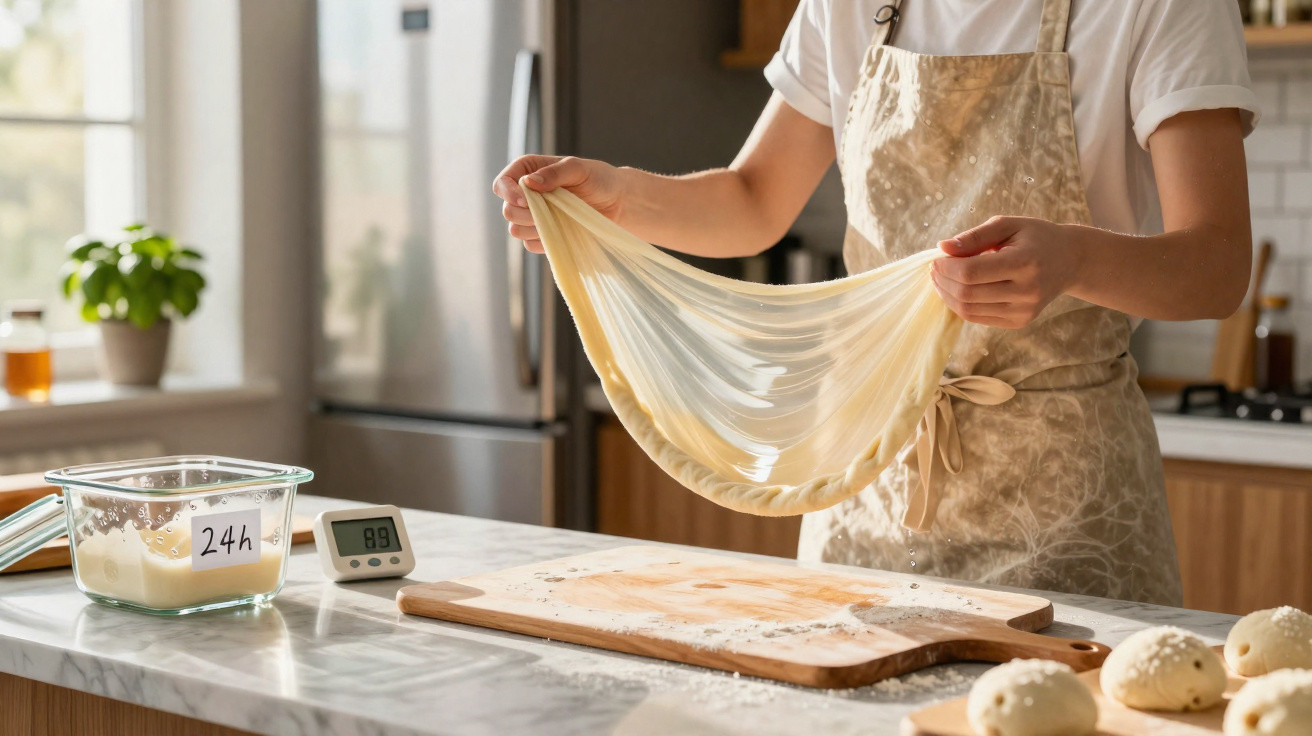
Last Tuesday evening, I saw my neighbour Maria take a container from her fridge after it had been there for precisely 48 hours. It held what appeared to be a standard pizza dough, yet as she drew it out between her fingers, it did something remarkable. Smooth as silk, the dough stretched to a paper-thin, nearly transparent sheet without splitting. With a knowing smile, she formed it into an immaculate round with barely any effort. “Cold fermentation,” she said simply, before putting the pizza into the oven. Within 20 minutes, the aroma wafting from her kitchen window made my own meal seem like cardboard. This approach has an almost ancient quality that today’s kitchens seem to have overlooked.
The Science Behind the Magic of Cold Fermentation
Cold fermentation slows yeast activity almost to a standstill while allowing enzymes to remain at work. Over those extended chilled hours in the refrigerator, enzymes break down proteins and starches in ways that a room-temperature rise cannot reproduce. This creates dough with layered flavours and an exceptionally easy-to-handle texture.
Naples’ professional pizzaiolos have practised versions of this method for generations, although they use different terms for it. Some leave their dough in cool cellars for 24 to 72 hours, allowing it to acquire what they call “character”. Research by food scientist Dr. Jeffrey Steingarten found that dough fermented at 4°C for 48 hours contained three times more flavour compounds than dough left to rise at room temperature for only a few hours.
The low temperature effectively sends the yeast into a mild hibernation, even as the other processes continue. Gluten structures loosen and reform, becoming stretchier and less likely to rip. At the same time, natural enzymes gradually turn starches into sugars, producing richer, more complex flavours that cannot be hurried. That is why dough left overnight can take on a near-sourdough flavour, including delicate tangy notes that were absent at the start.
Mastering the Overnight Transformation
This technique is remarkably straightforward, although timing matters enormously. Make the dough with around 20% less yeast than a conventional recipe recommends: time does the hard work rather than a large dose of yeast. Once kneaded, transfer the dough to an oiled container and place it directly in the refrigerator.
A common error among home cooks is to use their usual yeast quantity, then wonder why the dough has doubled overnight and become difficult to manage. We have all opened the fridge to discover a popped-off lid and dough escaping across the shelves. The answer is moderation: less yeast, greater patience and improved results.
“Cold fermentation changed everything about my pizza game. The dough became so much more forgiving, and the flavor development was incredible. I’ll never go back to same-day dough again.” – Chef Marco Benedetti, Brooklyn Pizza Workshop
- Use 25-30% of your normal yeast amount
- Oil your container generously to prevent sticking
- Allow 24-72 hours for optimal results
- Bring to room temperature 30 minutes before shaping
Beyond Tonight’s Dinner
The most compelling aspect of cold fermentation is the way it reshapes how we think about time in the kitchen. Rather than racing to put dinner on the table within an hour, we begin planning two days beforehand. This unhurried pace is deeply satisfying, linking us to the way people once cooked. Pizza for Wednesday evening really starts on Monday night, and somehow that makes it taste even better. The expectation grows, the flavours intensify, and you begin inspecting that container as though it contains treasure. In a sense, it does.
| Key point | Detail | Value for the reader |
|---|---|---|
| Reduced yeast quantity | Use 20-30% of normal amount | Prevents over-proofing during long fermentation |
| Temperature control | Store consistently at 3-4°C | Optimal enzyme activity with controlled yeast growth |
| Time flexibility | Best results between 24-72 hours | Can plan around your schedule, not rush cooking |

















Comments
No comments yet. Be the first to comment!
Leave a Comment