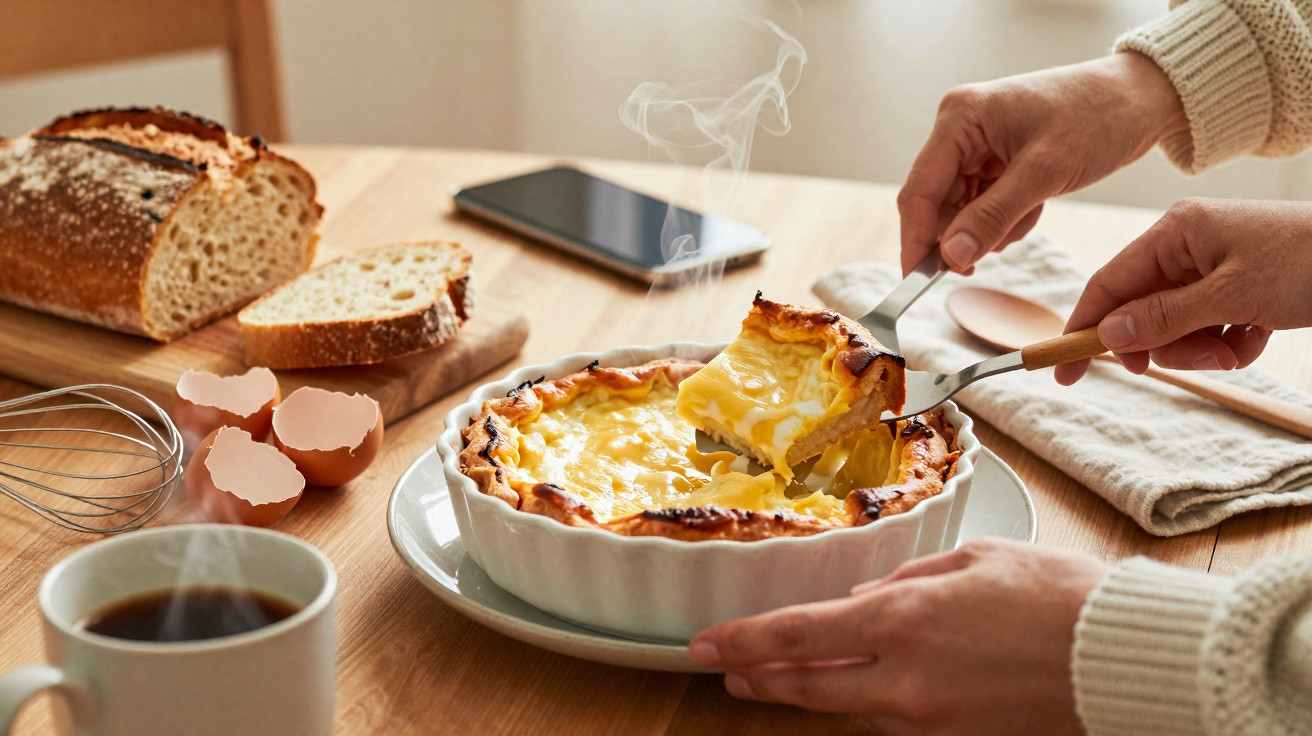
The first time I saw one, the dish resembled a miniature edible patchwork quilt. Toasted cubes of bread showed through a tender, quivering blanket of egg, while the edges had crisped enough to make a faint sound as the spatula slipped beneath them. The kitchen carried the scent of an unearned Sunday morning: buttery, toasted and slightly sweet, as though someone had risen early to do something thoughtful.
A friend described it as “poor man’s breakfast souffle.” Her grandmother gave it the name grandmothers give so many such dishes: “Oh, just something I threw together.” She would rip up leftover bread, soak it in whisked eggs with a splash of milk and an almost absent-minded pinch of salt, then leave it alone as if magic had no need of supervision.
That overlooked bit of kitchen magic has a name, and it may be the most comforting breakfast you are not currently making.
The humble egg-and-bread bake that has never truly left our kitchens
At heart, this recipe is precisely what its name suggests: bread and eggs baked gently together until they become something richer, softer and unexpectedly nostalgic. Some call it an egg casserole, while others know it as a breakfast strata. In older cookbooks, it appears as “bread and egg bake”, almost apologetically tucked into the margins because of its simplicity.
Simply tear or cube slightly stale bread, bathe it in beaten egg, milk, salt and a little fat, then leave the oven to finish the job. It does not rise theatrically like a television-style soufflé. Instead, it settles into a lightly crisp-topped, custardy bake, as if French toast and scrambled eggs had chosen to share a bed.
A woman I interviewed not long ago said her children were raised on this dish. After hospital night shifts, she would stumble through the door at about 6 a.m. and assemble it while barely awake. “It was the only breakfast that never burned,” she laughed, “because I could ignore it for 30 minutes.”
She would beat six eggs with milk, a handful of grated cheese and whatever was available: leftover ham, a few mushrooms lingering in the fridge or the final piece of onion. She then tipped the mixture over torn sandwich bread in an ovenproof dish and put it in the oven while changing out of her scrubs.
When her children eventually drifted into the kitchen, eyes still sleepy, the top would be golden, the room warm and the table laid with unmatched plates.
There is a reason versions of this recipe appear in old church cookbooks and on fading index cards stored in metal tins. It makes limited cupboard supplies go further. It is forgiving about timing, and it can wait without becoming rubbery or charred.
Eggs provide protein and fat; bread brings structure and comfort. Baked slowly together, the bread drinks in the egg like a sponge and becomes a soft, savoury custard that can be cut into slices. That is how one dish can feed a group without any unnecessary fuss.
And honestly, this is the sort of cooking that quietly keeps families going through both hectic weekdays and unhurried weekends.
How to bring this “forgotten” egg-and-bread bake back to your table
The method is so straightforward that it barely seems to require a recipe, which may be why people stopped discussing it and simply… made it. Begin with an ovenproof dish of roughly 20 × 30 cm, enough for four to six people, and lightly grease it with butter or oil.
Tear or cut 4–5 slices of bread into cubes; bread that is a little stale works particularly well. Spread it over the dish. In a bowl, whisk 5–6 eggs with 240–360 ml milk, a pinch of salt and some freshly ground pepper. Add a small handful of grated cheese if you wish.
Pour the egg mixture across the bread, then use the back of a spoon to press the pieces down so they absorb it. Leave it for 5–10 minutes before baking at 180°C for around 30 minutes, until the middle is only just set and the surface is softly golden.
This is often the stage at which people begin to second-guess everything. Was there too much milk? Too little bread? Why does the centre still seem slightly unsteady? Take a breath. This bake belongs somewhere between a firm omelette and a delicate custard, and it is meant to remain tender.
The biggest error is overbaking it. Everyone knows the moment: you decide to leave something in for “just two more minutes”, then return ten minutes later. Here, those extra minutes turn comfort into cardboard. Take the dish out when its middle gives the slightest wobble and its edges are risen and browned.
Overloading it with additions is another common problem. A modest amount of cooked bacon or vegetables is excellent, but pack it like a suitcase and the egg will struggle to set, leaving soggy patches and burnt edges.
Sometimes the simplest recipes are the ones that taste most like home. One grandmother told me, “We didn’t have names for half our dishes. We just cooked with what we had and hoped everyone left the table a little happier than they arrived.”
Use what you already have
Leftover baguette, sandwich bread, brioche or even the last heel that nobody wants will all work well.Experiment with flavours
Some grated cheese, leftover roasted vegetables or a few herbs can take the dish from plain to memorable.Prepare it the night before
Assemble the bread and egg mixture in the evening, refrigerate it, then bake it in the morning for an almost effortless breakfast.Look beyond breakfast
The same mixture makes a light supper alongside a salad, or a Sunday-night way to “clear out the fridge”.Leave it to rest for a few minutes before slicing
Those five peaceful minutes on the worktop allow the custard to settle and help each portion keep its shape.
A small pan of comfort in a hurried, scrolling world
There is something almost defiant about preparing a breakfast that needs half an hour in the oven rather than 30 seconds in the microwave. You pour, you wait, you make coffee. Gradually, the kitchen fills with the aroma of toasted bread and baked egg, and time seems to ease a little.
Breakfast need not be impressive to stay in the memory. Sometimes it is merely the crackle of the crust as you cut through it, or the softness of the middle that makes you reach for another slice-not because you remain hungry, but because, for once, it tastes as though there was no rush.
This old egg-and-bread bake discreetly deals with problems we rarely mention: the piece of bread turning stale on the counter, the half-bag of grated cheese, or the need to feed three people with two eggs when payday remains a week away. Honestly, nobody makes it every single day.
Still, knowing you could make it-that the approach is there in your back pocket-alters the way you see what is in the fridge. You are no longer wasting food; you are repurposing it. You are not “just” assembling something; you are drawing on a way of cooking that generations practised without giving it much thought.
Perhaps that is why this barely recorded, half-forgotten recipe has endured. It asks for neither specialist equipment nor fashionable ingredients. It does not pursue perfection. It will forgive unevenly torn bread, low-fat milk or forgetting to preheat the oven at the right time.
In return, it offers something quiet: a dish to place in the middle of the table, an invitation for everyone to help themselves and a chance to watch people slow down for a moment. You can make it grander with herbs and fancy cheese, or leave it as simple as a Tuesday. Either way, it creates space for conversation, second helpings and stories about whoever first showed you how to beat eggs in a chipped bowl on a drowsy morning.
| Key point | Detail | Value for the reader |
|---|---|---|
| Simple method | Eggs, milk and leftover bread are baked together into a soft, sliceable custard | Provides an easy, low-stress breakfast made from cupboard staples |
| Flexible ingredients | Suitable for many breads and small amounts of cheese, meat or vegetables | Reduces food waste and lets you tailor the dish to your taste or available ingredients |
| Make-ahead friendly | It can be assembled the evening before and baked in the morning | Saves time on busy days while still providing a comforting homemade meal |

















Comments
No comments yet. Be the first to comment!
Leave a Comment