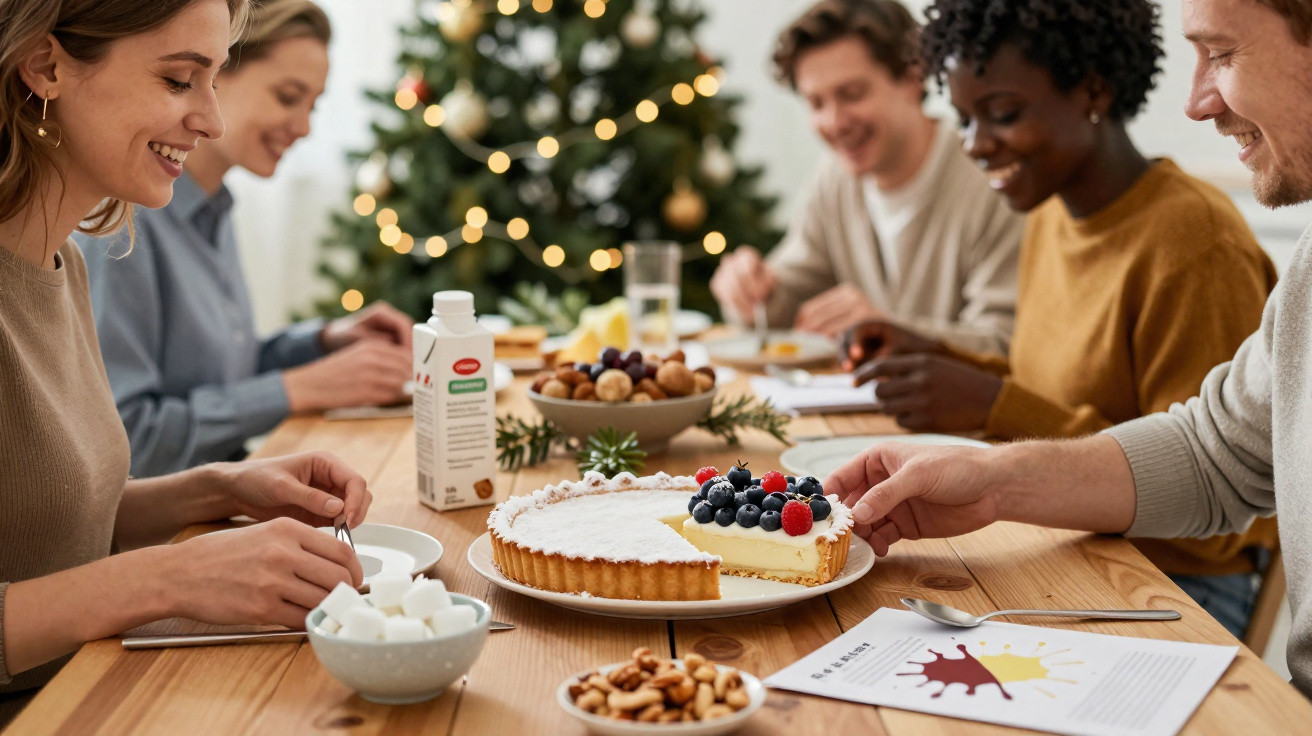
The season claims to bring everybody together. The pie shows who is left without a place at the table.
At a chilly Saturday market, a volunteer cuts into a towering white Christmas pie while carols crackle from a tinny speaker and a child’s mitten clings to the counter. Its crust splinters like thin ice, coconut scatters through the air, and a queue gathers with the quiet certainty of routine. People smile, recall Grandma’s kitchen and reach for another piece, while somebody mentions sugar, dairy and the friend who cannot eat eggs. For one brief moment, the knife stops, as stories do before their hardest passage. A single question lingers above the steam from the mulled cider: who is this tradition really for?
White Christmas pie: beneath the tinsel and under scrutiny
From Portland to Preston, white Christmas pie has become a measure of what “festive” means in 2025. Snowy in appearance, rich when cut and layered with whipped cream, coconut and frequently sweetened condensed milk, it has a devoted following. Supporters repeat “tradition lives on” as though it were a carol, arguing that the pie is central to the gathering: an anchor for memory and flavour. Its critics counter that a centrepiece pudding should not shut out entire groups, nor leave people with a sugar crash and a bin full of leftovers by the end of the evening. The argument may be noisy online, but it is noisier around the table.
Consider the Johnson family of Maple Street. They took two white Christmas pies to a neighbourhood swap last year, but half of one came home uneaten: two children had egg allergies, a neighbour avoided dairy and Aunt May was managing her glucose levels. A glance at Google Trends shows “white Christmas pie” reaching its high point every December, followed closely by a rise in searches for “dairy-free Christmas dessert”, trailing it like a shadow. That divide is visible in sitting rooms everywhere: one familiar dessert, but a guest list that has evolved. The questions begin as soon as the coats come off.
Holiday food, and food more generally, has duties beyond taste. It conveys belonging, triggers nostalgia and declares “you’re with us.” For some people, white Christmas pie does this wonderfully. For others, it has the opposite effect. Its sugar content is not solely a health concern; it is also about moderation when tables are already crowded with sweet treats. Leftovers can seem wasteful when a buttery crust turns soft overnight and whipped cream leaks into the dish. There is a symbolic issue, too: a dessert resembling a pristine snowfield may suggest purity and perfection, while many contemporary tables include vegans, gluten-free guests and people whose health or budgets require another option. Tradition can start to resemble a barrier.
White Christmas pie: retain the glow, revise the slice
It is possible to preserve the snowy spectacle while removing the elements that exclude people. Make a lighter crust from crushed oat biscuits and a little coconut oil, then use agar rather than gelatine to set a coconut-yoghurt custard. The result is a dairy-free, egg-free filling that still slices neatly. Stir through unsweetened desiccated coconut for texture, and finish with aquafaba meringue, toasted in patches like lanterns against snow. A smaller tin creates a taller pie while naturally controlling portions; maple and vanilla can provide a rounded sweetness rather than an overpowering one. Chill it thoroughly, use a warmed knife and let the flakes fall.
The main error is to substitute ingredients without considering their structure. Cream acts like cream; coconut yoghurt does not. Non-dairy fillings need both time and cold, while aquafaba must be whisked longer than expected if it is to hold up beneath the knife. Check sweetness by dipping a spoon into the filling rather than tasting residue from the bowl’s rim. Everyone has experienced the moment when the dessert table feels like a challenge. Let’s be honest: nobody actually does this every day. Balance does not remove joy; it creates space for it. If even one person cannot eat the main pie, prepare a small matching version for them with the same snowy topping.
A holiday dessert becomes more considerate when it transports easily, serves a crowd and does not leave anyone staring at an empty plate. The magic isn’t the sugar; it’s the signal that you thought of everyone.
“Tradition isn’t a recipe,” says pastry chef Lina Duarte. “It’s the feeling that arrives when the room goes quiet at the first bite. You can keep that feeling and change the formula.”
- Reduce the filling’s sugar by a third, then boost flavour with citrus zest and vanilla.
- Provide two sizes: one full pie and one small inclusive version.
- Mark portions with allergen information, including dairy, egg, gluten and nuts.
- Create a plan for leftovers: freeze individual slices on a tray before bagging them, then take a box to a neighbour working shifts.
- Finish with toasted coconut and pomegranate seeds for striking colour without extra icing.
What white Christmas pie reveals about togetherness
White Christmas pie now acts as a mirror for what people mean when they say “together.” Its fans stand up for taste and memory, while those seeking change stand up for bodies, budgets and belonging. The middle ground is not beige; it is more vibrant. You can retain the story and the snow while creating an ending suited to a room where allergies, faith and finances sit alongside tradition. A season that promises light should accommodate different bulbs, and a pie that resembles snowfall can still offer the warmth of a fire. Less sugar, same sparkle. A smaller slice can mean a greater welcome. It is a change that says “no one is excluded.” The refrain may shift from “tradition lives on” to “tradition lives with us.” That is a better chorus to sing.
| Key point | Detail | Why it matters to the reader |
|---|---|---|
| - | Why the white Christmas pie debate erupted | Understand the cultural and practical stakes at your table |
| - | Simple swaps that retain the appearance, reduce sugar and broaden access | Practical steps without sacrificing festive magic |
| - | Strategies for leftovers and labelling | Reduce waste, ease stress and include more guests |

















Comments
No comments yet. Be the first to comment!
Leave a Comment