You notice it on the worktop while making coffee: the baguette that looked beautiful yesterday is now hard enough to use as a rolling pin.
Press your thumb against its crust and it will not give at all-only that flat, frustrating resistance.
A small stab of guilt follows. You spent good money on that loaf and had ideas for it: sandwiches, perhaps, or a tartine topped with melted cheese. Now it looks remarkably like a brick.
Your immediate instinct is to throw it away, or perhaps save it for breadcrumbs at some undefined point in the future. Then you recall a friend sharing an odd tip: “Just use water and the oven.”
It seems far too straightforward to work.
That simplicity is precisely the point.
The understated sadness of stale bread on the worktop
There is something unexpectedly gloomy about stale bread.
It sits there as though it is reproaching you: “You forgot me.”
Bread is the sort of food we often buy automatically. We pick up a baguette on the way home, a farmhouse loaf on Sunday, or a good sourdough for “the week”. Then life gets busy: we work late, snack, or eat out. Gradually and quietly, the bread dries out.
When we finally notice, it can feel as though more than a few slices have gone to waste.
We have lost a modest everyday pleasure: tearing, dipping and sharing bread.
Imagine the scene.
It is Tuesday evening, you are exhausted, and you discover half a weekend loaf. It is rock hard, neglected behind the fruit bowl.
You cut into it, with the knife scraping noisily and crumbs scattering everywhere. One bite makes your jaw complain immediately, so you abandon it. You move the plate aside, slightly irritated with yourself.
Now picture a different outcome. Run the loaf briefly beneath the tap, put it in the oven for a few minutes, and its crust crackles as it did when it was fresh from the bakery. Steam rises as you tear it open. Dip it into olive oil or soup and, in an instant, dinner feels comforting rather than bleak.
A tiny change can make a big difference.
Bread does not simply become stale because it “dries out”; chemistry is involved.
As the crumb cools and sits, the starches within it rearrange themselves, making the loaf firm and crumbly.
Heat can reverse this process, while water gives the loaf a second chance. The aim is to restore moisture to the crumb and revive the crust, rather than leave it as a miserable, rubbery sponge.
When you refresh bread with water and an oven, then, there is no magic involved. You are merely helping its structure move back towards its earlier state.
Once you know this, the little “miracle” becomes reassuringly logical.
The water-and-oven method for reviving stale bread
Here is the small action that makes all the difference.
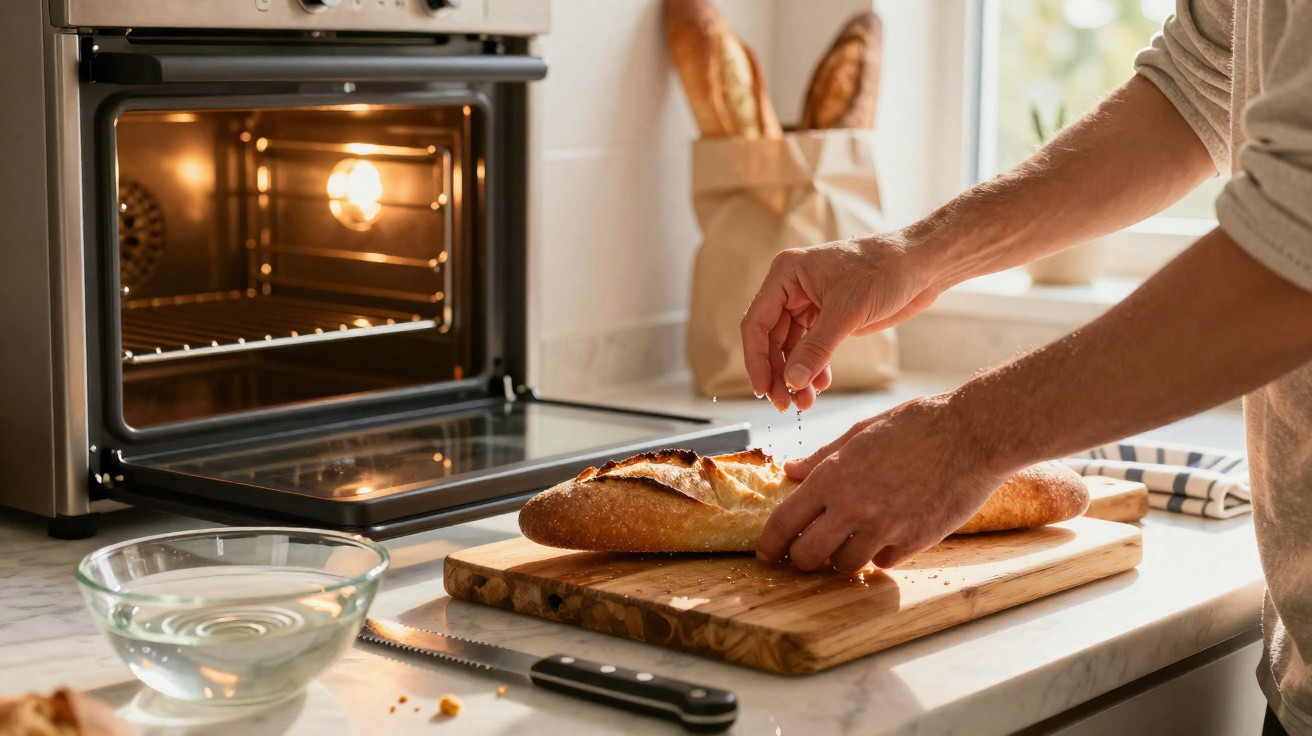
Take the stale bread-ideally as a whole loaf-and quickly hold it under a cold running tap. Yes, directly under the tap.
Moisten the crust generously, turning the loaf so each side becomes damp, but do not drench it as you would a sponge. A light, even coating of water is sufficient. Put the bread straight onto the oven rack, without a baking tray, in an oven preheated to roughly 160–180°C (320–350°F).
Bake it for 5 to 10 minutes, according to the loaf’s size.
The crust will start to crackle, a warm toasted scent will fill the kitchen, and the bread will suddenly feel yielding when pressed.
The main concern is nearly always the same: “If I put water on bread, won’t it go soggy?”
This is exactly where the oven does its work.
Its heat pushes moisture into the crumb, softening it, while the exterior dries out and turns crisp once more. Remove it too soon and the inside will still be too firm. Leave it in too long and it becomes toast. There is a useful middle ground, best judged by touch and aroma rather than the clock.
In truth, no one measures this perfectly every day.
You will probably look through the oven door and perhaps squeeze the loaf with an oven glove, listening for the light, hollow sound that says, “I’m back.”
There are a few pitfalls, but a little care-and some kindness towards yourself-makes them easy to avoid.
The first is using a microwave. It may seem faster, but it almost always produces bread that is chewy and strangely damp: soft for three minutes, then oddly hard again. The second is soaking rather than lightly wetting the loaf. If water reaches the centre, the middle can become gummy instead of light.
The third is deciding too soon that a loaf is “too far gone”.
Most loaves still have one good life left in them before crossing the line into crouton material.
“You don’t need fancy equipment or special recipes to waste less,” says Marion, a French home baker who swears by this method. “Just a bit of water, a warm oven, and the courage to trust that sad-looking loaf one more time.”
- Use cold water
Cold water offers greater control. Hot water can absorb too quickly and unevenly. - Preheat the oven properly
Putting bread into a lukewarm oven often results in a limp crust. It needs that immediate blast of dry heat. - Match the time to the loaf’s size
Small rolls: 3–5 minutes. Baguette: 5–8 minutes. Large round loaf: 8–12 minutes. The simple rule is to check sooner than you expect. - Revive only what you plan to eat
Once refreshed, bread will become stale again more quickly. It is better to restore half a baguette this evening and the remaining half tomorrow. - Be prepared to change course
If baking does not bring the bread back, do not force it. Cut it up for garlic bread, bruschetta or crisp salad croutons. It is not a failure, only a different recipe.
The quiet pleasure of saving a loaf from waste
Something changes, almost without you noticing, when you stop discarding every hardened piece of bread.
That forgotten baguette begins to look less like rubbish and more like an opportunity.
It can alter how you look in the cupboard, arrange quick meals and think about leftovers generally. One revived loaf can become a hot sandwich, tomato soup topped with torn pieces of crust, or a speedy breakfast of butter and jam when you thought there was “nothing in the house”.
There is also a subtle satisfaction in knowing such a simple trick. It feels like a small piece of knowledge handed down by grandparents, a gentle act of defiance against throwing food away at the first sign of imperfection.
We have all had that moment when a rescued piece of bread tastes even better because it was saved from the bin.
After hearing a crust crackle back into life, it becomes difficult to waste bread again without thinking twice.
| Key point | Detail | Value for the reader |
|---|---|---|
| Water on the crust | Briefly hold stale bread under cold water to lightly dampen the surface | Turns rock-hard loaves into bread that can be revived rather than thrown away |
| Oven heat | Bake at 160–180°C (320–350°F) for 5–10 minutes, directly on the rack | Brings back a crisp crust and soft crumb that is close to a bakery-fresh texture |
| Know the limits | Use this technique for bread that is dry rather than mouldy, and refresh only what you will eat | Cuts food waste while keeping meals safe, enjoyable and practical |

















Comments
No comments yet. Be the first to comment!
Leave a Comment