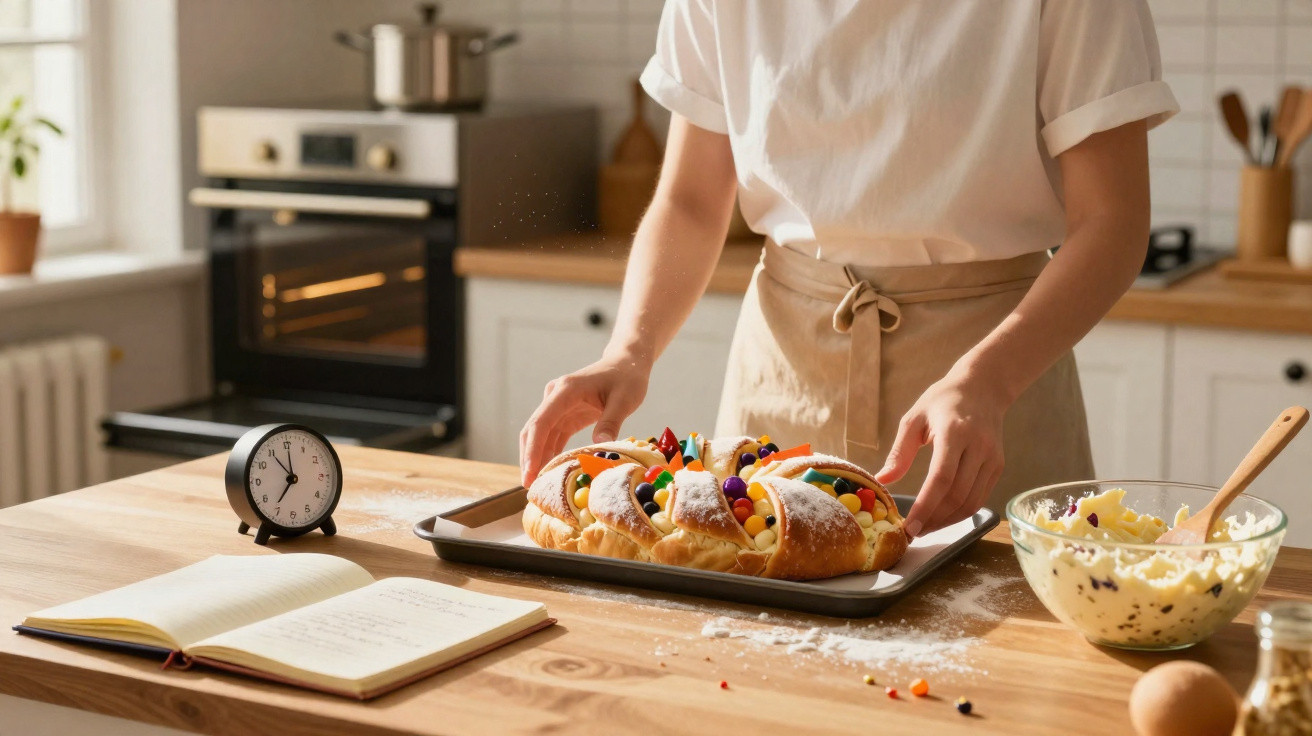
The kitchen carries the scent of butter, sugar and expectation. A king cake ring sits on the worktop, shining beneath an egg wash, while bowls of coloured sugar wait nearby like carnival confetti. You have enclosed a cinnamon-sugar spiral, perhaps a cream cheese ribbon and perhaps a tiny plastic baby for good luck. The oven is heating, the timer is ready, and you can already picture the Instagram likes.
But when you cut into it later, your heart drops. The filling has escaped into a sticky pool, the layers have slid away from one another, and the centre is wet and underbaked. You followed every instruction in the recipe… didn’t you?
There is one understated stage that nearly every home baker misses.
The quiet 5-minute step that decides your filling’s fate
Most home bakers assume the king cake drama unfolds in the oven: the reveal, the lift and the browning. Yet the fate of the filling is usually determined a few minutes before the cake meets the heat.
The overlooked step is simply this: chill or rest the filled dough before baking. It is not glamorous or TikTok-worthy, merely a quiet break that lets everything settle and cool.
Those few minutes alter the butter’s texture, the filling’s consistency and the strength of the dough seams. Without a rest, there is no structure.
Imagine the scene. It is late on a Saturday evening, sprinkles cover the kitchen, and you are rolling dough for a last-minute king cake ahead of Sunday brunch. The filling is still warm from the hob or has only just been mixed, so it is soft and easy to spread. You are tired, friends are messaging, and the oven is already hot.
You spread on the filling, roll up the log, form it into a ring and hurry it straight into the oven. As it bakes, the warm, loose filling bubbles and shifts, forcing against the seams like a miniature sugary volcano.
When you take it out, the ring has burst, filling has spilled across the tray, and parts of the inside are hollow. The exterior is golden, yet the centre eats like sweet, rubbery bread dotted with random pockets of goo.
There is straightforward science behind this small disaster. Because warm filling is more fluid, it expands sooner and moves farther while baking. Butter that is soft and unchilled melts too rapidly, creating a slip-and-slide between the dough layers. Meanwhile, dough that remains slightly elastic after shaping springs back and weakens the seams.
A brief rest in the fridge or a cool spot firms the fats and allows the gluten to relax into position. The filling thickens enough to remain where it belongs instead of rushing out at the first sign of heat. The oven doesn’t fix structural problems, it exposes them.
That modest pause separates a neat spiral from a sunken, leaking mess.
How to rest a king cake so the filling actually stays inside
The process is easy, and once you have tried it, you will not want to skip it. Once the filling is spread and the dough has been rolled into a log, firmly pinch the seams all along its length and at both ends. Form your ring or braid, place it on the lined baking tray, and then pause.
Loosely cover the shaped cake with cling film or a clean tea towel, then put the entire tray in the fridge for 15 to 30 minutes. With a particularly soft or cream-cheese filling, aim closer to 30. The dough should feel slightly cool, while the cake should feel “set” rather than wobbly.
Afterwards, allow it to complete its proof at room temperature if the recipe requires this, or place it directly in the oven if it has already risen.
This stage vanishes from many online recipes, hidden behind vague wording such as “let rest” or “set aside” that few people truly follow. We have all had that moment of clock-watching and wondering, “How bad could it be if I skip this?”
In truth, this rest acts as your filling’s seatbelt. Miss it, and every other imperfection becomes more obvious: dough rolled too thinly, excess filling or a seam that is not fully sealed. Give it those 20 minutes, and the cake is more forgiving of ordinary human error.
Let’s be honest: hardly anyone does this every day. Yet when you are making the effort to bake a king cake, those minutes matter more than an additional sprinkle.
You can practically hear the difference, as one New Orleans baker told me: “The cakes that go straight from table to oven hiss and leak. The ones that rest? They puff, they sigh, they keep their secrets inside.”
While it rests, carry out a quick three-point check. It is not elaborate, just sensible kitchen know-how of the sort aunties and grandmothers used long before food blogs.
- Pinch test: Trace the seam with your fingers. If you can feel or see any openings, pinch it closed again before chilling.
- Squish test: Gently press the ring. If filling escapes, you have either added too much or need to chill it longer.
- Pan test: Cover the tray with baking parchment or a silicone mat to catch minor leaks and prevent sugar cement from baking on.
Why this “boring” pause makes your king cake taste like a bakery’s
Although the calm 20-minute interval appears uneventful, plenty is happening beneath the surface. The butter in the dough and filling firms up, delaying its melt so that it releases gradually in the oven. Sugar in the filling also thickens slightly, becoming syrupy rather than watery.
The dough settles into its finished shape, helping it rise more evenly once it reaches the heat. Rather than bursting through its weakest spot, the ring expands like a properly inflated inner tube. The swirl remains distinct, the crumb cooks through and the centre sets.
When you cut the first slice, the filling stays in place like a ribbon instead of tumbling out like a landslide.
People may ask, “Where did you buy this?”, and you can enjoy the question quietly.
| Key point | Detail | Value for the reader |
|---|---|---|
| Chill the shaped cake | Rest in the fridge for 15–30 minutes before baking | Stops filling leaks and keeps the layers distinct |
| Seal seams firmly | Pinch the long seam and ends, then inspect them again after shaping | Limits splits and blowouts while baking |
| Watch filling texture | Choose cool, thick fillings instead of warm or runny ones | Produces a better texture and prevents soggy, underbaked centres |
FAQ:
- Question 1: Can I rest the king cake overnight in the fridge before baking? Yes, many bakers use a long, cold proof. Cover it thoroughly so it cannot dry out, then bake it straight from the fridge or after a brief warm-up at room temperature, according to your recipe.
- Question 2: My filling still leaks even when I chill the dough. What am I doing wrong? You might be using too much filling, rolling the dough too thinly or working with an especially runny filling. Use slightly less filling, keep the dough around 6 mm thick, and begin with a cool, thicker mixture.
- Question 3: Does this resting step change the baking time? A cake placed in the oven cold may require a few additional minutes. Look for a deep golden colour and check the internal temperature, aiming for around 88–93°C at its thickest point.
- Question 4: Do I need to rest a store-bought king cake dough or canned dough rings? Yes, a short chill remains useful. Even shortcut doughs benefit because the rest firms the filling and helps the seams stay secure in the oven.
- Question 5: Can I skip the rest if my filling is just dry cinnamon sugar? Dry fillings are more forgiving, but a brief rest still enhances the shape and texture. It is particularly useful when the dough is very soft or the kitchen is warm.

















Comments
No comments yet. Be the first to comment!
Leave a Comment