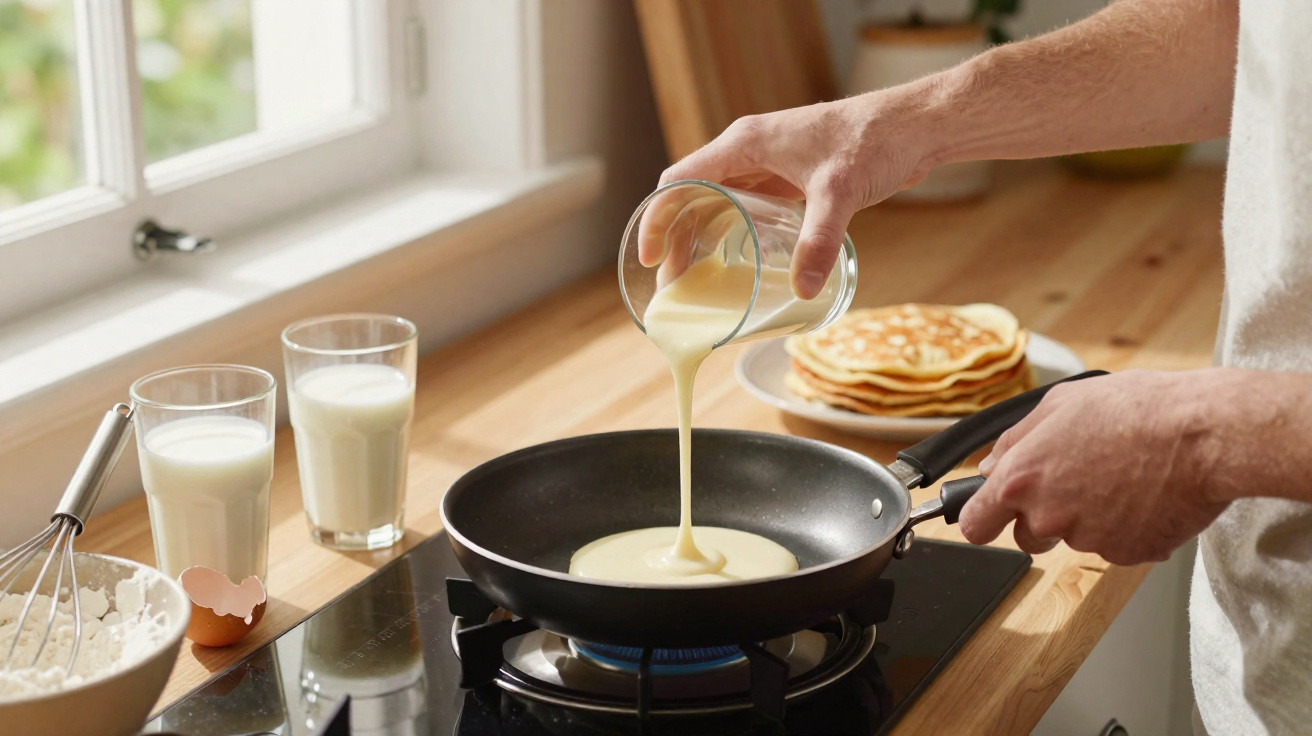
For anyone who has struggled with kitchen scales, misinterpreted a measuring jug or ended up with a batter full of lumps, a French-inspired shortcut is attracting notice. It delivers soft, pliable crêpes with only an ordinary glass and a number sequence simple enough to recall on holiday, at a friend's house or in a compact rental kitchen.
The crêpe craving problem: no scale, no measuring jug
A late-night urge for crêpes can often be stopped by one familiar issue: a lack of equipment. There may be no digital scales, no graduated jug and, occasionally, no reliable recipe either. As a result, many cooks estimate ingredients, adding milk by the splash and flour by the spoonful, then simply hoping it works.
That can produce highly inconsistent results: batter that is so thick it lies heavily in the pan, or so thin that it flows like water and breaks the moment you turn it. The 1-2-2-2 method is designed to remove that uncertainty by making a common household object the sole measuring unit.
With the 1-2-2-2 rule, one medium glass becomes your all-purpose measure for crêpes, wherever you are.
The idea follows the principle of the traditional French yoghurt cake, in which the yoghurt pot serves as the measuring vessel. In this version, a glass takes its place. Provided that the very same glass is used throughout, the proportions remain consistent and the batter stays dependable.
The 1-2-2-2 method: how it actually works
The 1-2-2-2 rule is not a secret formula; the numbers set out the complete recipe:
- 1 glass of flour
- 2 eggs
- 2 glasses of milk
- 2 tablespoons of oil
The glass is central to the method. Use it to portion the flour, then use it again to measure the milk. Only the eggs and oil are measured separately. This creates a smooth, pourable batter for thin, supple crêpes that can be folded without splitting.
From glass to pan: step-by-step
After measuring the ingredients, the technique is nearly as important as the proportions. These simple steps help ensure the batter is smooth and straightforward to cook:
- Sift the flour into a large mixing bowl first.
- Form a well in the middle, then break in the 2 eggs.
- Start whisking before slowly adding the 2 glasses of milk in small amounts.
- Whisk briskly until the lumps have disappeared.
- Stir in the 2 tablespoons of oil until the mixture is smooth and shiny.
- Leave the batter to stand at room temperature for around 1 hour.
That resting hour allows the flour to hydrate fully, giving a supple, cohesive batter that spreads thinly without tearing.
Once you are ready to cook, warm a lightly buttered frying pan over a medium-high heat. Add a small ladleful of batter and swiftly tilt the pan to spread it into a very thin coating, then cook for 1 to 2 minutes per side. The finished crêpe should be tender with pale golden spots, rather than dry and crisp.
Why the 1-2-2-2 balance leads to reliable crêpes
Although it looks simple, the recipe uses a sensibly balanced combination. Every ingredient has a distinct purpose, while the quantities prevent any one of them from taking over.
| Ingredient | Role in the batter |
|---|---|
| Flour (1 glass) | Creates structure and, once hydrated, a thin and flexible foundation. |
| Eggs (2) | Hold the batter together and supply sufficient protein for elasticity. |
| Milk (2 glasses) | Regulates the consistency and produces a batter that pours easily. |
| Oil (2 tablespoons) | Reduces sticking and helps the crêpes stay soft instead of becoming dry. |
The crucial proportion is one glass of flour to twice as much milk. An excess of flour makes the batter dense and produces firm pancakes instead of delicate, lace-like crêpes. Too much milk, meanwhile, leaves it unable to stay in place in the pan and likely to tear during turning. The 1:2 ratio keeps it between those extremes.
Resting completes the process. The flour needs time to take in all the liquid. Over that hour, the batter settles, bubbles of air disperse and the gluten loosens slightly. The result is a smooth, “coating” consistency: batter should fall in a ribbon from a lifted ladle and leave a light film on it.
Fine-tuning on the fly
No two kitchens are exactly alike. Glasses come in different sizes, eggs vary in size and flours do not all absorb liquid in the same way. The 1-2-2-2 formula remains effective, but one or two small corrections can keep the batter right.
- If the batter seems overly thick as you tilt the pan, whisk in a splash of milk.
- If it is nearly as liquid as water, mix in a little flour using that same glass.
- Treat the first crêpe as a trial: assess its colour, texture and thickness, then make adjustments.
The first crêpe becomes your rehearsal: taste it, adjust the batter, and the rest of the batch benefits.
A properly heated pan also does much of the work. In a pan that is not hot enough, the batter will sit and stick. In one that is fiercely hot, the crêpe colours too quickly and loses moisture. Look for a gentle sizzle as the batter hits the pan, applying only a thin brushing of fat before each crêpe or every other one.
Which glass should you use, and does size matter?
The comforting feature of this technique is how adaptable it is. There is no need for one particular or “official” glass. Any medium-sized household glass will do, so long as you use it consistently from beginning to end.
There is only one essential principle: one recipe, one measure. If you begin with a small tumbler, use it for both the flour and milk. This makes a smaller batch, suitable for two or three people. Choose a large water glass instead and you can serve a small group without working out new quantities.
For larger groups, simply repeat the sequence: 2-4-4-4, 3-6-6-6 and so forth, always retaining the same ingredient relationships. There are no conversion tables or calculations to manage.
Sweet, savoury, and everything in between
The standard 1-2-2-2 batter has no sugar in it, making it particularly adaptable. Take it in a sweet direction with fillings or toppings such as jam, chocolate spread, caramelised apples or citrus zest; alternatively, make it savoury with ham, cheese, mushrooms or wilted spinach.
For a gently sweeter result, add one or two spoonfuls of sugar to the batter without changing the fundamental balance. Many French home cooks also add flavour with vanilla extract, orange blossom water, rum or a little finely grated lemon zest.
The same neutral batter can host breakfast crêpes, late-night Nutella rolls, or cheese-stuffed galettes, depending only on what you add.
Useful tips, from gluten to storage
Two technical terms frequently arise when making thin batters: gluten and hydration. Wheat flour contains proteins which create gluten when they are combined with liquid and mixed. For crêpes, you need enough gluten for flexibility so the crêpe can bend without cracking, but not enough for a tough, rubbery texture.
Vigorous whisking at the outset helps remove lumps, although there is no benefit in beating the mixture endlessly. When it is smooth, allow resting and hydration to do the remaining work. The 1-hour rest gives the gluten structure time to settle gently rather than becoming tight through continual whisking.
Storing the batter can also be useful. A prepared 1-2-2-2 batter will keep in the fridge for about 24 hours. It may need another whisk before cooking because the flour often settles at the bottom. Should it become thicker overnight, a small dash of milk will generally restore its light, flowing consistency.
Practical scenarios: from tiny flat to holiday rental
Imagine a cramped student kitchen containing unmatched mugs, one frying pan and no measuring equipment. Under the 1-2-2-2 rule, a single mug becomes the measure, while an ordinary whisk or fork is all that is needed. In less than an hour, you can have a stack of crêpes that transforms leftover spreads and fruit into an inexpensive meal.
Or consider a winter break in a rented cottage. The kitchen drawer contains a few glasses, a pan and little more. You can still arrange a Crêpe Night for friends: measure the flour and milk with one glass, find a bowl and trust the familiar ratio. The method is far easier to take with you than kitchen scales.
For families, the rule can serve as a teaching aid too. Children can learn “1 glass of flour, 2 eggs, 2 glasses of milk, 2 spoons of oil” and join in with the preparation. It makes a potentially daunting French staple into a shared weekend tradition, without repeatedly consulting recipes.

















Comments
No comments yet. Be the first to comment!
Leave a Comment