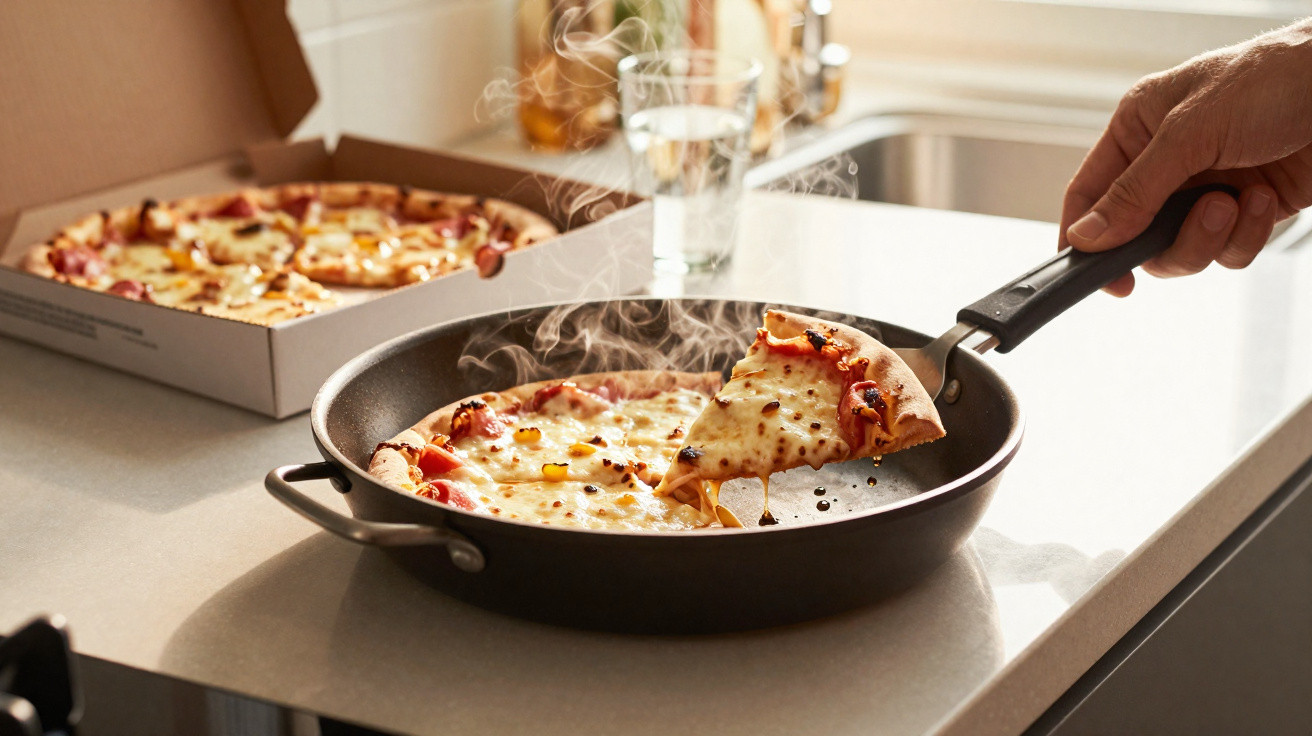
Last night, at 11.47 pm, I was in my kitchen looking at three cold pizza slices in their cardboard box. The cheese had taken on that waxy, set appearance that is mildly heartbreaking. The base resembled cardboard and, truthfully, I was moments away from eating it cold like a complete barbarian. We have all faced it: yesterday’s flawless slice becoming today’s underwhelming leftover.
Then I recalled something Maria, my Italian neighbour, had told me months earlier: reheat pizza using only a frying pan and a tiny amount of water. It seemed far too straightforward to actually work.
Why Most Pizza Reheating Methods Let You Down
Let’s be direct: the microwave is pizza’s greatest enemy. Within around thirty seconds, it makes the base rubbery and leaves the cheese with the same unpleasant texture. What remains barely resembles the glorious slice you originally enjoyed.
The oven is certainly an improvement, but it takes ages to heat up and can leave the toppings dry, while the crust becomes either overly hard or strangely chewy. Last week, my friend Jake reheated four slices in his oven and produced something resembling pizza-flavoured crackers. That was hardly the comforting meal he had hoped for.
The central issue is controlling moisture. Fresh pizza delivers an ideal contrast: a crisp base, melted cheese and toppings that have not shrivelled into rather miserable little scraps. Most reheating approaches either introduce excessive moisture-hello, soggy microwave pizza-or remove it entirely-goodbye, oven-dried disaster.
The Pan Method for Reheating Pizza That Changes Everything
This is where it gets clever: take an ordinary skillet or frying pan, then put your cold pizza slices in it without oil or butter. Set the hob to medium-low heat-this is essential, as a high temperature burns the base before the topping has warmed through. Leave the slices for roughly two minutes.
Next comes the key detail that many people get wrong: place exactly three to four drops of water in an empty area of the pan, never directly on the pizza. Do not overdo it-we mean drops, not a splash. I have watched people use far too much water and steam their pizza into a soft mess.
“The steam creates this beautiful little microenvironment that gently warms the toppings while the direct heat crisps up the bottom,” explains chef Roberto Mendez from Brooklyn’s famous Tony’s Pizza. “It’s basically recreating the conditions of a pizza oven at home.”
Here is the process in order:
- Put cold pizza in a dry pan over medium-low heat
- Leave it for two minutes so the base begins to crisp
- Add 3-4 water drops to an empty area of the pan
- Immediately cover the pan with a lid
- Wait another 2-3 minutes, then check and serve
When Pizza Tastes Like Pizza Once More
The first time you get this method right, you may well break into a small celebratory dance in the kitchen. There is that pleasing crunch as you bite through the base, followed by properly melted cheese and toppings that seem freshly removed from the oven-it is genuinely rather magical. Your leftover pizza is not merely tasty; it feels intentional again.
In truth, nobody tends to plan their leftover pizza approach ahead of time. Once you have learned this technique, though, you may start anticipating Day Two pizza rather than dreading it. Some people even say it surpasses the original, although that may be taking things a little too far.
| Key point | Detail | Value for the reader |
|---|---|---|
| Water placement | 3-4 drops in empty pan space, never on pizza | Prevents soggy crust while creating steam |
| Heat level | Medium-low throughout entire process | Crispy bottom without burning |
| Timing | 2 minutes uncovered, 2-3 minutes covered | Perfect texture balance every time |

















Comments
No comments yet. Be the first to comment!
Leave a Comment