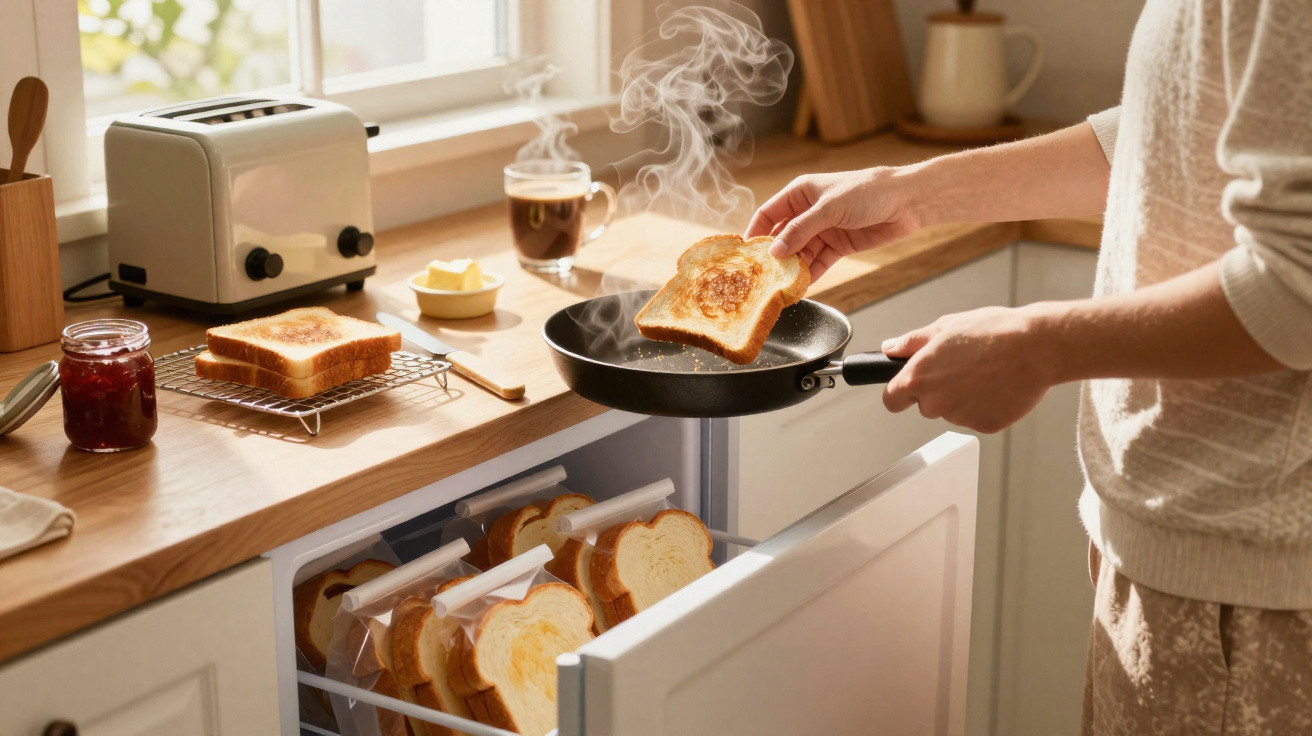
The other evening, barefoot in a silent kitchen, I was trying to prise apart two slices of frozen bread fused together like blocks of ice. The toaster was heating up, my tea was going cold, and I was wrestling with a frosty pile of supermarket bread, wondering how making toast had become a small workout. The slices went from solidly frozen to burnt around the edges while remaining barely warm at the centre. It was still edible, technically, but nowhere near the reassuring crunch I had been after.
Then, during a phone call, a friend said something that made me stop: “You know freezing sliced bread can totally change how it toasts, right?”
I had assumed I knew every freezer trick.
Apparently, I did not.
What freezing really does to sliced bread
Look inside the freezer in almost any hectic home and you are likely to see it: a tilted packet of sliced bread in plastic wrapping, squeezed between a bag of peas and a half-eaten tub of ice cream. Freezing it feels like a modest win against food waste. No mould, no stale loaf abandoned on the worktop, and toast whenever you want it.
But when those pale, icy slices go into the toaster, the result often seems slightly wrong. The crust may turn crisp while the middle stays strangely chewy. Alternatively, the outside can brown quickly even though the centre remains cold. You eat it anyway because it is breakfast, after all. Yet you know the toast could have been much better.
Remember the last time you took a slice directly from the freezer, put it in the toaster and left it to do its thing. Perhaps you ran it through an extra cycle or turned the dial up, assuming frozen bread simply “needs more time”. It often emerges too pale, so you put it back in. Then, in moments, it changes from underdone to “how is it already this dark?”
One UK survey found that households throw away the equivalent of millions of loaves every year, with bread at the top of the list of foods most often discarded at home. That is one reason freezing it can feel so sensible. Even so, many frozen slices still go in the bin because their texture is unpleasant or the toast tastes stale, despite being technically fresh.
The overlooked reality is that freezing does not simply pause a loaf’s ageing process. Within every slice, water molecules move, expand and become ice crystals. Those crystals can harm the structure of the crumb, particularly in soft, pre-sliced sandwich bread. If you move it straight from the freezer into strong heat, the exterior dries rapidly while the inside tries to defrost and release its moisture. That imbalance produces toast that is crisp on the outside but oddly rubbery or tough within. That distinctive “freezer toast” flavour is not in your imagination - it is real.
How to freeze sliced bread and revive it for better toast
One small routine can make a considerable difference: preparing sliced bread properly before it ever goes into the freezer. First, stop the slices freezing into one solid mass. Place them flat on a plate or tray for an hour, allowing each slice to chill separately. Afterwards, restack them, leaving a little room between them or placing a strip of baking parchment between every few slices, then put the stack into a freezer bag. Remove as much air as possible before sealing it.
When you are ready to make toast, take out only the number of slices you need. Leave them on the worktop for a few minutes, just long enough for the frost on the surface to vanish. Toast them at a slightly lower setting than fresh bread, but for a little longer. This lets the middle heat through and dry gradually rather than being hit with an abrupt blast of heat.
Many of us simply put the opened bread bag straight into the freezer, fasten it with a clip and consider the job done. We have all had that tired 11 p.m. moment when the only aim is “don’t let this loaf die by tomorrow”. The issue is that the thin bag it came in was not made for long-term freezing. Air gets inside, frost forms, and the bread begins drying out before it even reaches the toaster. Then the toaster, or the bread brand, gets the blame.
Realistically, hardly anyone will do this flawlessly every day. You are not going to date-label every batch and vacuum-seal each slice like a food laboratory technician. Still, one extra minute of attention - forcing out surplus air, closing the bag securely and avoiding pressing the bread against the freezer wall - will often protect the crumb from freezer burn and that disappointing cardboard-like taste.
“People think freezing ruins bread,” a baker once told me, leaning on the counter dusted with flour. “Freezing doesn’t ruin it. Bad freezing ruins it. And bad toasting finishes the job.”
Freeze quickly, but do not keep it indefinitely
For the best toast, try to use frozen sliced bread within 1–3 months. After that, its flavour and texture gradually decline, even though it may still be safe to eat.Keep air away from the slices
Choose a proper freezer bag or put the loaf into two bags. Press out the air before sealing and avoid storing the bread in the frostiest areas of the freezer.Change your toaster settings
Reduce the heat slightly and give it longer. If your toaster has a “frozen” setting, it is not a gimmick - it simply adjusts the time-and-heat balance that frozen bread needs.Avoid overfilling the toaster
Toasting two slices at once gives a more even result than forcing in four when you are in a hurry. The heating elements can only handle so much at one time.Toast bread when it is chilled, not icy
Let slices stand briefly on the worktop. That tiny amount of thawing can prevent burnt crusts and cold, damp centres.
A small change to your breakfast routine
Consider how often toast quietly supports your day: a quick breakfast before commuting, a late-night snack when the fridge is nearly empty, or a slice handed to a child as you hurry out of the door. Frozen sliced bread is a small safety net in the freezer, reassuring you that you are never entirely out of options.
Improving the way you freeze and toast it is not about getting everything perfect. It is about rescuing a small daily comfort from being merely average. When the bread browns evenly, butter melts into it rather than sliding across a dry, charred surface. The crust breaks with a light crackle rather than turning chewy like rubber. They are minor details, but they can affect the feel of a morning more than we tend to acknowledge.
There is a discreet environmental benefit sitting inside the toaster slot too. Freezing and toasting more effectively means fewer slices are thrown away for being “not quite right”. It can also mean fewer urgent trips to buy another loaf, only for half of it to spoil on the worktop. One household will not transform global food-waste figures overnight, but the difference can still feel real: less guilt and more purpose.
The next time you reach into that frosty bag for your usual rushed slice, you may stop for a moment. You might separate a small stack to make it easier to take out, press out the air or turn the toaster dial down by one notch. Perhaps you will notice the improvement and mention it to someone else. That is how small domestic revolutions begin: in quiet kitchens, one slice of toast at a time.
| Key point | Detail | Value for the reader |
|---|---|---|
| Freezing changes bread’s structure | Ice crystals harm the crumb and gradually dry out the slices | Explains why frozen bread often toasts unevenly or has an “off” taste |
| Good preparation beats poor freezing | Separate slices, remove air, use freezer bags and avoid storing it for too long | Offers simple habits that keep frozen bread closer to fresh quality |
| Adapt the way you toast | Briefly thaw it, use lower heat, allow more time and do not overfill the toaster | Creates better texture and flavour while wasting fewer slices |

















Comments
No comments yet. Be the first to comment!
Leave a Comment