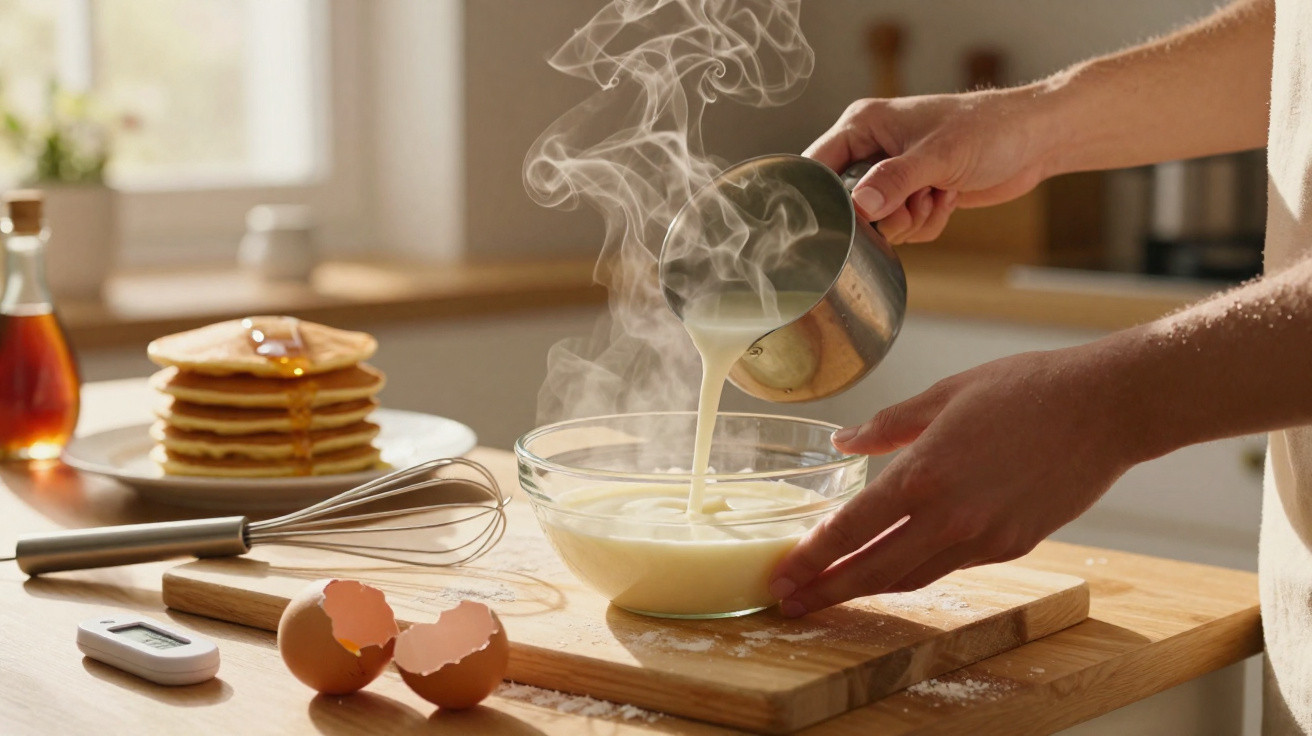
Sunday morning: the frying pan is warming up, your coffee is going cold too quickly, and the pancake batter does not look right. It is slightly too thick, rather lumpy, and the first pancake somehow always turns out rubbery, like a disappointing coaster. You have followed the recipe, whisked furiously and even invested in a posh non-stick pan. Yet you still cannot achieve that soft, cloud-like texture all over Instagram.
Then, almost accidentally, you add milk that has just been warmed for coffee. The mixture immediately becomes silkier and looser. The flour absorbs the liquid, with no stubborn dry pockets left behind. The pancakes rise, brown well and remain tender.
The ingredients are unchanged. So is the recipe. Only the temperature has shifted slightly.
And breakfast is completely different.
Why slightly warm milk transforms pancake batter
Consider what happens when cold milk from the fridge goes straight into flour and eggs. The fat begins to firm, melted butter starts to seize around the sides, and the mixture resists as you stir. Streaks and little cold lumps appear. That just-mixed appearance never quite disappears, even when you whisk until your arm aches.
Use lukewarm milk instead: not steaming or scalding, but gently warm when touched. The batter comes together more quickly, and the whisk moves smoothly rather than dragging. It is almost possible to watch the flour soften as it takes in the liquid. The change may seem minor in the bowl, but it is clear once the pancakes reach the plate.
Imagine two pancake batches at a family brunch. They use the same flour, sugar and eggs. For one bowl, somebody adds milk cold from the carton. For the other, a cousin who previously worked in a café discreetly heats the milk in the microwave for 20–30 seconds before combining everything.
The first batch is acceptable: slightly tough around the edges, pale in places and full of uneven bubbles. Everyone eats them. The second batch, however, rises more uniformly and feels almost as soft as cake when cut with a fork. People automatically go back for another. Nobody reveals the trick; they simply notice that the pancakes taste more “professional” without understanding the reason.
There is a practical explanation for that tender result. Milk that is slightly warm dissolves the sugar and salt more evenly, distributing flavour through each mouthful. It also keeps melted butter liquid, rather than allowing it to form tiny chilled pieces that are difficult to incorporate. When the liquid is not icy, the flour’s starches hydrate more completely, producing a smoother, more unified batter.
That improved hydration creates a tender crumb rather than a chewy one. The tiny air bubbles made during whisking can move more freely through a warm, fluid mixture, helping the pancakes rise more consistently in the pan. Ultimately, this small adjustment in temperature gently changes the entire structure of the pancakes.
The right way to warm milk for fluffier pancakes
No thermometer or barista-standard technique is required. Pour the milk into a mug or small jug, then microwave it for 20–30 seconds. Swirl it and test it with a clean finger. It should feel pleasantly warm, similar to fresh bathwater, rather than like hot chocolate.
If you would rather use the hob, heat the milk gently over a low heat and keep a close eye on it. Remove the pan as soon as you notice the faintest trace of steam, long before it begins to simmer. If it seems overly hot, leave it for a minute. That mild warmth is all that is needed to encourage the flour, eggs and fat to work together rather than oppose one another.
Many home cooks fall into one particular trap: heating the milk too much. If it is too hot, the eggs may scramble as soon as they enter the bowl. Tiny pieces of cooked egg hardly suggest a “luxury brunch”. They suggest an “omelet accident”.
Most of us have experienced that moment when pancake batter suddenly smells more like failed custard than pancakes. When it happens, simply allow the milk to cool further next time, until it is only slightly warm. Think of the temperature of a baby bottle against your wrist. That gentle warmth is the ideal point. The batter should feel lively, not shocked.
“Once I started using warm milk in the café, our pancake complaints disappeared overnight,” says a brunch chef I interviewed last year. “People kept asking if we’d changed the recipe. We hadn’t. We’d just changed the temperature.”
- Warm, not hot: Choose milk that feels comfortably warm to the touch, never hot enough to produce heavy steam or burn your finger.
- Add it gradually: Introduce the milk in stages as you whisk, allowing the batter to loosen evenly and the lumps to disperse more easily.
- Combine fats wisely: Stir melted butter or oil into the warm milk before it goes into the dry ingredients, keeping the mixture silky.
- Rest the batter: Leave it for 5–10 minutes once mixed, giving the warm liquid time to hydrate the flour fully.
- Don’t overwhisk: Stop when the flour has been incorporated. A few very small lumps are fine and help preserve a tender texture.
Rethinking all those “little” details in pancake recipes
Once you have seen how warm milk affects pancake batter, other small kitchen routines may start to seem worth questioning. Are the eggs ice-cold while the pan is smoking? Has the butter become half-solid before it reaches the bowl? Do you move the batter straight from whisk to pan without allowing it time to settle and breathe?
In truth, hardly anyone manages this every day. Most mornings are about being quick, children asking where their socks are and somebody shouting that they are late. But on those occasional mornings when you slow down, warm the milk, crack the eggs with care and give the batter a few peaceful minutes, the pancakes nearly always repay the effort.
| Key point | Detail | Value for the reader |
|---|---|---|
| Use slightly warm milk | Warm milk only until it feels just warm to the touch, never hot or boiling | Smoother batter, improved hydration and softer pancakes |
| Mix warm milk with fats first | Combine melted butter or oil with the warm milk before adding it to dry ingredients | Stops fat from seizing and creates a more even, silky texture |
| Rest the batter briefly | Leave the warmed batter for 5–10 minutes before cooking | Enhances structure and produces fluffier, more consistent pancakes |

















Comments
No comments yet. Be the first to comment!
Leave a Comment