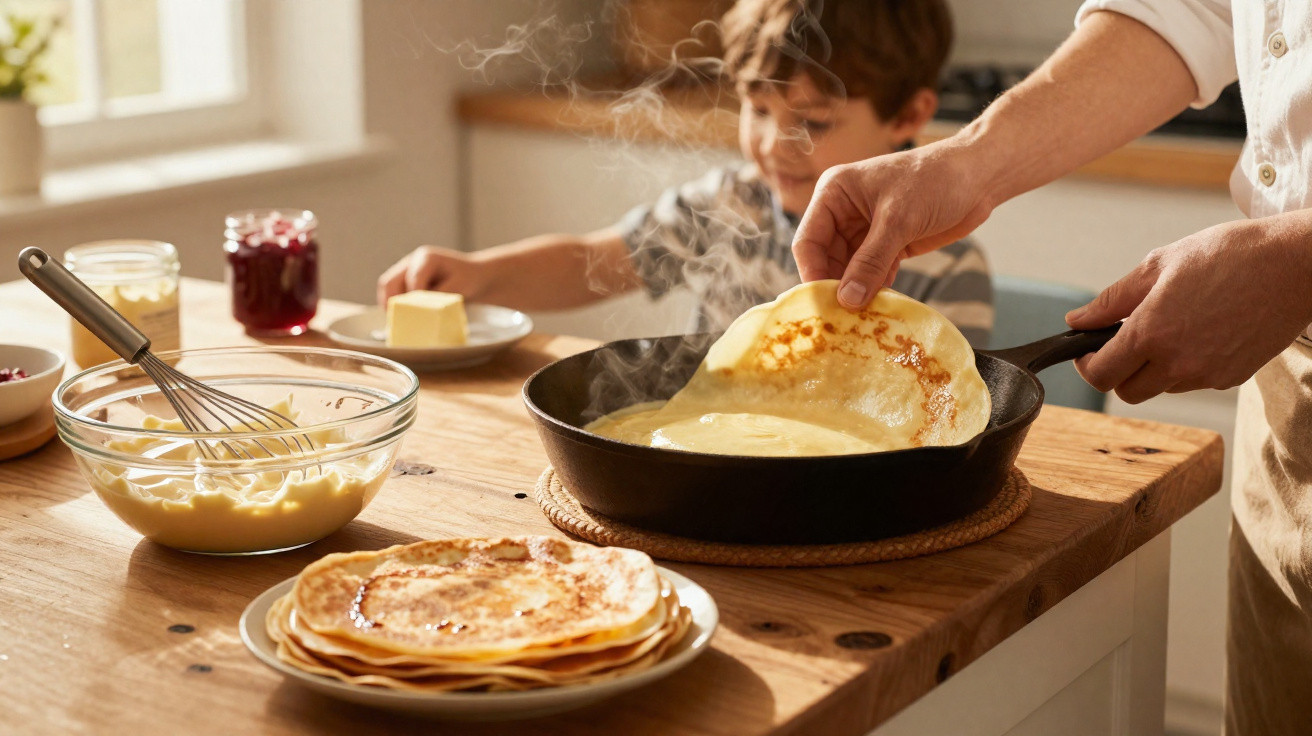
In France, countless home cooks believe they have mastered the perfect crêpe - until a professional quietly shows them otherwise.
Across the Channel, an experienced crêpe maker has revealed one small detail that transforms the texture, keeping crêpes tender rather than dry and leathery. The surprise lies not so much in what he does at the pan, but in what he absolutely will not do.
The French crêpe obsession, far beyond February
In France, crêpes are not reserved for Candlemas at the beginning of February. They appear at children’s birthday celebrations, as late-night treats, at Sunday brunch and, frankly, whenever a carton of eggs is nearing its use-by date. The process is straightforward: a bowl, flour, eggs, milk and a hot pan on the hob.
Their popularity is partly social. Crêpes travel around the table, are folded, rolled or filled, and are eaten with either fingers or cutlery. They turn inexpensive, everyday ingredients into something adaptable, with toppings ranging from sugar, lemon and jam to chocolate spread, caramel, fruit, honey and maple syrup.
Achieving the soft, silky texture served by professionals at markets and Breton crêperies, however, is less straightforward. Home cooks commonly contend with lumpy batter, unevenly thick crêpes and crêpes that become chewy as they cool.
The usual mistakes before the pan even heats up
Professionals understand that a crêpe can succeed or fail before it reaches the hot plate. Everything begins with the batter:
- Lumpy flour: leaving out the sieve increases the chance of lumps.
- Milk added too fast: adding all the milk in one go makes the mixture harder to combine.
- Wrong consistency: overly thick batter produces heavy crêpes, while overly thin batter makes them delicate and prone to tearing.
French cooks frequently describe the ideal batter as having the consistency of “fluid cream”: it should flow readily while still covering the back of a spoon. Many leave it to rest for at least 30 minutes, allowing the flour to hydrate properly. This helps produce a softer result and stops crêpes from tearing in the pan.
Meet the crêpe master who refuses to flip
In Seine-Maritime in northern France, professional crêpe maker Nicolas Le Breton has worked on a bilig, a traditional crêpe griddle, for more than twenty years. During a recent television feature, he explained the method he believes ensures a perfectly soft crêpe.
His rule is blunt: never flip the crêpe. He cooks it on one side only.
For families used to throwing crêpes high into the air, this challenges a habit built over decades. Le Breton maintains that turning a crêpe puts it at risk of drying out. The second side becomes tougher, the edges turn crisp, and the moisture that keeps the centre tender escapes faster.
Unilateral cooking, from fish to crêpes
Le Breton adapts a technique used in refined fish cookery: “unilateral” cooking. A delicate fish fillet is often cooked solely on its skin side, allowing heat to travel softly through the flesh without the upper surface touching the pan. He uses the same principle for crêpes.
He spreads the batter in a thin layer over the heated plate. While it cooks, the upper surface gradually dries and turns matte, yet never comes into contact with the metal. Only the underside takes on colour. Just before removing the crêpe, he dusts its surface with sugar, then quickly folds it into a tidy triangle in one skilled movement with the spatula.
The crêpe leaves the heat with a golden base, a tender top, and just-melted sugar trapped inside the folds.
Why not flipping keeps crêpes soft
Technically, his explanation is simple. Flipping a crêpe exposes both surfaces to direct heat, even if only briefly. This accelerates moisture loss from the batter. With less moisture, the texture becomes firmer and can sometimes turn rubbery. Anyone who has eaten a reheated leftover crêpe will recognise the sensation.
Cooking on one side lets the underside brown and develop flavour, while steam rising from the batter finishes the top. The interior remains moist, and although the edge sets, it does not become brittle.
The technique can also work for home cooks using an ordinary frying pan instead of a professional griddle, as long as they follow a few conditions:
- Choose medium heat instead of intense heat.
- Use only a light coating of fat, so the crêpe releases without ripping.
- Do not fold until the top appears dry and the edges start lifting.
What this means for Candlemas flipping traditions
On 2 February each year, many French households celebrate Candlemas by tossing a crêpe with one hand while holding a coin in the other, a custom believed to bring prosperity. To them, Le Breton’s recommendation may sound close to sacrilege.
The superstition and the new technique need not conflict, however. Families could retain the flipping ceremony for the first crêpe, accepting that it may be a little drier, then use unilateral cooking for every crêpe that follows. The symbolic toss remains, while the later plates gain the softer texture.
A step-by-step method to try at home
For anyone wishing to use this professional tip in a home kitchen, the method is easy to set out:
- Make a smooth, fluid batter and, ideally, leave it to rest for at least 30 minutes.
- Warm a non-stick frying pan over medium heat, then grease it very sparingly.
- Add a ladleful of batter and swirl the pan to create a thin, even coating.
- Observe the surface: bubbles should form before the glossy finish disappears.
- When the top appears set and the edges rise a little, add a light line of sugar.
- While the crêpe remains in the pan, fold it in half and then into quarters.
- Transfer it to a plate and serve at once, or pile it beneath a clean cloth to keep it warm.
The key moment is resisting the urge to flip. Patience at the pan pays off on the plate.
Different toppings, different textures
Le Breton’s unilateral technique is especially suited to sweet crêpes, because sugar melts into the warm surface to create a light syrup. It can suit alternative fillings as well, provided they do not need strong heat.
| Style | Best fillings | Cooking advice |
|---|---|---|
| Unilateral, soft | Sugar, lemon, jam, chocolate spread, honey | Add toppings near the end, fold quickly. |
| Classic, flipped | Ham, cheese, egg, sautéed vegetables | Flip once to cook both sides and melt cheese fully. |
| Reheated | Already-cooked plain crêpes | Warm briefly in a covered pan to keep them soft. |
Savoury crêpes filled generously with cheese and ham usually require turning so that the fillings cook correctly. In these instances, a slightly firmer crêpe can be useful because it holds the ingredients in place. For soft crêpes intended as desserts, though, the one-sided approach creates a gentler texture.
Why professionals care so much about texture
In areas such as Brittany and Normandy, making crêpes is a craft. The contrast between a crêpe that folds like silk and one that splits at the first bend may determine whether a customer returns. For professionals, managing texture matters as much as managing flavour.
Texture also changes how fillings perform. Sugar or melted chocolate can sink slightly into an exceptionally soft crêpe, forming pockets of flavour. On a dry crêpe, spreads are more likely to remain on the surface and cool rapidly. Even with identical ingredients, the mouthfeel is different.
Trying the pro technique with kids and guests
For home cooks, Le Breton’s approach provides a simple experiment for a future weekend brunch. Make two batches: flip one batch and cook the other unilaterally. Offer both without identifying them to friends or children, then ask which seems softer and more enjoyable.
This modest comparison often demonstrates just how important heat control is in a basic recipe. It can also help children see cooking as a blend of chemistry, tradition and personal preference rather than a set of unchanging rules.
When unilateral cooking might not be ideal
There are some occasions when the no-flip method may disappoint. With very low-powered electric hobs, the underside might not brown sufficiently before the upper surface has set, producing a pale crêpe with a slightly bland flavour. A short, gentle turn to colour the other side can still help in that situation.
Thicker batters, such as those used for American-style pancakes, are not appropriate for unilateral cooking either. They require heat on both sides to prevent uncooked centres. By comparison, the French crêpe is thin enough for steam to move through it without exposing the top to too much heat.
From crêpes to other soft bakes
The principle behind Le Breton’s advice - shielding the upper surface from direct heat to preserve moisture - can be applied to other recipes. Cooks already cover cakes with foil when they brown too quickly, or steam buns to keep them soft. Unilateral cooking is simply that same instinct used with a very thin batter.
People who like preparing flatbreads, tortillas or particular varieties of omelette can experiment with similar ideas: moderating the heat, reducing flipping and allowing steam to complete the cooking. The outcome is often similar: a softer bite and a more forgiving texture, achieved not by adding ingredients but by changing how the pan is used.

















Comments
No comments yet. Be the first to comment!
Leave a Comment