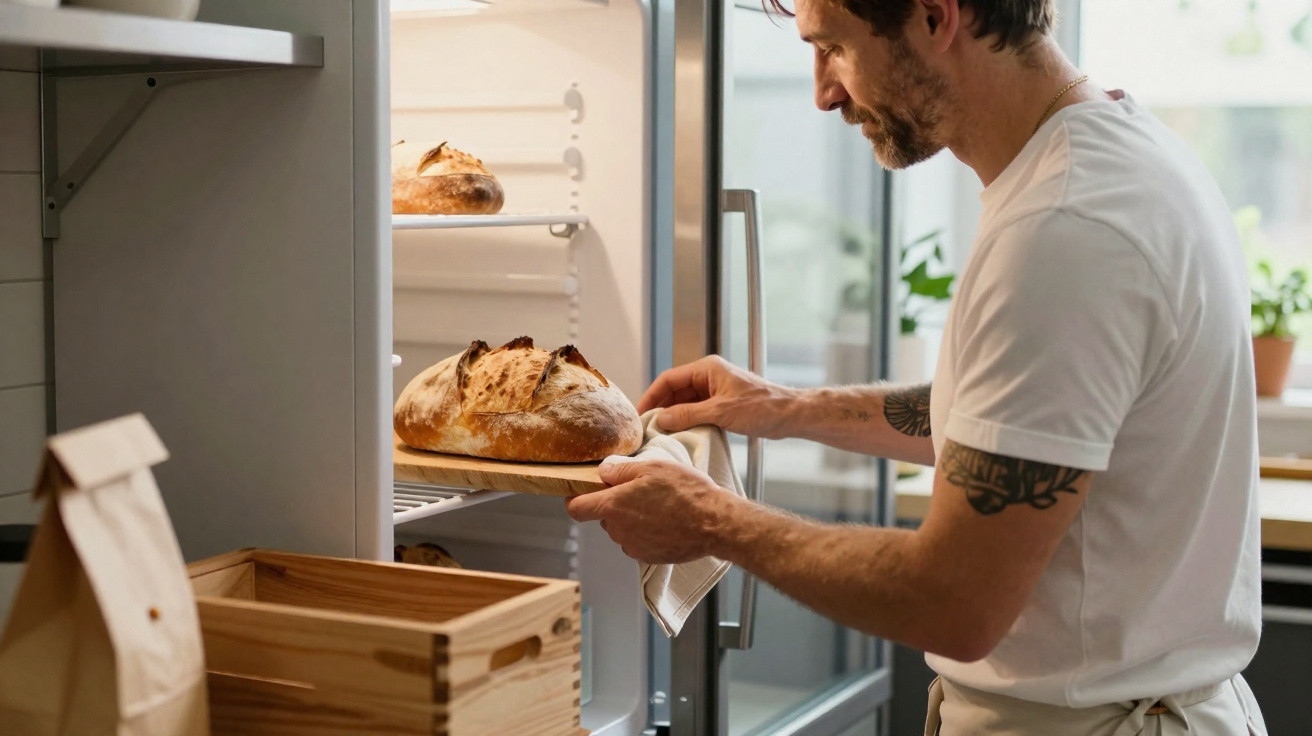
In French chef Norbert Tarayre’s home kitchen, bread appears to stay fresh far longer than it does in many of ours.
The place he keeps it may come as a surprise.
Known for his booming laugh and no-nonsense manner, the television chef follows a highly particular bread-storage routine at home. It contradicts much of the advice given by bakers, but he insists it keeps loaves fresh for several extra days.
Why bread becomes rock hard after only a few days
Anyone who has bought a fresh baguette will know the frustration. Within two or three days, its crust can become hard while the crumb turns cardboard-like. This is not simply down to poor luck or “cheap bread”: it is straightforward food science.
A number of things determine how long bread remains enjoyable to eat:
- Type of flour: White loaves generally lose moisture more quickly than wholemeal or multigrain bread.
- Leavening: Sourdough often lasts better than bread made solely with commercial yeast.
- Shape and size: A substantial round loaf retains its moisture longer than a slim baguette.
Each of these factors affects the rate at which the starch in bread recrystallises, making the crumb dry and firm. Recipes can help bakers delay the process to some extent, but once a loaf has left the bakery, storage at home makes a major difference.
What bakers normally advise at home
Ask a traditional baker how bread should be stored and they are unlikely to suggest the fridge. Across France, the UK and the US, the standard recommendation is broadly the same.
Most artisans still swear by a bread box or a fabric bag, far away from the refrigerator.
Commonly “approved” ways to store it include:
- A wooden or metal bread bin kept on the worktop, shut but not airtight.
- A linen or cotton bread bag that shields the loaf from air while allowing it to breathe.
- Paper bags instead of plastic, helping to prevent moisture build-up and mould.
The aim is to shield bread from drying air currents without locking in excessive humidity. Bakers frequently caution that cold harms its texture by accelerating starch retrogradation. To many professionals, the refrigerator is almost bread’s greatest enemy.
Norbert Tarayre’s controversial bread fridge method
Norbert Tarayre, a former Top Chef contestant and well-known French television personality, takes precisely the opposite approach. In a recent Instagram post, he revealed that he always puts bread directly into the refrigerator.
He stores his bread in the fridge, tightly wrapped in cling film or sealed in a plastic bag, and keeps it up to a week.
He even anticipated that “people are going to be outraged” by the technique. Nevertheless, he stands by it. His reasoning is simple: while refrigeration may alter the starch structure, it also helps the crumb retain moisture.
The cling film or plastic bag seals in the loaf’s own humidity. Rather than allowing the water inside the bread to travel through the crust and escape into the air, it keeps much of that moisture enclosed. Tarayre says that, when he cuts the loaf several days later, it remains soft and damp in the middle instead of becoming dry and crumbly.
How long he keeps his bread
He says this routine substantially lengthens the useful life of an ordinary loaf.
“My bread, instead of lasting three or four days, can last a week,” explains the chef.
For busy households, or for those who only get to the bakery once a week, that additional lifespan is particularly attractive. It makes bread less of a daily purchase and more of a weekly essential.
The drawback: crusts need reviving
There is, however, a compromise. The humidity that prevents the crumb from drying out also softens the crust. Baguettes, bâtards and other loaves lose the crisp exterior that many people enjoy.
Tarayre is happy to accept this trade-off, but he adds a final stage before serving.
- He puts slices in the toaster for a few minutes.
- For larger pieces, he uses a hot oven.
- He also suggests an air fryer as a fast and effective alternative.
A brief burst of dry heat removes excess moisture from the surface and restores the crunch. Refrigerated storage leaves the centre soft, while the exterior gets its bite back.
A quick pass through the toaster or oven brings the crust back, turning limp bread into something close to fresh.
Fridge versus bread bin: what really happens
At the heart of the disagreement is a straightforward question: does dryness or cold spoil bread more quickly? Traditional guidance has placed considerable emphasis on avoiding low temperatures. Food scientists offer a more balanced perspective.
At room temperature, bread gradually gives up moisture to the air around it. That continues even when it is kept in a bread bin. The crumb becomes firmer and the flavour fades. In a fridge, the starch changes faster, potentially producing a dense, firm texture, yet wrapped loaves lose much less water.
For many people, bread with slightly changed starch but plenty of moisture is preferable to slices that are dry and crumbly. This may be why Tarayre’s approach performs well in everyday kitchens, despite conflicting with traditional training.
| Storage method | Main benefit | Main drawback |
|---|---|---|
| Bread box | Preserves crust, no condensation | Crumb still dries over a few days |
| Linen bag | Breathable, limits mould | Less protection in very dry homes |
| Fridge + plastic wrap | Keeps crumb moist for longer | Crust softens, flavour slightly muted |
Practical tips for trying his method
Anyone interested in following Tarayre’s method can use several straightforward steps.
- If the loaf is still warm, allow it to cool fully before wrapping it.
- Wrap it closely in cling film or place it in a securely sealed plastic bag.
- Keep it on a fridge shelf rather than in the door, where temperatures are more consistent.
- Cut only the amount you intend to eat, preventing the exposed surface from drying out.
- Warm it briefly before eating to revive its crust and aroma.
This technique works well for households that eat bread regularly, though not immediately. For a person living alone, a large loaf can remain usable for most of a week instead of becoming a kitchen weapon.
When freezing remains the better option
Refrigeration is not the sole choice. For anyone who eats bread only now and then, freezing is still the most reliable method. It nearly stops staling and significantly reduces mould growth.
Slices or portions can be frozen individually, then toasted straight from the freezer. This maintains a reasonable texture, particularly for everyday toast or sandwiches. Tarayre’s chilled-storage approach, on the other hand, is designed to extend “fresh-style” eating across a week.
Key terms: staling, moisture and mould risks
The term “staling” may be misleading. It does not merely mean “getting old”. In bread science, it chiefly describes starch molecules rearranging over time, forcing water out and making the crumb firmer. Manipulating heat and moisture can partly reverse this, which is why warming bread is so effective.
There is a compromise, however. Bread kept very moist, particularly in a warm setting, may be more likely to develop mould. The fridge has an additional advantage here: it retains water in the loaf while slowing the growth of mould spores. For people living in humid climates, this combination can be genuinely useful.
Choosing the right method for your bread habits
Different kitchens need different routines. Someone buying a baguette every evening may still favour a traditional cloth bag at room temperature. The bread is unlikely to be around long enough for storage to become an issue.
For households that buy bread twice a week, Tarayre’s refrigerated, wrapped approach can offer a useful middle ground. The crust requires refreshing when it is served, but the crumb remains agreeably soft and fewer neglected dry heels end up in the bin.

















Comments
No comments yet. Be the first to comment!
Leave a Comment