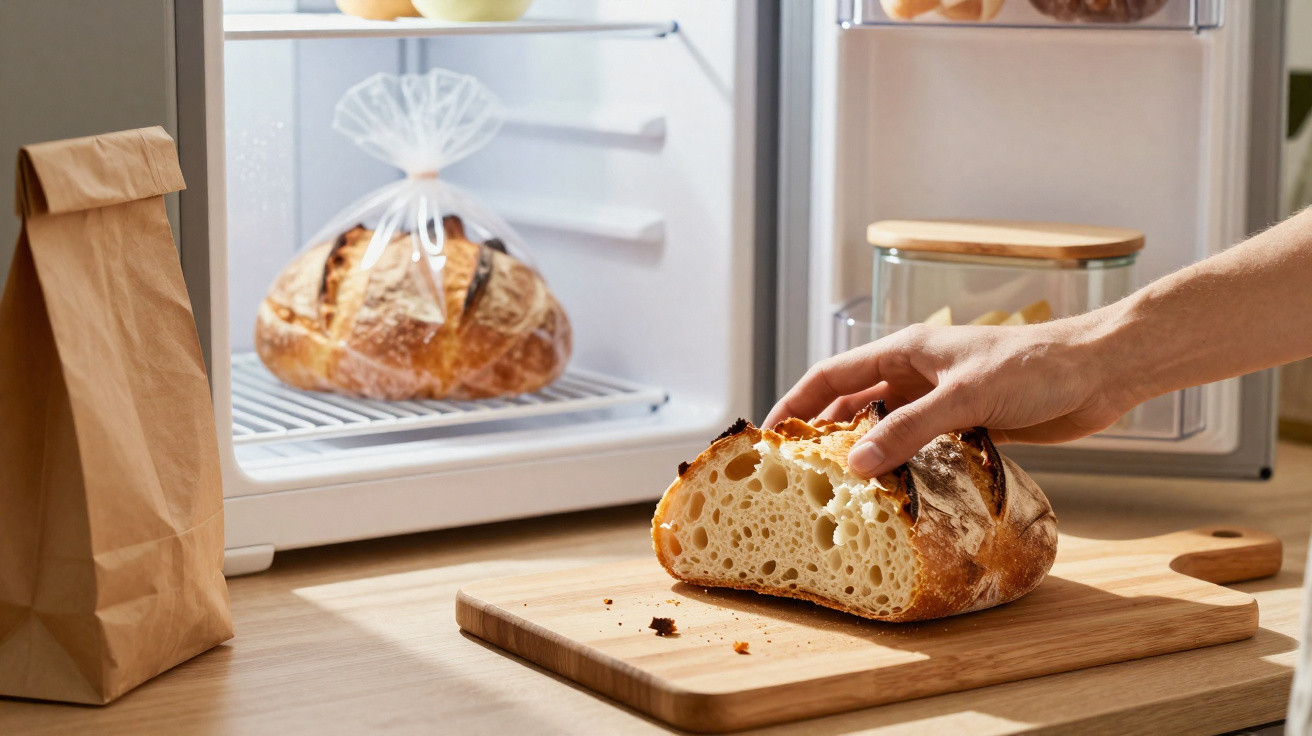
The loaf looks flawless as you place it on the chopping board.
A few hours in the fridge later, it is firm, dry and almost squeaks against your teeth. Leave that same loaf on the worktop and it somehow remains soft, even if its crust becomes slightly tougher. Oddly enough, the fridge is meant to “keep things fresh”. Bread does not follow that rule.
You may know that minor morning disappointment. You reach for yesterday’s sourdough, open the fridge with half-awake optimism… and find that cardboard-like texture. Toasting helps, in a way, but the enjoyment has vanished. It is as though the fridge has taken a day off your bread’s life.
But bakers, food scientists and probably your grandmother would all say the same: the fridge makes bread age before its time. There is no magic behind it.
Why your fridge turns bread stale in record time
Leave a fresh loaf on the kitchen worktop for a day and its character seems to shift before your eyes. In the morning, it is bouncy, aromatic and happily shedding crumbs. At lunchtime, it remains welcoming. By the end of the day, the crust has more chew, while the centre is still largely soft and yielding. Kept on the counter in a paper bag, a decent loaf can remain enjoyably edible for several days.
Put that identical loaf in the fridge instead, however, and the contrast is clear. Following one night at 4°C, each slice feels strangely stiff. It will bend, but it no longer springs back. Its aroma disappears more quickly too, as if the volume has been lowered on the wheat and yeast. You have not necessarily lost moisture in any dramatic sense. What disappears is the sensation of fresh bread.
This is the real explanation. Stale bread is not simply bread that has dried out; it is mainly the result of a gradual, subtle restructuring of starch molecules known as retrogradation. As bread cools after baking, its starches begin to recrystallise. This leaves the loaf firmer, more crumbly and drier in the mouth. Temperatures at fridge level accelerate that change dramatically. Freezing stops it, while room temperature allows it to progress slowly, but the fridge sits in the ideal range for starches to rapidly form a rigid structure. The loaf may still be technically “moist”, yet it tastes like chalk.
How to actually keep bread fresh (without babying it)
The easiest approach is surprisingly uncomplicated: room temperature, some air circulation and modest protection. Most loaves are best kept in a breathable covering, such as a paper bag or clean tea towel, on the worktop and away from direct sunlight or heat. This limits drying without creating the condensation that turns a crust rubbery. For preservative-filled supermarket sandwich bread, a loosely closed plastic bag at room temperature generally works well for a few days.
If you will not finish a loaf within two or three days, slice it before freezing. Put the slices in a freezer bag, squeeze out the excess air and freeze them flat. Then you can take only the amount you want and toast it straight from frozen. Once toasted, the texture is often nearer to “just baked” than that depressing slice made stale by the fridge. Ironically, bread is treated more kindly by freezing than by chilling.
We have all resorted to the “put the half-loaf in the fridge and deal with it later” method. Let’s be honest: nobody really does this every day. The issue is not so much laziness as routine. Many of us were raised to think that anything perishable automatically belongs in the fridge. Bread is the exception that proves the rule. If a hot, humid kitchen makes you genuinely concerned about mould, leave out a small amount and freeze the rest rather than subjecting the whole loaf to the cold.
“Bread hates the middle cold,” laughs one veteran baker I spoke to. “Room temperature, it ages. In the freezer, it sleeps. In the fridge, it dies fast.”
Keep this quick guide near your bread bin:
- Eating it within 2 days? Keep it at room temperature in paper or a cloth bag.
- Need bread for the week? Slice and freeze it, then toast or reheat it from frozen.
- Crusty loaf? Do not use sealed plastic bags; they hold in moisture and spoil the crust.
- Soft sandwich bread? A loose plastic bag on the worktop is suitable for a couple of days.
- Fridge? Reserve it for emergency mould control, and reconsider even then.
The strange life - and afterlife - of your daily bread
Consider what bread really contains: cooked grain, water, air and time. After leaving the oven, it does not merely “sit there”. It continues changing and shifting at a microscopic scale. Steam moves around, the crust softens and the crumb settles. Where you store the loaf determines how this quiet process unfolds. On the worktop, it matures like fruit. In the fridge, it jumps directly to “tired leftovers”.
There is an emotional side to this, too. Slicing into fresh bread on a good day can feel almost like a ritual. By contrast, picking up a hard, fridge-muted slice at 7 a.m. is one more small disappointment. On a screen, it is merely “starch retrogradation at 0–10°C”. In the kitchen, it separates a comforting breakfast from one that feels like a duty. At a human level, that difference counts.
The next time you come home carrying a warm baguette or a supermarket bag of sliced wholemeal, you are making a small choice without realising it: what sort of life should this bread have? Allowing it to breathe on the worktop, freezing what you will not eat soon and refusing the fridge for once are minor changes. Still, they alter your everyday routine in ways you can taste more readily than you can see.
| Key point | Detail | Why it matters to the reader |
|---|---|---|
| Fridge speeds staling | Cold triggers starch retrogradation faster between 0–10°C | Explains why bread feels dry and stiff after a night in the fridge |
| Room temperature is kinder | Paper or cloth at ambient temperature slows drying without trapping moisture | Helps keep bread soft and flavourful for 1–3 days |
| Freezing beats chilling | Freezing pauses staling; sliced bread toasts well straight from the freezer | Lets you avoid waste and enjoy near-fresh texture all week |

















Comments
No comments yet. Be the first to comment!
Leave a Comment