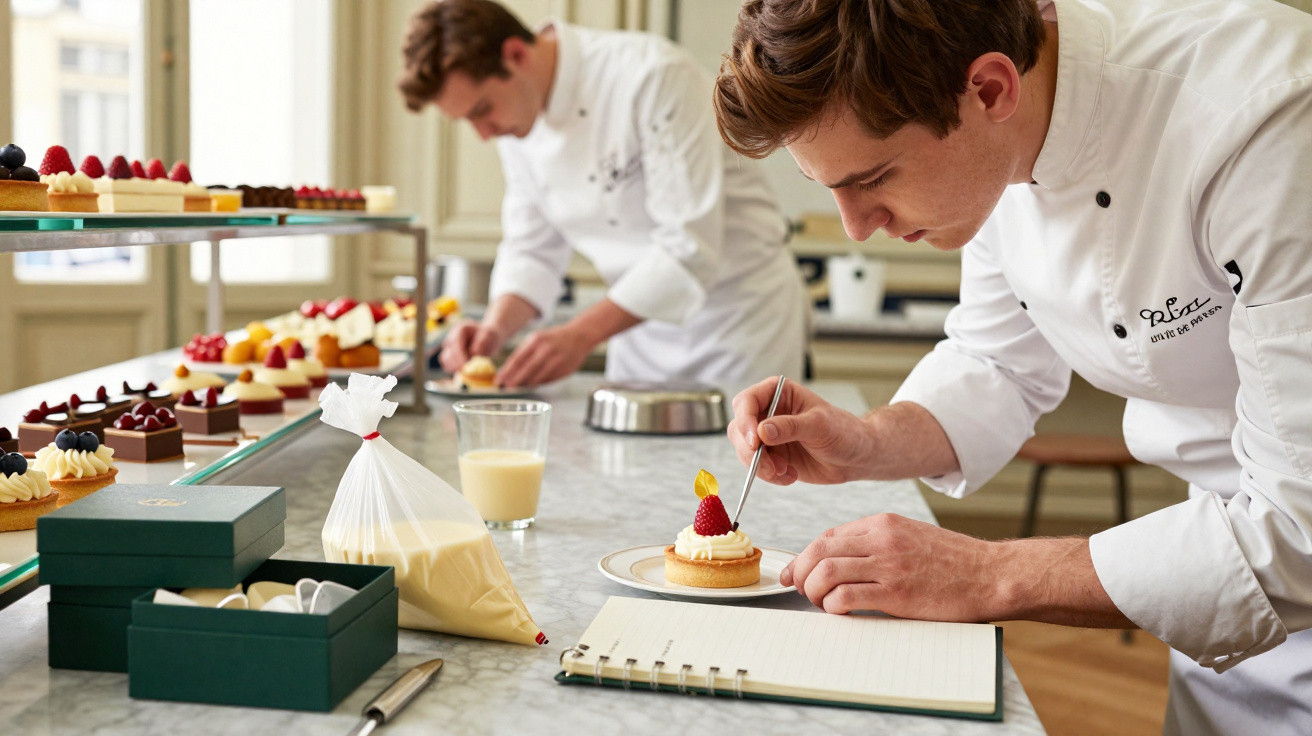
The exit of star pastry chef François Perret has not created a gap; instead, it has prompted a strategic reshaping. Rather than naming one successor, the Ritz Paris is relying on two talents developed within the house to lead its next chapter in sweet creations.
A new pastry era built on two pairs of hands
For years, the Ritz’s dessert identity was inseparable from the name François Perret. When he left at the end of August, the landmark Place Vendôme hotel had to address a sensitive question: who could take his place?
Management has opted against installing a single heir to the pastry crown. From 1 January, responsibility for the hotel’s sweet offering is formally divided into two distinct areas, with each one headed by a chef who already knows the establishment from within.
The Ritz is turning the page on the era of the solitary star chef and embracing a more collective, resilient pastry structure.
Through this shared leadership, the hotel intends to uphold its exceptionally high standards while creating greater scope for flexibility and imagination in the way desserts are conceived, made and presented across its restaurants, bars and boutiques.
Olivier Lainé, the discreet teacher stepping into the spotlight
Olivier Lainé, a familiar presence who has long worked away from public attention, will now oversee the palace’s principal kitchens. His remit covers everything from the gastronomic restaurant L’Espadon to Bar Vendôme, afternoon tea and breakfast.
For the past seven years, Lainé has helped train a new generation of pastry chefs at the École Ritz Escoffier, the hotel’s own culinary school. Away from social-media attention, he has played a central part in the hotel’s technical standards and in passing on its expertise.
A career rooted in French rigour
After qualifying in 2002, Lainé developed his craft in Brittany before joining the team responsible for Café Pouchkine’s elaborate entremets, from a brand recognised for its Franco-Russian refinement.
He subsequently became sous-chef pâtissier at the Shangri-La Paris, another luxury hotel where precision, timing and presentation are essential. That experience has already made him accustomed to the exacting pace of Parisian grand hotels.
By promoting Lainé, the Ritz is choosing continuity: a chef already soaked in the DNA of Place Vendôme rather than an external star.
Within the hotel, the appointment is regarded as a means of preserving the house’s character while allowing greater space for technical exploration and considered new versions of classics.
Tradition with a modern twist on the plate
Lainé’s work is founded on solid traditions. He begins with established French dessert references - such as millefeuille, tart, soufflé and baba - before guiding them towards a more contemporary expression.
Texture sits at the heart of his method. He builds precise layers of crisp, soft and melting components so that each mouthful remains engaging from the opening spoonful to the final one.
The focus is on the meeting of flavour and texture: not just how a dessert tastes, but how it breaks, melts and lingers.
For diners, this is likely to translate into technically precise desserts that remain approachable and reassuring. Forms will be clean and flavours such as vanilla, praline and citrus easily identifiable, while temperature, layering or seasoning introduce restrained surprises.
- Crisp components: wafer, feuilletine, caramelised puff pastry
- Soft elements: sponge, biscuit, light mousses
- Melting touches: creams, sauces, ganaches, sorbets
This style enables the Ritz to retain its classic French luxury appeal while giving returning guests something fresh to discuss on every visit.
Joris Theysset takes charge of Ritz Paris Le Comptoir
While Lainé leads the palace restaurants, another internal appointment sees Joris Theysset take responsibility for the brand’s retail operation: the Ritz Paris Le Comptoir boutiques in the 1st and 6th arrondissements.
Theysset joined the project in 2019 as a member of its founding team alongside Perret. Initially his right-hand man, he became head of production in 2021. He has been instrumental in expanding the boutique concept without losing its artisanal character.
From Ardèche childhood to Parisian boutiques
Theysset trained initially in Ardèche, a region associated with chestnuts and rustic desserts. He later worked at Ladurée in Paris, a name that is almost synonymous with French pâtisserie among international visitors.
These two influences inform his approach: an attachment to comforting, nostalgic flavours combined with the need for the exact production and dependable quality expected of a busy boutique.
His goal is a “sincere” pastry – emotionally charged, rooted in childhood memories, yet produced with the discipline of a luxury house.
Since November 2025, the Ritz has officially allowed him more artistic freedom. His festive “Sucre d’Orge” Yule log, a candy cane-inspired cake conceived as both a Christmas centrepiece and a personal expression, is one example.
Extending the Ritz experience beyond Place Vendôme
Theysset’s new position involves more than creating pastries. He must preserve the immediately recognisable character of the Ritz while adapting it for takeaway formats, queues and tourists who may be in Paris for just one or two days.
He often describes his role at Le Comptoir as that of the “guardian of creativity”. In practice, this requires him to reconcile several demands at the same time:
- Keeping flavours sufficiently accessible for an international clientele
- Making sure products travel well and retain their structure
- Preserving a powerful visual identity for social media
- Meeting the taste expectations and standards of the Ritz Paris brand
His pastries are intended to give guests a lasting memory, almost as a souvenir positioned between gastronomy and a gift. For many visitors, a box of pastries from Le Comptoir is their sole direct encounter with such a celebrated hotel.
Why luxury hotels are rethinking their pastry strategy
The Ritz’s choice to separate pastry leadership between a palace chef and a boutique specialist mirrors a wider development in luxury hospitality.
Today, high-end hotels work through numerous channels simultaneously: fine dining, bar snacks, room service, afternoon tea, street-facing shops and, in some cases, e-commerce. Every setting brings its own logistical demands, price levels and clientele.
| Area | Main focus | Pastry challenge |
|---|---|---|
| Gastronomic restaurant | Plated desserts, tasting menus | Complexity and on-the-spot execution |
| Afternoon tea & bar | Small cakes, snacks | High volume with refined presentation |
| Boutiques | Takeaway cakes, travel-friendly items | Shelf life, transport, consistent quality |
By assigning in-house service to Lainé and the boutiques to Theysset, the Ritz matches technical leadership to these differing requirements instead of expecting a single chef to cover every role at once.
What this means for guests and pastry lovers
For established Ritz guests, the immediate shift may not feel dramatic. The palace’s visual codes, renowned attention to detail and carefully choreographed service will remain in place.
The differences may emerge in subtler ways: restaurant desserts may show slightly more pronounced textural contrasts, boutique cakes may carry a stronger sense of nostalgia, and the distinction between creations to be eaten immediately and those intended for takeaway may become clearer.
The Perret chapter is closing, but the hotel is using the transition to refine how each sweet moment fits into the guest journey.
For pastry enthusiasts visiting Paris, this arrangement offers two separate experiences under one name: L’Espadon’s more formal plated desserts and Le Comptoir’s more accessible, giftable treats. Sampling both in one day can offer a deeper sense of how a grand hotel communicates its taste.
Key notions behind high-end French pâtisserie today
A number of ideas frequently arise when discussing chefs such as Lainé and Theysset, shaping both dessert menus and the way pastries are enjoyed.
“Revisiting a classic” generally involves retaining the defining identity of a traditional dessert - its key flavours, structure or story - while altering certain parts of its recipe. This could mean making a cream lighter, lowering the sugar level, introducing acidity or transforming a large family-style cake into an individual portion.
“Texture play” is another central concern. Rather than simply producing something rich, chefs seek contrast. A tart might bring together a crisp pastry base, soft almond cream, silky custard and a slightly chewy garnish. Diners experience these layers as they cut through the slice, adding rhythm and avoiding palate fatigue.
For travellers who want to discover this approach, a practical option is to try both a “classic revisited” dessert and a more seasonal creation during the same visit. This provides a clear view of how the chef honours French heritage while responding to current ingredients, techniques and trends.
There is also increasing attention to the way pastries develop over time. Boutique products are commonly designed to reach their best a few hours after purchase, whereas restaurant desserts are made for immediate eating. Recognising this timing can prevent disappointment: a delicate millefeuille will seldom fare well on a long Metro journey, while a carefully engineered cake from Le Comptoir may remain stable until the evening.
With Lainé and Theysset now leading the operation, the Ritz Paris offers an instructive example of how a historic institution can renew its pastry identity without abandoning its roots, using structure, memory and texture as its principal tools.

















Comments
No comments yet. Be the first to comment!
Leave a Comment