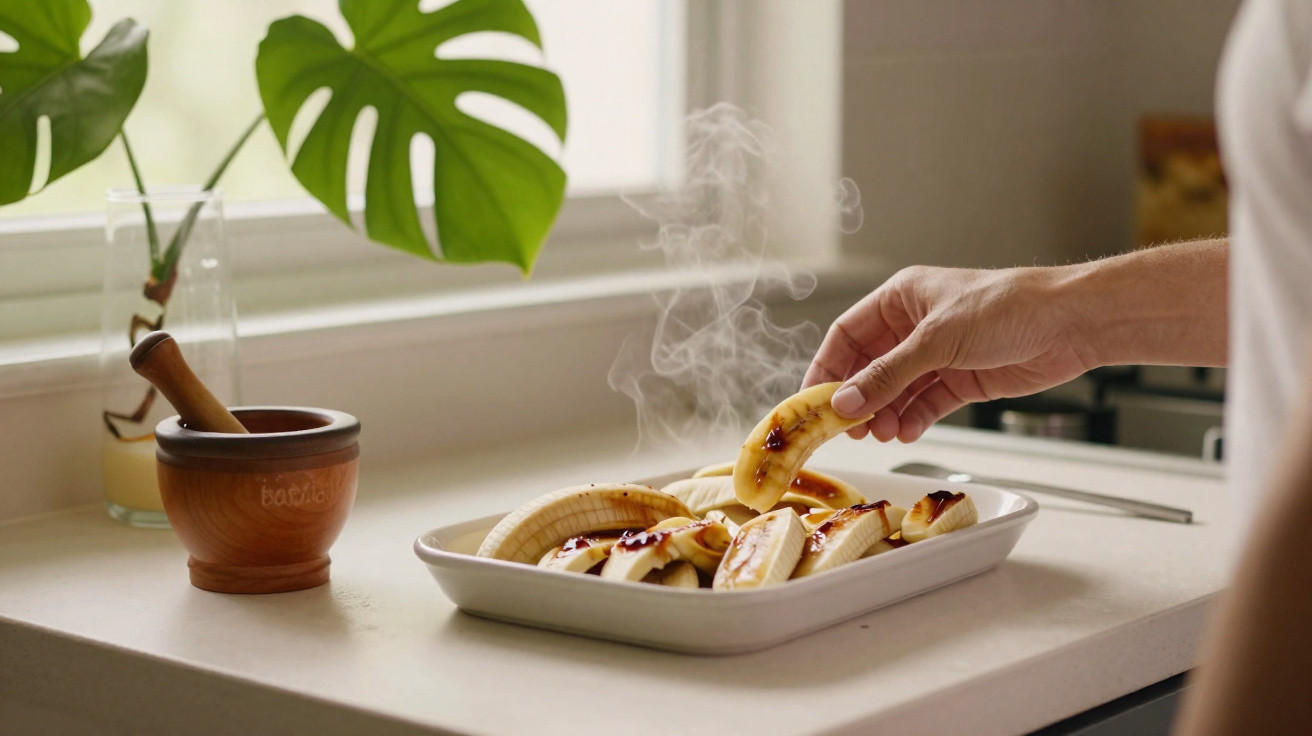
The first time I watched someone place banana peels neatly on a baking tray, I assumed they had gone mad. Not the bananas-the person. Those yellow skins seemed destined for the bin, not for oven space beside a tray of entirely normal potatoes. A faintly sweet, unusual scent filled the kitchen, like a pudding recipe that had somehow gone off course halfway through.
I kept an eye on the timer: 30 minutes. For banana peels. It seemed ridiculous, like a TikTok trick designed purely to attract views and create washing-up.
Then I watched what happened to the crisp, browned peel edges once they had cooled.
That was the moment it stopped seeming “pointless”.
Why people are suddenly baking banana peels for half an hour
A subtle kitchen-counter revolution is under way, beginning with something that would normally go straight in the bin. Banana peels are the sort of automatic discard most people barely register before throwing away. Increasingly, though, people are washing them, arranging them flat on baking trays and putting them in a hot oven for 30 minutes as though they were a treat.
At first glance, it can appear to be eco-perfectionism taken too far. Who has the time to tend to a peel? Yet the purpose becomes clear very quickly once you see what follows that half hour.
Consider Maya, a 34-year-old plant enthusiast who once spent a small fortune on specialist fertilisers. Her balcony jungle flourished, but her finances did not. One evening, she came across a short video saying: “Don’t throw your banana peels away, bake them.” She laughed, before replaying it three times.
Intrigued, she gave it a go. She rinsed the peels, baked them at a low temperature for 30 minutes and crumbled them into a jar after they had dried. She added one tablespoon to the soil of her struggling basil plant and another to the pot containing a drooping monstera. Within a few weeks, fresh leaves appeared, greener and more robust than before. The costly fertiliser bottles at the back of her cupboard began collecting dust.
The reason is straightforward. Banana peels contain plenty of potassium, which plants need for sturdy stems, healthy roots and flowering blooms. Gently baking the peels removes their moisture, concentrates their nutrients and makes them much simpler to keep, grind and scatter.
Rather than simply “using trash”, you are converting something your bin once consumed into a slow-release boost for the garden, balcony containers or even that forlorn supermarket mint. It may resemble an odd internet craze, but it discreetly addresses a genuine issue: depleted soil and the repeated need to purchase more fertiliser.
How to bake banana peels so they actually help your plants
The basic process is almost suspiciously straightforward. Once you have eaten the banana, rinse its peel under running water to remove sticky residue or labels. Briefly pat it dry with a towel. Place the peels flat, yellow side down, on a parchment-lined baking tray, ensuring they are not stacked over one another.
Put the tray in an oven set to a low temperature of roughly 90–110°C (195–230°F). Leave the peels for around 30 minutes, turning them once if you wish. They are ready when they are completely dry and darker in colour, snapping easily when bent. Allow them to cool, then break them down with your hands, a pestle and mortar or a blender into rough flakes or powder.
This is where people often make the task more complicated than it needs to be. It becomes an elaborate ritual involving timers, exact temperatures and guilt when a day is missed. In truth, nobody does this every day.
A more workable routine is to save peels in a container in the fridge or freezer throughout the week, then bake the whole batch when the oven is already being used for something else. This avoids wasting energy and makes it feel like an extra job rather than another household chore. Kept in an airtight jar, the dried peel can sit patiently on a shelf until your plants begin to look a little… meh.
Once you have made crunchy peel flakes, applying them could hardly be easier. Scatter a small spoonful over the soil surrounding your plants, then gently work it into the surface layer. Once a month is sufficient for potted plants. You can use slightly more for outdoor flowers or vegetable beds, particularly during the growing season. It’s less about perfection and more about a steady, gentle nudge to the soil.
“I stopped thinking of banana peels as trash the day I saw my roses double their blooms,” says Léa, who cares for a tiny but wildly colorful courtyard in the middle of the city. “It’s like someone quietly turned the volume up on the garden.”
- Dry the peels fully – if they flex rather than snap, leave them longer to prevent mould developing in the jar.
- Choose peels from ripe rather than green bananas – they dry and crumble more easily.
- Add small amounts – one spoonful for each pot is enough; using more will not make things happen faster.
- Mix with ordinary compost or quality potting soil – peels offer a boost, not a complete feed.
- Keep experimenting – balcony herbs, tomatoes, roses and even houseplants may all benefit quietly.
Beyond the tray: what banana peels say about our way of living
After baking your first batch of peels, the way you view your kitchen can change in a small but noticeable way. You start to spot how much useful material enters the bin each day: coffee grounds, eggshells, carrot and leek ends, or that solitary apple which is slightly too soft to eat but ideal for a quick compote.
Baking banana peels for 30 minutes will not save the planet by itself. Instead, it does something more modest yet unexpectedly meaningful: it teaches you to recognise value in things you were accustomed to treating as waste. Tray by tray, your home becomes a small laboratory for common sense.
| Key point | Detail | Value for the reader |
|---|---|---|
| Banana peels are nutrient-rich | They provide potassium and trace elements that aid plant growth and flowering | Offers a free, readily available alternative to shop-bought fertilisers |
| Baking transforms the peel | Thirty minutes at low heat dries and concentrates the peel, so it can be stored and scattered easily | Changes daily waste into a useful, long-lasting garden booster |
| Small habits, big mindset shift | Using banana peels alters how you view food scraps and encourages other low-waste habits | Enables readers to save money, cut waste and feel more resourceful at home |
FAQ:
- Question 1 Can I put fresh banana peels straight onto the soil rather than baking them?
- Question 2 How frequently should I add baked banana peel to my houseplants?
- Question 3 Is this suitable for every plant, or just flowering and fruiting varieties?
- Question 4 Is it possible to bake banana peels alongside other food?
- Question 5 If I do not have an oven, can I dry the peels another way?

















Comments
No comments yet. Be the first to comment!
Leave a Comment