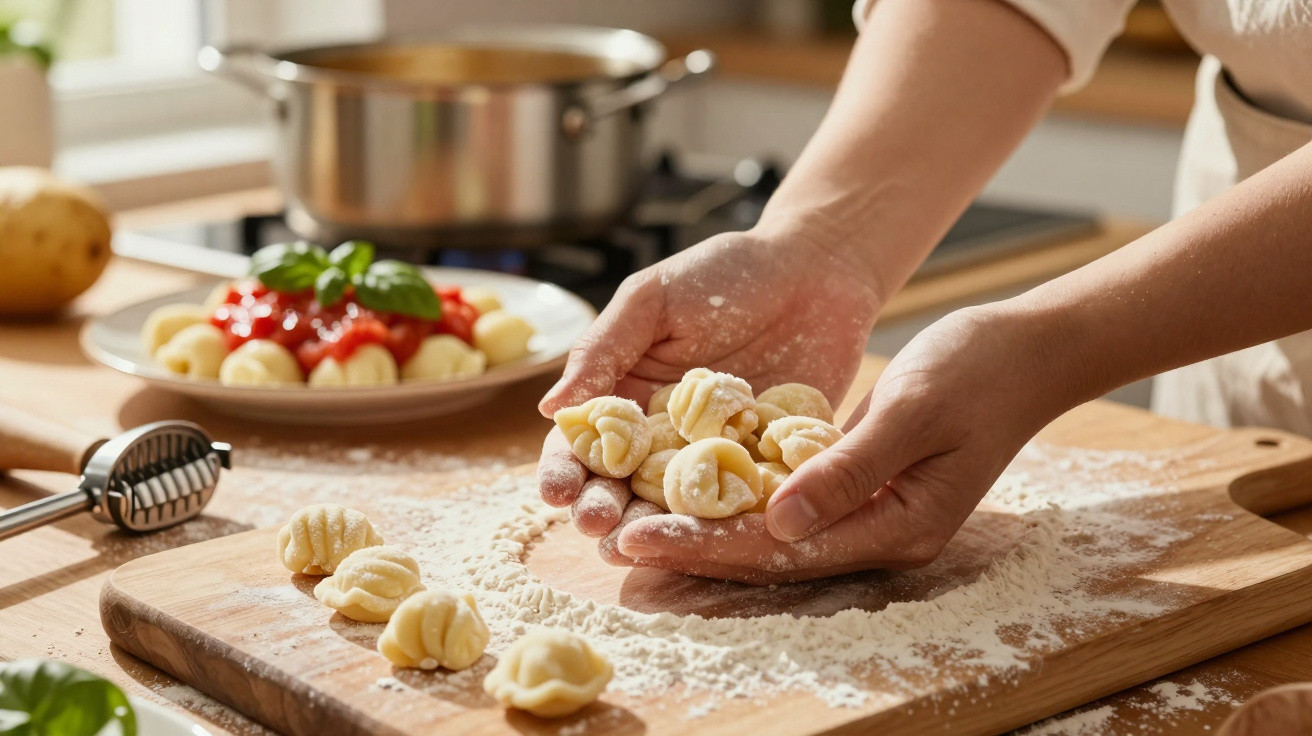
There are evenings when you open the cupboard with little enthusiasm, find three potatoes rolling around in the basket, and simply want something soft, warm and comforting to eat. Flour soon leaves a white dusting across the worktop, your hands become slightly sticky, and the kitchen takes on the cheerfully untidy look of a meal made without a plan. Potato gnocchi have a rare gift: they turn next to nothing into a proper family dinner. You need neither a machine nor an Italian cookery qualification, only patience and a light touch. Often, the best moment comes when the first gnocchi floats to the surface. Suddenly, everything feels more indulgent.
Homemade gnocchi: an Italian recipe that fits in your hand
We all know the moment when a very simple dish tastes better because it was made together, or because it brings back a noisy table, a rainy Sunday, or tomato sauce simmered for far too long. Potato gnocchi belong to that kind of cooking: modest, generous and slightly unpredictable. The traditional recipe relies on just three ingredients: potatoes, flour and an egg. Nothing more is needed, at least for the dough.
For four people, allow 1 kg of floury potatoes, around 250 g of plain flour and one egg. A variety such as Bintje, Agria or Caesar will often give good results, as these contain less water than new potatoes. In many Italian households, the flour is never weighed to the nearest gram: the dough is watched, touched and adjusted. This is a recipe that calls for a little instinct.
The real secret lies in moisture. Potatoes holding too much water absorb the flour, making the dough heavy and robbing the gnocchi of their softness. It is therefore best to cook the potatoes whole in their skins, ideally by steaming them or in gently simmering water, then leave them to dry for a few minutes before mashing. A fork then creates its small grooves, ready to catch the sauce. That detail makes all the difference.
A simple method for light, melt-in-the-mouth gnocchi
Cook the potatoes in their skins until a knife blade passes through without resistance, then carefully peel them while still hot. Put them through a potato ricer, or mash them finely with a fork on a lightly floured worktop. Make a well in the centre for the egg, add 180 g of the flour first, then bring the dough together without kneading it for too long. Stop as soon as it is barely sticky: overworked dough becomes elastic and disappointing.
Roll the dough into small ropes around 2 cm in diameter, cut them into hazelnut-sized pieces, then gently mark each one with the back of a fork. Let us be honest: nobody really does this every day, especially on a Tuesday evening at 8.30 pm. Still, the motion is surprisingly calming. If the dough sticks to your fingers, add a pinch of flour rather than an avalanche; this is the most common mistake, and it quickly makes the finished gnocchi too heavy.
Lower the gnocchi into a large pan of gently simmering water in small batches, without overcrowding them, then lift them out one minute after they rise to the surface. They are cooked, tender and delicate, so handle them gently. Cooking is decided in a matter of seconds.
“A good gnocchi should be light enough to make you want another one, then ten.”
- 1 kg of floury potatoes;
- 250 g of flour, adjusted according to the moisture in the potatoes;
- 1 whole egg;
- cooking in gently simmering water, never at a vigorous boil.
The small triumph of a homemade dish
Then comes the most enjoyable question: what should you serve them with? Homemade tomato sauce, a few sage leaves fried in butter, a punchy pesto or even a simple drizzle of olive oil can be enough. Gnocchi do not need to be drowned in an elaborate sauce to shine. Their soft texture suits bold accompaniments that smell wonderful without taking over. Simplicity is often the best sauce.
This recipe also leaves room for mishaps, and perhaps that is what makes it so endearing. Slightly misshapen gnocchi will be just as delicious, sometimes even more so than the perfectly uniform ones from an industrial packet. You can make the dough with children, improvise an unusual shape, laugh at a piece that is too large, then drop everything into the hot water. The meal then takes on a different value: that of time shared, however imperfectly.
Once you have mastered the technique, the possibilities open up without really betraying the spirit of the dish. Some people replace part of the potatoes with squash, while others add herbs to the sauce rather than the dough to keep the basic recipe intact. Make a little extra if you can: uncooked gnocchi freeze very well when first spread out on a tray. On a busy evening, that small treasure in the freezer feels almost like a good decision made in advance.
| Key point | Detail | Added value for the reader |
|---|---|---|
| The three ingredients | Floury potatoes, plain flour and egg | An accessible recipe using everyday ingredients |
| The right technique | Work the dough for as little time as possible | Lighter gnocchi that are less elastic and more melt-in-the-mouth |
| Cooking | Remove the gnocchi shortly after they rise to the surface | A tender texture without the risk of them falling apart |

















Comments
No comments yet. Be the first to comment!
Leave a Comment