The pepper sauce looked flawless thirty seconds ago: glossy, hot and thick enough to coat a spoon. Then it starts leaving a small pool of fat around the edge of the plate, as though it has chosen to lead a life of its own. That moment, suspended between pride in a home-cooked dish and quiet panic, is far more common than most people realise.
We have all had that dinner when everything is ready, the pasta is slowly cooling in the colander, and the dressing or cream sauce suddenly refuses to hold together. You stir harder, turn down the heat, add a little salt… then stare at the split sauce with almost personal disbelief. The thing that changes everything is often a very small action.
When a sauce “splits”, it is not necessarily your fault
A separated sauce can make it feel as though you have failed at something complicated, even though the issue often occurs in the simplest recipes. A mayonnaise turns runny, a butter sauce releases its fat, or a lemon cream sauce becomes grainy: the two elements of the sauce no longer want to stay combined.
The classic example is a vinaigrette thrown together just before serving. After a few minutes, the oil sits above the vinegar, despite your most determined stirring. That is perfectly normal, because these two liquids do not naturally mix without a little help.
With a hot sauce, the effect is even more obvious. Fat and water create a delicate emulsion made up of tiny droplets held together; excessive heat, an addition made too abruptly or leaving it to stand for a little too long can all break that balance. At heart, a sauce has moods too.
The one-step fix: add a spoonful of cold water and whisk
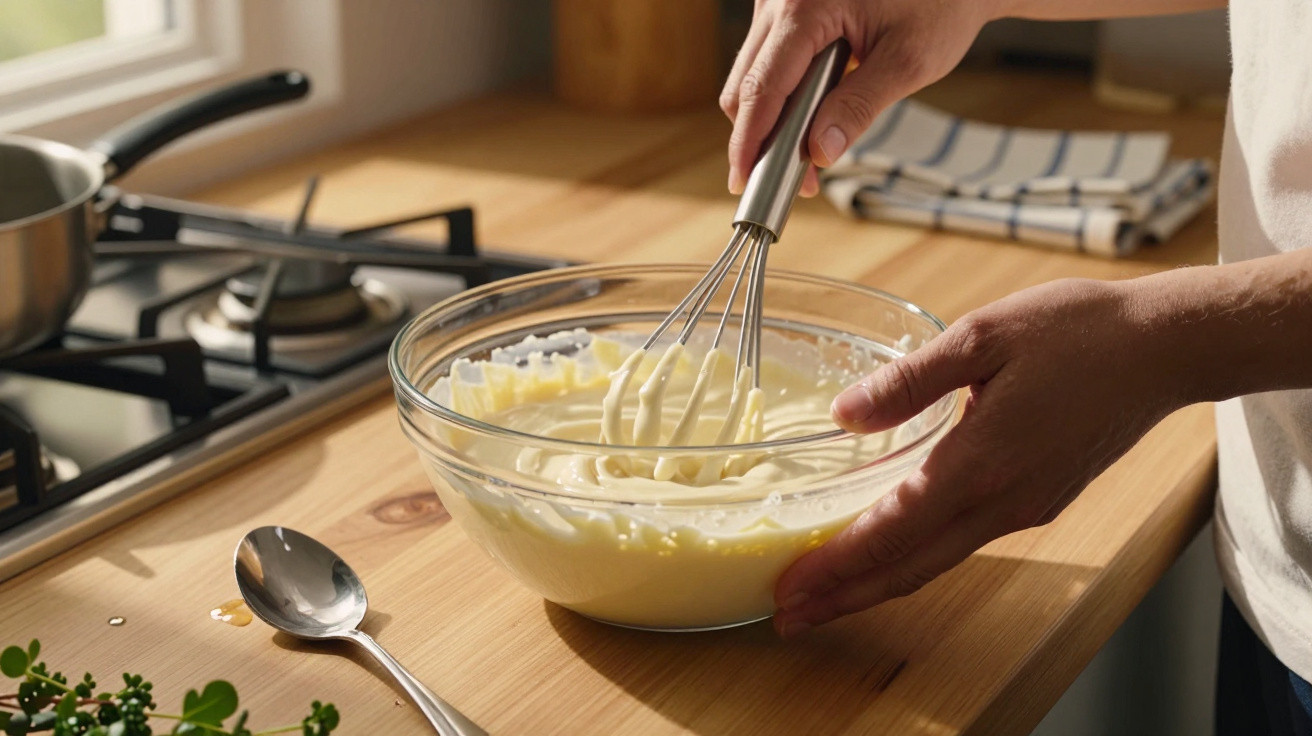
If a butter, cream or cheese sauce begins to separate, take it off the heat first. Add one tablespoon of very cold water, then whisk briskly for a few seconds: the change in temperature helps redistribute the fat droplets, and the texture will often return as if by magic.
The key word is “little”. Pouring a large glass of water into a distressed béarnaise will not rescue it; it will simply turn it into flavoured soup. Begin with one spoonful, then repeat only if the sauce needs it. Let us be honest: nobody measures this to the millilitre every day.
For split mayonnaise, the same principle works with one very simple variation: start again in a clean bowl with a spoonful of cold water or an egg yolk, then gradually whisk in the failed mayonnaise. The movement matters more than the force: you are rebuilding the emulsion gently, without rushing.
“A sauce does not ask you to fight it: it asks you to give it a point of connection again.”
- Always take the sauce off the heat before trying to rescue it.
- Use cold water for a hot sauce that is releasing fat.
- Add liquid in small amounts, never all at once.
- Whisk as soon as the first signs of separation appear.
Small habits that prevent a sauce disaster
Heat that is too high remains the number-one enemy of delicate sauces. A butter sauce must not boil, lemon cream does not cope well with a forgotten saucepan, and melted cheese quickly turns oily when pushed too far. Low heat may seem less dramatic, but it prevents plenty of swearing.
Another very common trap is adding oil, stock or cream too quickly. When everything is poured in at once, the ingredients do not have time to bind. A thin stream, followed by steady whisking, gives the sauce much longer-lasting stability, especially with mayonnaise and vinaigrette.
Some ingredients also act as mediators. Mustard in a vinaigrette, egg yolk in a hollandaise, starch in a creamy sauce or even a touch of honey can help an emulsion hold together. They do not disguise the flavour; they simply give the liquids a reason to remain combined.
A rescued sauce can sometimes transform the whole meal
There is something reassuring about this technique because it removes some of the pressure from cooking. A sauce that separates does not automatically need throwing away: it is often signalling that it became too hot, sat for too long, or simply needs a little water and attention.
Next time a slick of fat appears at the bottom of the saucepan, there is no need to hide the disaster beneath a handful of parsley. Turn off the heat, take a spoonful of cold water, whisk calmly and watch what happens. In many cases, the texture tightens before your eyes, almost at once.
This small repair also helps build confidence in the kitchen. You end up following recipes less rigidly, tasting more often, recognising the sound of a sauce simmering too fiercely, and holding on to one simple reflex: never panic before you have whisked.
| Key point | Detail | Added value for the reader |
|---|---|---|
| A separated sauce is a broken emulsion | The fat and watery element no longer remain bound together | Understanding the issue prevents you from throwing it away too quickly |
| Cold water can rescue a hot sauce | One spoonful off the heat, followed by whisking | A quick reflex for restoring a smooth texture |
| Taking your time stabilises the preparation | Low heat and gradual additions of liquid | More reliable sauces every day |

















Comments
No comments yet. Be the first to comment!
Leave a Comment