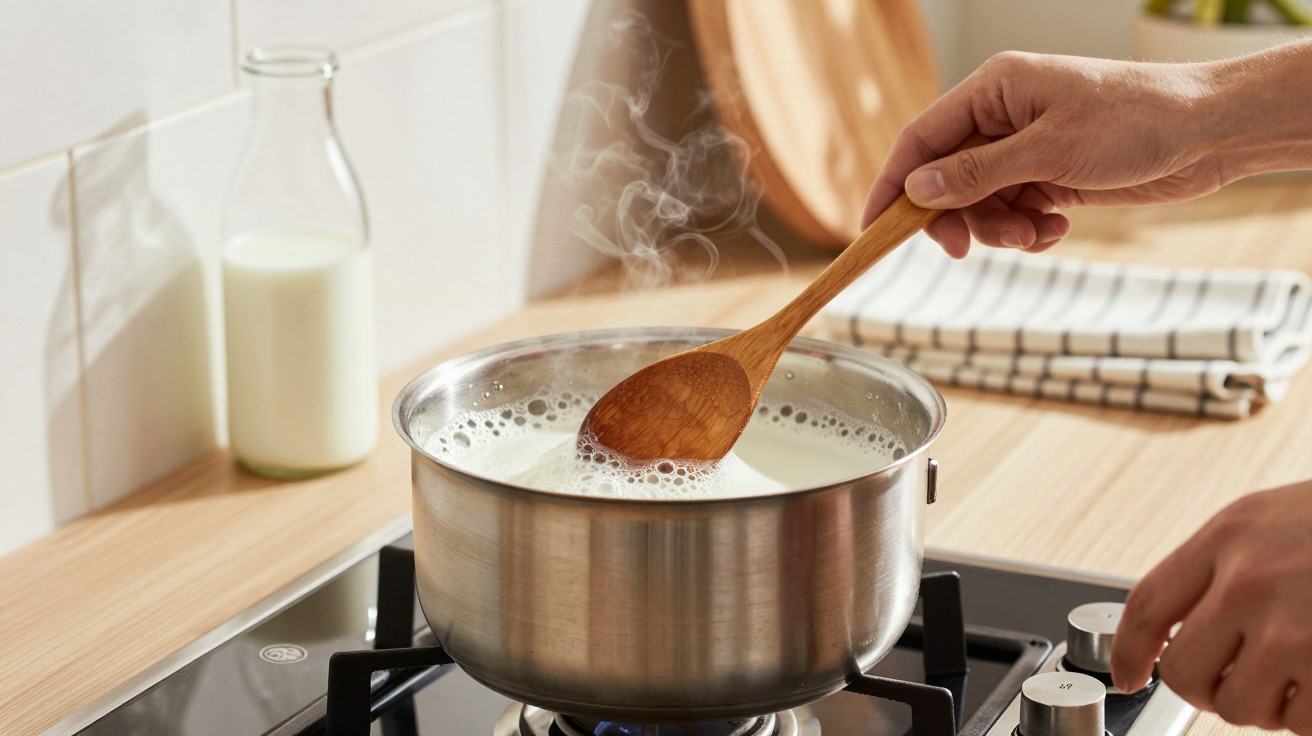
The scenario is familiar: a saucepan of milk is warming gently, you turn around to fetch a bowl or reply to a message, then a sudden, heavy sound signals disaster. White foam spills over, runs across the hob and leaves a burnt-milk smell that lingers in the kitchen. In many households, the response is almost automatic: lay a wooden spoon across the saucepan. It seems like a simple, near-magical trick, passed down by a grandmother or picked up from watching somebody cook. But does this spoon genuinely stop milk boiling over, or does it merely create the impression that the situation has been saved? This everyday habit has a more nuanced explanation than it first appears. It may, however, spare you some tiresome cleaning.
The wooden spoon: a cooking habit with a real basis
As milk nears boiling point, its surface alters quickly: a thin skin forms, then bubbles develop beneath it and lift a dense foam. Resting a wooden spoon across the rim creates a small obstruction. When the rising foam touches it, the spoon can burst some bubbles and slow their build-up for a few seconds. It is not dramatic, but the foam can sometimes drop just enough for you to take control again. The spoon does not stop the milk from boiling. It simply disrupts the foam as it tries to pass over the edge.
This trick often appears more effective with a wide saucepan that is only half full. Picture 500 millilitres of milk heating over a medium setting: the foam expands, meets the wooden handle and splits into two less even sections. That brief pause can be enough time to turn the heat down. By contrast, with a litre of milk in a small, already rather full saucepan, the spoon is quickly outmatched. The liquid continues heating underneath the foam, and pressure drives everything outwards. We all know the moment when we think we have found a solution, immediately before wiping down the hob.
The main reason lies in the foam itself. Milk contains proteins and fats that stabilise air bubbles far more effectively than water alone. At the start of heating, wood is often cooler than metal, so it can pop some of those bubbles when they reach it. Its surface is not completely smooth either, which interrupts the foam’s even rise. The effect is real, but delicate. Once the heat is too high or the saucepan is too small, temperature takes over and the spoon can do very little.
What really prevents milk spilling onto the hob
The most dependable approach is to choose a sufficiently large saucepan and never fill it to the brim. When heating milk, ideally leave at least one third of the pan empty above the liquid: this space holds the foam before it spills over. Use a low or medium heat rather than trying to rush the process. Once the first small bubbles appear around the sides, stay nearby. A quick glance every twenty seconds makes all the difference. If the milk starts to swell, take the saucepan off the heat for a moment, stir it, then return it to a gentler setting.
A wooden spoon can still be a useful habit, provided you do not ask it to perform the impossible. It should be clean, dry and long enough to sit securely across both sides of the saucepan. A damp spoon may drip into hot milk and cause minor splashes, particularly if it has just come from the washing-up bowl. Honestly, nobody watches a saucepan every second, especially in the morning. Keeping the spoon there can work as a visual reminder: seeing it tells you the milk is heating and that it is best not to go and fold laundry at the other end of the flat.
There are also a few common mistakes, often made without a second thought. Covering the saucepan encourages condensation and traps heat, speeding up the foam’s rise; high heat turns a calm preparation into an instant overflow.
“The wooden spoon gives you time, not a guarantee: real control lies in the heat setting and the size of the saucepan.”
- Choose a pan two to three times larger than the volume of milk being heated.
- Set the hob to a moderate heat, even when you are in a hurry.
- Treat the wooden spoon as a visual aid, never as automatic supervision.
- Remove the saucepan from the heat immediately when the foam rises into a dome.
Myth or reality: a useful trick when you understand its limits
So the wooden spoon is neither a silly myth nor a foolproof shield against spills. It can genuinely burst some of the foam and provide a short reprieve, especially with gentle heating and an appropriately sized saucepan. How well it works depends on the quantity of milk, the heat level, the width of the pan and even how quickly you react. This small gesture also says something about everyday cooking: we value modest tips, handed on without an instruction manual. They do not replace attention, but they can sometimes be genuinely useful between two hurried tasks.
| Key point | Detail | Benefit for the reader |
|---|---|---|
| The spoon affects the foam | Wood bursts or disrupts some bubbles when they reach a spoon placed across the pan. The effect is most noticeable at the start of the rise, before foam has covered the whole surface. | Understanding this mechanism prevents you from expecting a miracle. The spoon can give you a few valuable seconds to reduce the heat or move the saucepan. |
| Low heat remains the best protection | Gradual heating reduces the sudden formation of steam beneath the milk skin. Once bubbles show at the edges, the rise can speed up within seconds. | Reducing the heat lets you warm milk without stressful supervision and also lowers the chance of a burnt taste at the bottom of the pan. |
| Saucepan size changes everything | A saucepan that is too small leaves no room for foam, even with a wooden spoon. A wide pan filled no more than halfway or two thirds full accommodates the rise more effectively. | This very simple choice prevents most overflows and makes the spoon trick much more effective in everyday use. |

















Comments
No comments yet. Be the first to comment!
Leave a Comment