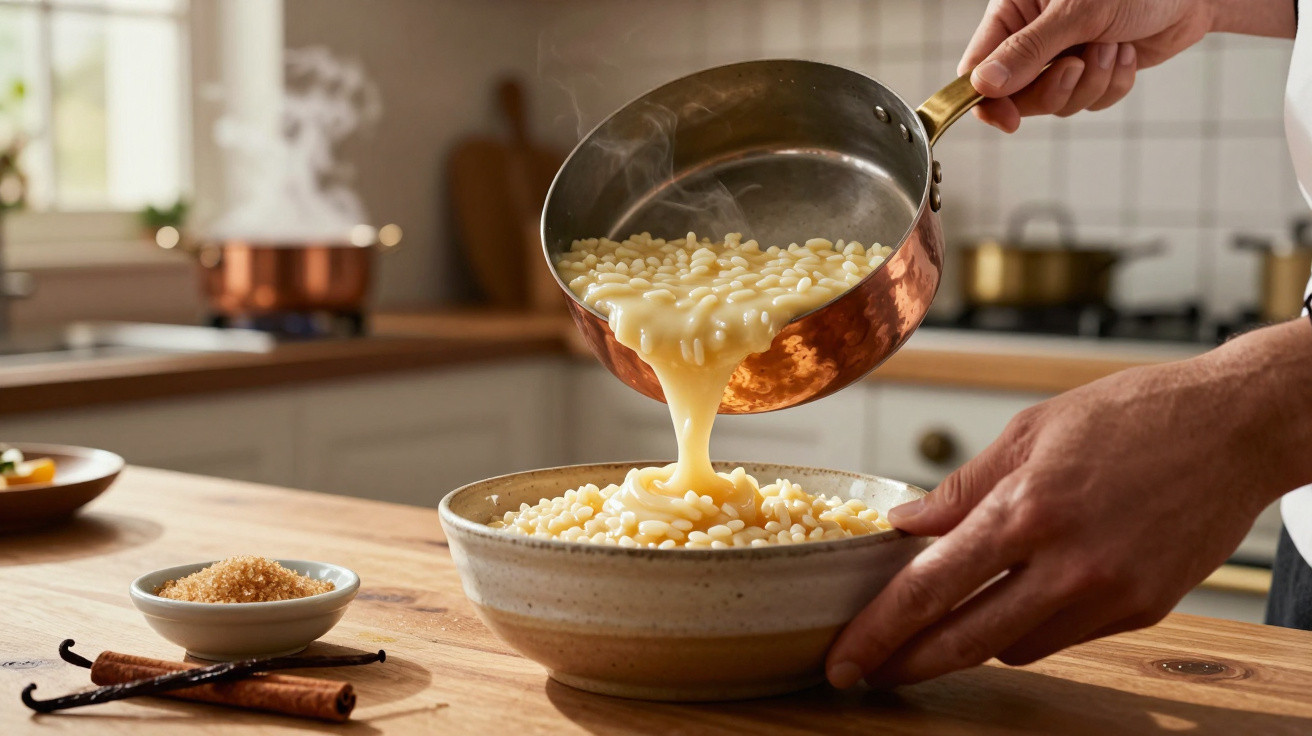
Creamy without feeling heavy and fragrant without becoming overly sweet, Juan Arbelaez’s rice pudding relies on a handful of very simple techniques that are often overlooked in home kitchens. The French-Colombian chef favours patience, the right rice and cooking watched as closely as milk on the hob over any showmanship.
There is a moment, on a Sunday or a rainy evening, when a saucepan of warm milk is enough to transform the atmosphere in the kitchen. Rice pudding looks easy, almost childish, until the base catches, the grains remain too firm or the finished dish turns into an overly thick paste. We all know that small gap between the memory of a comforting dessert and the reality of a saucepan neglected for three minutes. For Juan Arbelaez, success does not depend on an impossible-to-find ingredient, but on paying attention to the produce and the timing. It is the sort of detail that elevates a classic and makes you want to bring out the saucepan again.
The right rice changes everything before the first simmer
In the kitchen, rice is often chosen automatically: you reach for the open packet, whether it is meant for risotto or that evening’s side dish. Yet, for rice pudding worthy of the name, Juan Arbelaez chooses round-grain rice, which is high in starch and able to create the soft, coating texture expected in every spoonful. This short grain slowly absorbs the milk while retaining some bite. It should not vanish into the cream. Good rice pudding remains a dessert of grains, not a disguised custard.
Round-grain Arborio rice can work, although dessert rice or Camargue round-grain rice often produces a softer, more consistent result. For four people, allow around 120 to 150 grams of rice per litre of whole milk: this ratio gives the dessert time to thicken without becoming firm in the fridge. A grandmother might say she cooks “by eye”, and she would not be wrong. For a first attempt, however, scales prevent unwelcome surprises.
The secret lies in the starch, the natural substance released gradually during cooking that thickens the milk without flour or any other thickener. Longer-grain rice yields less creaminess, while rice that has been washed too thoroughly makes for a lighter result that can feel a little sad. Let us be honest: nobody does this every day, weighing every grain or studying the variety they have picked. Even so, taking twenty seconds to read the packet label can save the dessert and prevent the dry texture nobody wants at the table.
Juan Arbelaez’s method: cook slowly and add sugar at the right time
The most reliable approach starts with a very short pre-cook of the rice in water, just long enough to soften it and remove some of its floury taste. After five minutes in gently simmering water, drain it and add it to already-warm whole milk infused with a split and scraped vanilla pod. Keep the heat low, almost timid, for thirty to forty minutes. Stir regularly with a wooden spatula, scraping across the base of the saucepan. Gentle heat makes a real difference here.
The most common mistake is to add all the sugar at the start, then turn up the heat to speed things along. Sugar can slow the absorption of liquid, while a vigorous boil makes the milk catch and ruins the dessert’s delicacy. Instead, add the sugar in the final ten minutes, once the rice is already tender. Should the mixture look slightly loose at this point, do not worry: it will thicken as it cools. This is the classic trap that leads people to overcook it.
The chef’s touch is not about watching the saucepan solemnly, but tasting several times and accepting that rice pudding changes between the hob and the fridge.
“Rice pudding must remain soft in the saucepan, as it will naturally gain body while resting.”
To maintain that generous texture, keep these straightforward pointers in mind:
- use whole milk, which is richer and more indulgent than skimmed milk;
- split a vanilla pod rather than relying solely on flavouring;
- stir without frenzy, but often enough to stop the base from taking on colour;
- keep back a little warm milk to loosen the dessert at the last moment;
- leave it to rest for at least twenty minutes before serving.
The detail that takes a familiar dessert to another level
Juan Arbelaez’s rice pudding can remain wonderfully simple: vanilla, milk, sugar and rice. That very restraint allows for a few well-chosen additions when serving. A spoonful of salted butter caramel, orange zest, fresh mango or a scattering of chopped hazelnuts changes the picture without masking the dessert’s flavour. In his cooking, the chef enjoys clear contrasts between milky sweetness and a sharper note. The right topping must never steal the whole show.
Served warm, rice pudding feels silkier and releases more of its vanilla aroma; served cold, it evokes childhood dessert pots, with a firmer set. This is not a dilemma: it simply depends on the occasion. After school, a chilled version with a drizzle of caramel is a universal favourite. After a winter meal, a warm portion with roasted pears delivers an almost quiet kind of sweetness, one that slows the conversation around the table.
There is also the small freedom that makes recipes endure: adapting them. Some will enjoy a pinch of fleur de sel, while others may prefer orange blossom water, cardamom or a little cinnamon. Keeping Juan Arbelaez’s base in mind makes it possible to experiment without losing the thread: round-grain rice, whole milk, slow cooking and sugar added without haste. From there, every saucepan tells a slightly different story. It is home cooking, imperfect at times, but far more appealing than a shop-bought dessert chosen out of habit.
| Key point | Detail | Added value for the reader |
|---|---|---|
| Choose round-grain rice | A short grain high in starch delivers the desired natural creaminess. | A melting texture, without thickener or a gluey mouthfeel. |
| Cook over a low heat | The milk should barely simmer for thirty to forty minutes. | Less risk of catching, with evenly cooked grains. |
| Add sugar towards the end | Sugar goes into the saucepan once the rice is already almost tender. | A better-balanced dessert that stays soft and is easy to adjust to taste. |

















Comments
No comments yet. Be the first to comment!
Leave a Comment