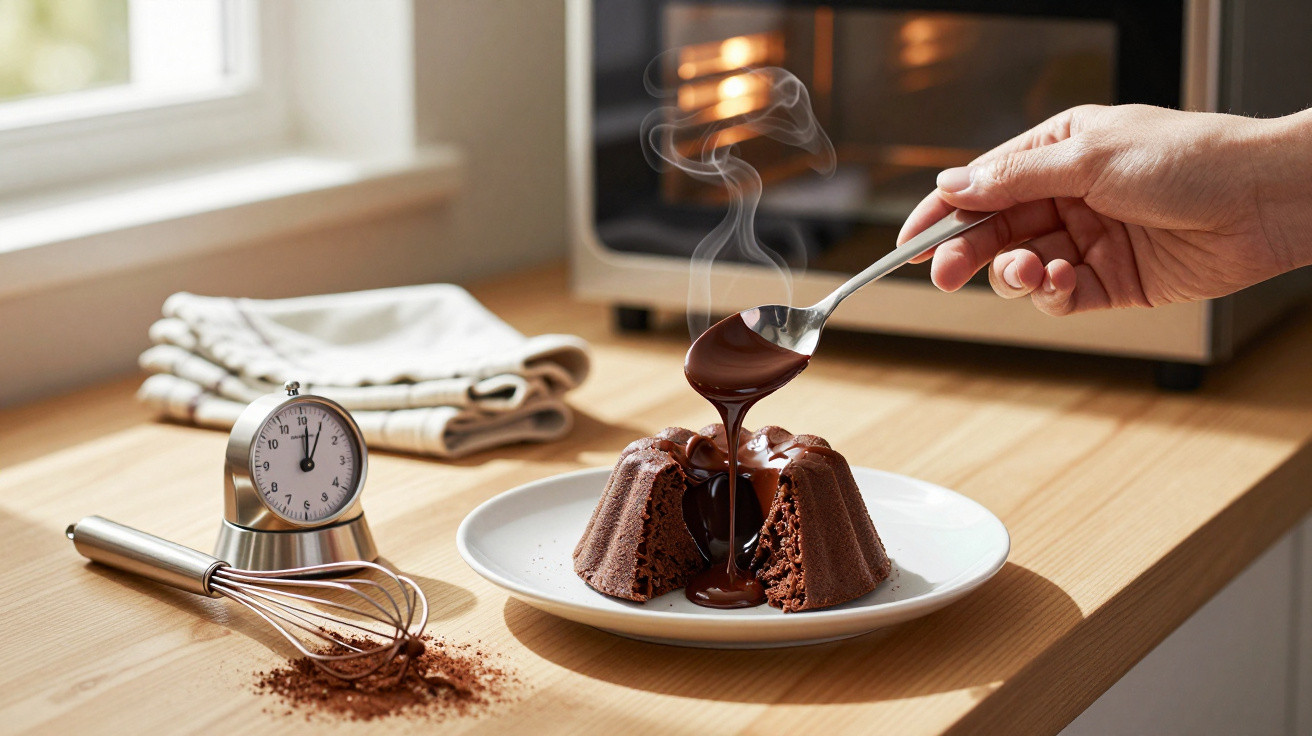
Dinner is nearly over, the plates are still warm, and someone says the words everyone likes to hear: “Is there any dessert left?” In the kitchen, the chocolate fondant is waiting quietly in its individual moulds. Turn it out, press in a spoon, and dark chocolate should slowly spill out like lava. Or perhaps not. Sometimes just thirty seconds too long produces an excellent cake… but one that is no longer molten. We all know that hesitation at the oven door, caught between caution and the hope of achieving that famous liquid centre. The difference comes down to a tiny detail. And that detail changes everything.
A molten centre depends on more than chocolate
A successful chocolate fondant begins with a simple picture: the edges must hold their shape while the centre deliberately remains delicate. When the mould comes out of the oven, the middle should look barely baked, and the surface should wobble slightly when the baking tray is moved. That is precisely the result you want. The chocolate also continues cooking for the first few minutes after leaving the oven, held by the heat of the ramekin. The perfect fondant is not a cake you can simply forget about. It just needs a little care-the kind reserved for the small things that matter.
For a classic recipe making four fondants-100 g dark chocolate, 100 g butter, 80 g sugar, two eggs and 40 g flour-allow 9 to 10 minutes at 200 °C in a preheated conventional oven. With a fan oven, 180 °C for 8 to 9 minutes is often enough. One cook used to hosting Sunday guests said she always set her timer for nine minutes, then watched her guests’ reaction. When nobody spoke during the first spoonful, she knew she had got it exactly right.
That exact timing nevertheless depends on three factors: the oven’s true power, the size of the moulds and the temperature of the batter before baking. A mixture taken straight from the fridge may need an extra minute, while batter poured into small, shallow ramekins will cook faster. Let us be honest: nobody really does this every day with an oven thermometer in hand. Yet understanding these differences prevents disappointment. The best approach is to choose a starting cooking time, then adjust in thirty-second increments in later attempts.
Exact chocolate fondant baking time: a method that reduces surprises
Preheat the oven for at least fifteen minutes before putting the fondants in. It may seem routine, but an oven still coming up to temperature lengthens the baking time and makes every guide less reliable. Butter the moulds, dust them lightly with flour, or use unsweetened cocoa powder so the cake edges do not turn white. Fill them three-quarters full, place the ramekins on a baking tray and bake on the middle shelf. For individual moulds measuring 8 to 9 cm across, the most dependable guide is 9 minutes at 200 °C using conventional heat.
The most common mistake is waiting until the top is completely dry. By then, the centre has usually already set. A chocolate fondant should have a thin, matt crust around the edges, with a central area that is still slightly glossy and soft. Do not feel guilty if the first attempt is a little too runny or slightly too firm: it is almost a rite of passage. A domestic oven may display 200 °C while actually fluctuating by several degrees. Write down your ideal timing on the recipe, just as you would keep the number of a good restaurant.
Once out of the oven, leave the ramekins to rest for one minute-no longer. This brief pause allows the edges to firm up without giving the centre time to set. Turn them out onto plates with a confident movement, then serve immediately: a molten centre will not wait.
“To make a successful fondant, you do not aim for perfect baking throughout: you accept that the centre is deliberately unfinished.”
- 8 minutes: a very liquid centre, almost a chocolate sauce;
- 9 minutes: a generous lava effect and well-defined edges;
- 10 minutes: a creamy centre that is easier to carry;
- 11 minutes: a soft fondant with little or no flow.
A small dessert that always makes a big impression
Chocolate fondant offers something comforting: with only a few ingredients, you can create a moment that feels exceptional. It does not need elaborate decoration to impress. A scoop of vanilla ice cream, a few raspberries or a pinch of fleur de sel is enough to lift the warm chocolate. Some people prefer to place a square of chocolate in the middle before baking to guarantee the flow; others rely on the traditional recipe and precise timing. Both choices have their appeal, especially when dessert reaches the table still steaming.
| Essential point | Detail | Added value for the reader |
|---|---|---|
| Oven temperature | 200 °C conventional heat, with the oven preheated | Even baking from the very first minute |
| Guide time | 9 minutes for standard individual ramekins | A molten centre without collapsed edges |
| Resting after baking | One minute before turning out | Neater fondants that remain very molten |

















Comments
No comments yet. Be the first to comment!
Leave a Comment