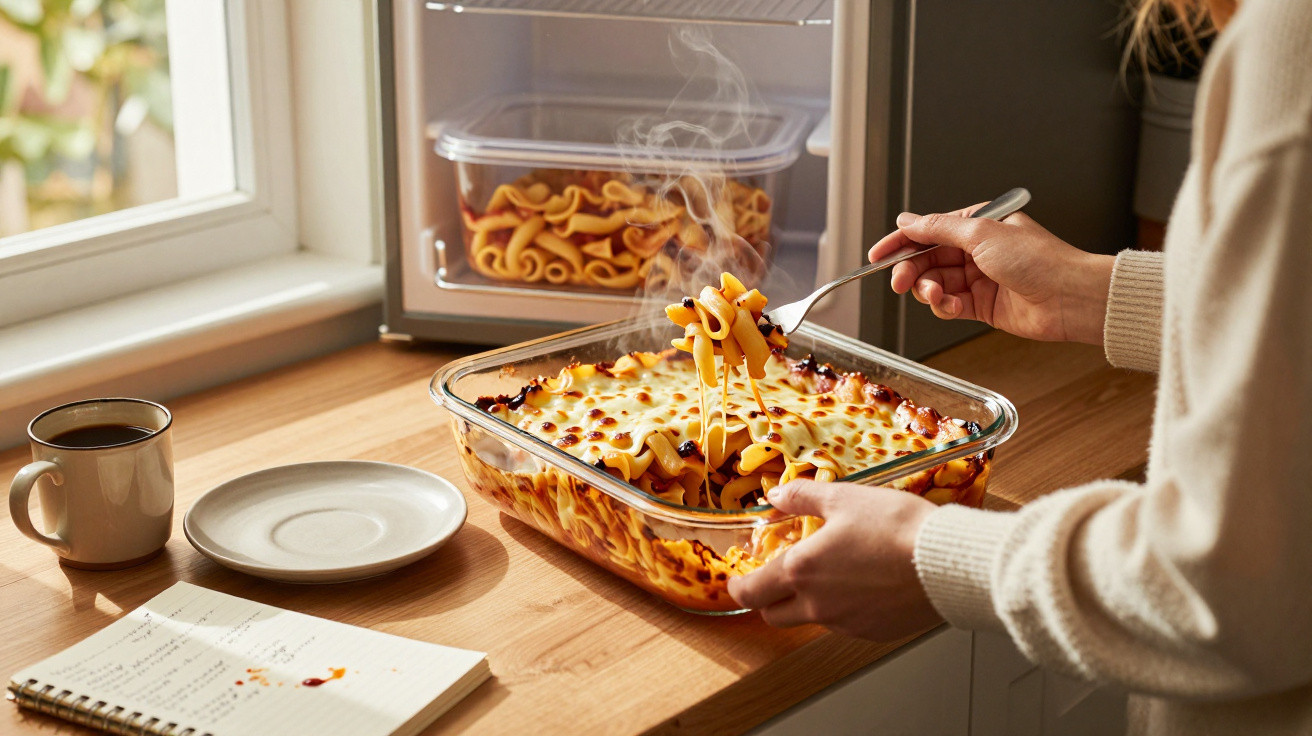
The meal was meant to be “just something quick” for a weeknight: pasta in a dish, a jar of tomato sauce, a handful of cheese, all pushed into the oven as emails continued to ping and the washing machine whirred nearby. You ate at the kitchen counter while looking at your phone, deciding it was pleasant and comforting, but nothing exceptional. Yet the following day, you took the leftovers from the fridge and warmed up a portion in the oven, and the kitchen suddenly smelled as though a proper Italian grandmother had arrived overnight.
Some recipes are lovely on the day you cook them.
This one patiently waits until the following day to reveal what it is truly capable of.
Why next-day baked pasta is so good
There is something almost deceptive about baked pasta becoming better when you are not paying attention. Straight from the oven, it is molten and unruly, with bubbling cheese and sauce pooling around the edges of the dish. After twenty-four hours, though, it slices into tidy squares with crisp golden sides, holding its shape like lasagne’s more relaxed cousin.
You lift a forkful and the cheese still pulls, but only slightly.
The flavours seem fuller, gentler and more mature.
Imagine an ordinary Tuesday evening: penne is mixed with a garlicky tomato sauce, perhaps with sausage or leftover roast vegetables, then covered with grated mozzarella and a little Parmesan. Supper is enjoyable, everybody is content and the plates are empty. You put the dish in the fridge, thinking, “Lunch tomorrow, I guess.”
The next day, you heat a serving in the oven and that unassuming pasta suddenly has depth. The tomatoes’ sharpness has softened, the herbs have a richer flavour and the cheese has developed a lightly chewy, savoury crust.
You may find yourself eating more slowly and picking up on details that passed you by the previous evening.
Food scientists might describe starch retrogradation, moisture redistribution and the other complicated changes that occur while the dish sits in the cold. The sauce has time to work its way into every hollow piece of pasta, the cheese sets before loosening again with gentle reheating, and fats transport flavour farther and more deeply.
The reasoning is straightforward: a night in the fridge gives all the ingredients time to agree with each other.
Rather than being “pasta plus sauce plus cheese”, it becomes one unified, almost nostalgic block of comfort food that can be cut with a spoon.
How to make baked pasta taste even better the next day
Begin by cooking the pasta slightly less than usual. Take it out of the boiling water a full two minutes before the packet instructions suggest, while it still has a definite bite. It will then finish cooking in the oven rather than turning soft and mushy by the second day.
Mix it immediately with a generous quantity of sauce so that every piece is coated, then build it up in a baking dish with frequent, thin layers of cheese rather than a single heavy covering.
Those layers need to develop so that, the next day, each mouthful tastes like the best corner portion.
Season more generously than you may think necessary. Salt, pepper, a pinch of chilli flakes, dried oregano or basil will all become more subdued overnight. When it seems perfectly seasoned straight from the oven, the leftovers are likely to taste a little muted.
We have all had that experience: yesterday’s brilliant supper becomes a bland, beige disappointment after reheating, leaving you to wonder where it went wrong.
Honestly, hardly anyone tests recipes on the second day, even though that is when many of us actually eat them.
After baking the pasta, leave it to cool almost completely before covering it and placing it in the fridge. This stops steam from condensing back into the dish and diluting the sauce.
The following day, warm it slowly in the oven at about 170°C. Cover it loosely with foil at first so that it heats through without drying out, then remove the foil near the end to restore the golden topping.
“Next-day baked pasta is the closest thing I have to a guaranteed good mood,” laughs Clara, 32, who batch-cooks one giant tray every Sunday. “On Wednesday, when work is chaos, I pull out a square, reheat it, and it tastes like I planned everything. I absolutely did not.”
- Undercook the pasta slightly – helps it retain a firm, satisfying texture on day two.
- Create multiple thin cheese layers – creates more pockets of flavour and a better texture when reheated.
- Cool, then chill properly - maintains that rich, comforting consistency.
- Reheat gently rather than at full power - keeps in moisture and prevents rubbery cheese.
- Add a fresh topping after reheating - olive oil or herbs give it a lift.
The comfort of leftovers that genuinely improve
There is a particular comfort in opening the fridge to discover not merely “something to eat”, but something that truly tastes better than it did the previous day. Leftover baked pasta can feel like a small gesture of self-respect during a week that is not quite going to plan. It is the complete opposite of those sad, congealed takeaway containers that get guiltily thrown away two days later.
You have looked after your future self, even if that was not entirely the intention, and now that future self is quietly thankful.
Next-day baked pasta has its own social warmth as well. It is what you can heat up for a flatmate who arrives late, a child returning from practice, or a friend who calls in “just for a minute” and stays for supper. You slice another square, put it in the oven and nobody realises it is technically leftovers.
The flavours seem settled and assured, as if they have had time to consider what they want to say.
There is no one “correct” recipe. Some cooks make it much like lasagne, with layers of ricotta, spinach and slow-cooked ragù. Others combine rigatoni, jarred sauce and whichever cheese remains in the fridge, from scraps of Cheddar to the last heel of Parmesan. The amusing part is that an overnight rest levels the playing field.
Even the most effortless versions develop more character by the second day.
Somewhere between that first spontaneous assembly and the next-day reheat, a basic tray of baked pasta turns into a small, edible promise that tomorrow might genuinely taste a little better than today.
| Key point | Detail | Value for the reader |
|---|---|---|
| Cook for tomorrow, not just tonight | Cook pasta slightly less, season boldly and use plenty of sauce | Leftovers seem deliberate rather than second-rate food |
| Let it rest, then chill | Cool before covering, refrigerate and reheat gently in the oven | Retains texture, intensifies flavour and prevents dryness |
| Improve the reheat | Add fresh herbs, olive oil or extra grated cheese after warming | Turns simple leftovers into a fresh, comforting “new” meal |
FAQ:
- Question 1: How long can I keep leftover baked pasta in the fridge?
- Question 2: Is it better to reheat baked pasta in the oven or the microwave?
- Question 3: Can I freeze baked pasta and still get that “better the next day” effect?
- Question 4: What type of pasta works best for next-day baked dishes?
- Question 5: How can I stop reheated baked pasta from drying out?

















Comments
No comments yet. Be the first to comment!
Leave a Comment