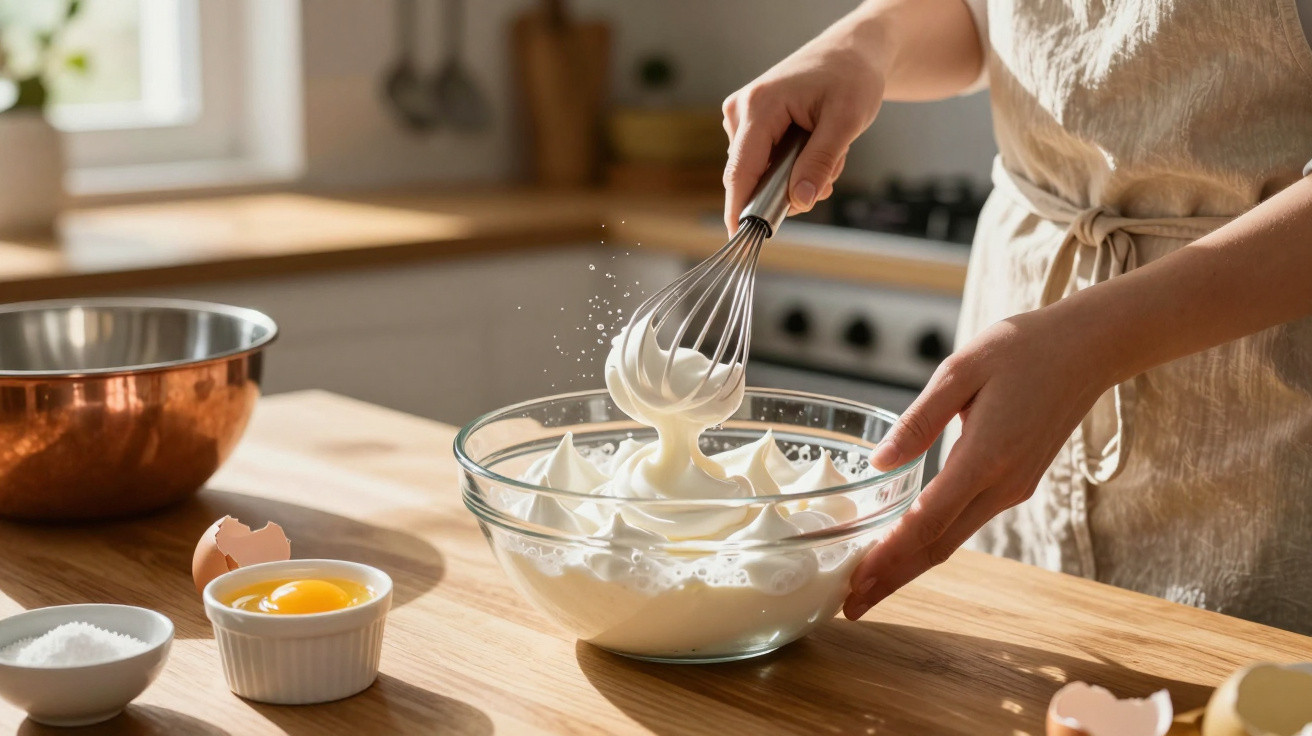
The bowl is ready, the whisk is spinning, yet the foam stays flat, glossy and almost mocking. We have all had that moment of watching egg whites, hoping for a firm cloud, only to find they still look like slightly stirred soup. We blame the mixer, eggs that are too old, a poorly written recipe or even the weather, because there has to be someone to blame. Yet the explanation is often hidden in one tiny detail, barely noticeable at first glance. That detail can spoil a meringue, financiers or a soufflé within seconds. The real secret is far simpler than it seems.
The invisible detail that stops egg whites whipping
Egg whites turn into peaks because their proteins trap air as the whisk moves. When it works, the process feels almost magical: the mixture turns white, expands, then makes soft peaks that hold to the whisk. However, even the smallest trace of fat disrupts this delicate balance.
The usual problem occurs while separating the eggs. A little yolk slips into the bowl, perhaps only a drop, and it is tempting to think it will not matter. In the kitchen, though, this tiny mark can stop the proteins from forming a stable foam: yolk contains lipids - in other words, fat - and the whites will then refuse to increase in volume.
Yolk is not always to blame. A bowl that was not properly rinsed after holding a vinaigrette, a whisk stored near an oiled frying pan, or fingers still coated in butter may be enough. Egg whites are remarkably sensitive. They ask for very little, but the equipment must be impeccably clean, dry and completely free from grease.
The steps that genuinely improve the result
The safest habit is to crack each egg into a small separate container before adding the white to the main bowl. If the yolk breaks, you will not spoil the four whites you have already separated. Choose a stainless-steel or glass bowl where possible, as some plastic bowls retain an invisible greasy film even after washing.
Before you begin, wipe the bowl and whisk attachments with kitchen paper lightly moistened with white vinegar or lemon juice. This may sound excessive for a simple foam, but it removes the final traces of grease. To be honest, hardly anyone does this every day, but for pavlova or macarons, the difference is very clear.
Egg temperature matters too, although it is not the main reason for failure. Whites at room temperature often whip to a greater volume, whereas chilled eggs produce a slightly tighter, more stable foam.
“An egg white does not forgive fat, but it rewards patience.”
- Use a completely dry glass or stainless-steel bowl.
- Separate the eggs individually into a separate container.
- Start at a medium speed, then increase it gradually.
- Add sugar only once the foam has already formed properly.
Why whisking egg whites harder does not solve everything
When egg whites refuse to whip, the instinct is to turn the mixer up immediately. It makes sense: the noise is reassuring, and the movement creates the feeling that something is being done. Starting too fast, however, produces large, uneven air bubbles that are less robust and may collapse before the mixture even reaches the oven.
Begin gently, allowing the whites to become foamy and opaque before increasing the speed. Stop when they form a peak at the end of the whisk. Overwhipped whites become grainy and dry, sometimes releasing a little liquid at the base of the bowl; at that point, they are harder to fold into a batter without deflating them.
Salt is another common source of confusion. Many older recipes recommend a pinch to “help” the whites, but this does not guarantee anything and may even weaken the structure depending on the preparation. A little lemon juice or cream of tartar is more useful for stabilising the foam, particularly when piping a meringue that will sit on a baking tray for some time.
A light foam, never left to chance
Making whipped egg whites is not a mysterious skill reserved for pastry chefs. It comes down to cleanliness, pace and attention to those small details that are easy to overlook when dinner needs to be ready in twenty minutes. A clean bowl, discarded yolk and a whisk started without haste: these are what turn a frustrating attempt into a dense, glossy foam.
The next time an egg white remains liquid, there is no need to battle with the stand mixer for another ten minutes. Instead, consider what happened before the whisk made its first turn: a poorly separated shell, a utensil that was still greasy, a drop of water or an overly aggressive speed often tells the whole story. There is something particularly satisfying about realising that a kitchen mishap is not inevitable.
Whipped egg whites also illustrate a simple truth: the most everyday recipes can sometimes depend on surprising precision. Once you have mastered the technique, it becomes easier to make floating islands on a weekday evening, a lighter chocolate cake, or the pavlova you have been putting off for months. The secret is not an expensive appliance. It is already in your cupboard, and in how you prepare the first bowl.
| Essential point | Detail | Added value for the reader |
|---|---|---|
| Fat is the enemy | Yolk, butter or oil prevent the foam from stabilising. | Quickly identify why an egg white remains liquid. |
| The right bowl | Glass and stainless steel are easier to degrease than plastic. | Achieve a more even rise without changing the recipe. |
| Gradual speed | Starting slowly creates a finer, stronger foam. | Avoid deflated, grainy or overwhipped egg whites. |

















Comments
No comments yet. Be the first to comment!
Leave a Comment