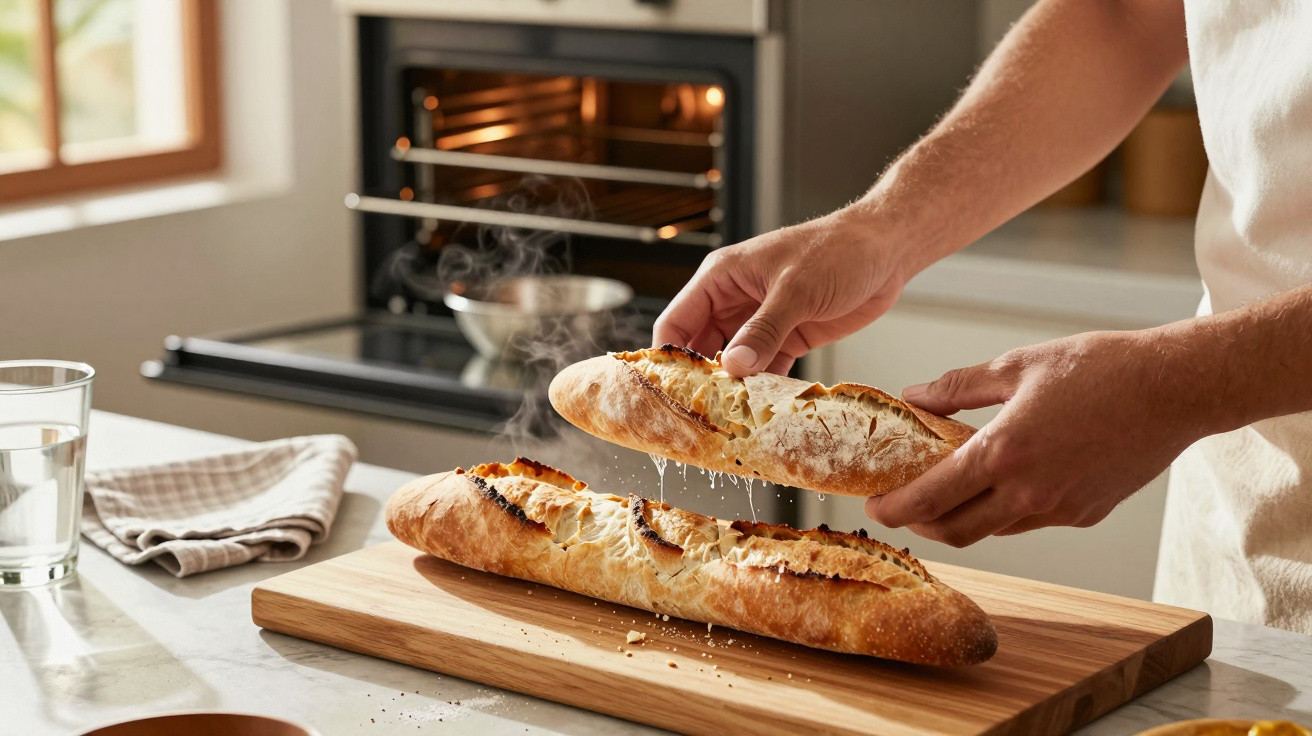
Chefs rarely mention this: what transforms yesterday’s baguette into a crackling, steam-speckled marvel is not really a “chef trick” - it is a baker’s everyday ritual, sitting in plain sight.
On the worktop sat a baguette that had been magnificent at breakfast but woeful by supper: the crust had lost its shine and the centre was as rubbery as an old eraser. I pulled off a piece in hope. There was no crackle or warm exhale, only the disappointing thud of stale bread.
I remembered the bakery queue that morning, the baker’s flour-covered forearms and the small nod he gave as he drew flawless loaves from the oven. “This life is heat and water,” he’d said to me, half joking. He was right: heat and water, applied in precisely the right sequence.
What follows seems like a modest piece of magic.
The quiet science behind that perfect crackle
Stale bread is not truly “dry”. As the crumb cools, its starch tightens, forcing moisture out and trapping flavour. To your mouth, that tastes like cardboard. Meanwhile, the crust that was once crisp absorbs moisture from the crumb and becomes softer still. The result is a loaf that appears perfectly acceptable yet tastes lifeless.
We have all been tempted by the microwave as the effortless answer. It is quick and available: press 30 seconds and cross your fingers. But the outcome is hot and damp, with a spongy bite that becomes gummy within minutes. Heat without circulating air is a dead end. Bread needs a little performance if it is to come alive again.
The baker’s approach could not be simpler: restore moisture to the surface, then hit it with fierce, circulating heat, so the outer millimetre dries to a glass-like crust while the interior turns tender again. There is no magic involved; it is simply starch becoming soft once more. To avoid sogginess, begin with fast steam and finish with dry heat. Bakers repeat this process before dawn, loaf after loaf, without ever giving it the grand name of a trick.
The baker’s two-step: water first, heat second
This is the precise technique bakers use to “refresh” bread. Heat your oven to 220°C (200°C fan). Hold the baguette beneath a cold tap for roughly three seconds on each side, or spray the whole loaf with 8–10 firm mists. It should glisten, not be drenched. Loosely wrap it in foil with the seam facing upwards, then place it directly on the oven rack for 6 minutes. Remove the foil, return the uncovered baguette to the oven and bake for 4–6 minutes, until the crust sings. Stand it upright on the rack for 3 minutes, allowing the crackle to set. This two-phase heat is the entire game.
Only have half a baguette? Neaten the cut edge with a fresh slice, add a light layer of water and use the same timings, though check it a minute sooner. Starting from frozen? Add 3 minutes to the foil stage. The usual mistake is saturating the loaf. You are not cleaning it; you are reviving it. Another error is an inadequate preheat. The oven needs to be properly hot, or the crumb will steam while the crust turns dull. Let’s be honest: nobody actually heats a pizza stone on a weekday, so the rack is your best friend.
If you are worried about taking it too far, use your ears. As a refreshed baguette cools, it murmurs with tiny cracks along its crust. That is how you know you have got it right.
“Water wakes it, heat finishes it. We don’t hide this,” a baker in Hackney told me, laughing. “It’s just bread being bread again.”
- Quick guide: mist or a 3-second rinse → 6 min in foil → 4–6 min unwrapped → 3 min rest.
- Fan ovens run hot: aim for 200°C fan, 220°C without.
- Softer crumb? Keep foil on for 1–2 extra minutes, then crisp fast.
- Extra crackle: preheat a tray and finish the last 2 minutes on it.
- No microwave. Ever. That’s how you get chew, not crust.
Why this works at home, every single time
Consider what takes place during those first minutes in foil. Surface water turns to steam, working its way back into the crust and upper layer of the crumb. The steam gently brings the loaf above 60°C, the temperature at which starch loosens and softens. When the foil comes off, the oven’s dry air completes the process, crisping the exterior before moisture can gather. It follows the same principle bakers use when they steam a new loaf at the beginning and vent it at the end. You are simply doing a smaller version with a weary baguette and a little confidence. You’re not rescuing bread so much as rewinding it, briefly, to the minute it left the oven.
Its forgiving nature is the best part. Even with five minutes either way, you can still achieve a shattering crust and a tender, fragrant middle. Pull it apart by hand and you will spot delicate strands of steam, catch that sweet fresh-toast aroma and hear a gentle crackle. Let’s be honest: nobody really does this every day. Still, when you make the effort, the entire table feels different. An ordinary soup becomes bistro-worthy, cheese becomes supper and leftovers no longer need to apologise.
The errors tend to be predictable, and entirely human: adding too much water because you do not trust the heat; not heating it enough because you are in a hurry; or keeping baguettes in the fridge, which speeds up staling. If you will not eat it on the first day, freeze it instead, then refresh it from frozen. Should the crust look ready while the centre remains cool, put it back in foil for a couple of minutes to carry the heat through. This is home cooking, not a purity test.
Try it, then pass it on
This small ritual makes a weeknight feel a little gentler. It is neither elaborate nor showy. It simply restores the pleasure you bought in the first place: the crackle that helps butter melt more quickly and the crumb that embraces soup like an old friend. Try it once and you will hear the distinction. Do it twice and you will begin assessing bread by its sound. Pass it on to anyone who insists bread “goes off” by tea time. They will reconsider the moment the crust sings. And if you ever feel like leaving out the water, test both halves side by side. One will be muted and dull; the other will feel alive. That is the unspoken secret bakers keep.
| Key point | Detail | Benefit for the reader |
|---|---|---|
| Rehydrate, then heat | Light water rinse or mist, then hot oven in foil before finishing unwrapped | Prevents sogginess and restores a glassy, crackling crust |
| Temperature matters | 220°C (200°C fan), middle rack, short timings | Reliable results with kit you already own |
| Science, simply used | Reverse starch staling with steam, then dry the crust | Confidence to fix any “day-old” baguette like a pro |

















Comments
No comments yet. Be the first to comment!
Leave a Comment