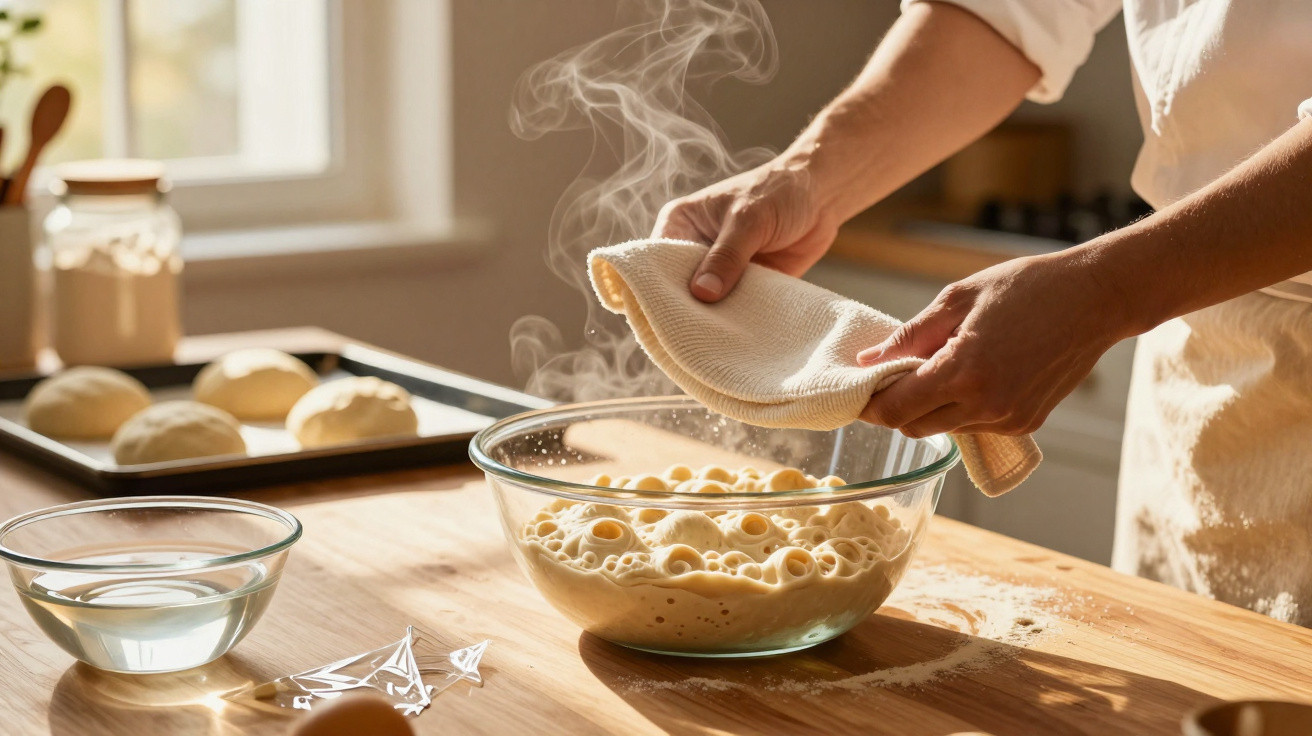
Many home bakers take care to use quality ingredients and dutifully knead according to the recipe, only to be disappointed when pizza emerges tough, brioche turns out dry or a cake base is brittle. The issue often lies not with the flour or yeast, but with what happens to the ball of dough while it rests. This is where a surprisingly simple technique can help, with no need for cling film.
Why protecting dough during its resting time matters so much
Whether it is pizza dough, brioche, braided loaf or shortcrust pastry, a great deal happens inside a ball of dough during its resting period. Gluten relaxes, fermentation gas develops and the dough’s structure changes. If its surface dries out at this stage, the final bake suffers.
“The most important factor for supple dough is an evenly humid environment – not an airtight plastic cover.”
This is especially relevant in winter, when central heating leaves indoor air dry and dough loses moisture rapidly. A thin, firm layer forms on the outside. That skin then stops the dough from rising lightly and makes it harder to roll out or shape later.
What truly happens inside dough while it rests
Three factors are determined during the resting stage:
- Texture: Will the crumb be soft later, or more crumbly?
- Elasticity: Can the dough be stretched easily, or will it tear?
- Volume: Will it rise into an airy dough, or remain dense?
When left uncovered, the outer layer dries faster than the centre. The dough develops tension cracks, becomes more difficult to shape and often bakes unevenly. Many people try to compensate by adding extra water or oil, but this merely shifts the issue: the structure becomes inconsistent and the flavour suffers.
Why cling film is overrated for dough
Cookery programmes, recipe books and baking videos almost automatically show every bowl covered with cling film. It may look professional, yet in a home kitchen it is often unnecessary.
The kitchen habit of reaching for plastic
Cling film has mainly become standard through habit: it is transparent, easy to use and creates a sense of control. Many assume that only an airtight cover is “truly professional”. In reality, dough chiefly needs a gentle, humid setting rather than a completely sealed environment.
Sealing a bowl tightly can even be counterproductive. Condensation gathers above the dough, making its surface overly wet and sticky, and it may lose crispness during baking – as can happen with a pizza base.
Hidden drawbacks of covering dough with plastic
- Environmental impact: Cling film is single-use plastic that goes straight into the bin.
- Distorted structure: Excess condensation can make dough soggy or uneven.
- Frustrating to handle: Film sticks to fingers, bowl rims and usually exactly where it is least wanted.
Anyone who bakes regularly soon finds that using cling film all the time is neither convenient nor sustainable. There is a far neater and simpler option.
The overlooked kitchen tool: a damp tea towel
The best answer is usually already in the kitchen: an ordinary damp tea towel. This traditional grandmother’s trick works remarkably well while saving both waste and money.
“A lightly dampened cloth creates a small, humid microclimate over the dough – entirely without plastic.”
Why a tea towel benefits dough
A tea towel acts like a breathable lid. It keeps the air above the dough humid while still allowing oxygen to circulate. As a result:
- the surface stays supple
- the dough can rise evenly
- no thick, hard skin develops
- the inside remains light and moist
The difference is particularly clear with long proving times, such as brioche or pizza dough left for several hours. The dough remains airy, while the finished crumb is soft and shreddable rather than dry and crumbly.
How to use a damp tea towel properly
The method is straightforward, although a few details make it foolproof:
- Choose a clean towel, preferably one without a strong detergent scent.
- Dampen it with cold or lukewarm water.
- Wring it out thoroughly: it should be damp, not dripping wet.
- Lay it loosely over the bowl or drape it directly over the dough.
- For longer proving periods, check it occasionally and dampen it again if necessary.
This protects almost any dough effectively, from a yeast-plaited loaf and burger buns to flatbread dough for the barbecue.
Clever alternatives when no tea towel is available
Out of cling film and with every towel in the wash? There is still no need to leave the dough bowl exposed. Many kitchens already contain useful alternatives sitting unused in a cupboard.
Suitable covers and how they work
The guiding principle is always the same: dough requires a humid microclimate. A range of everyday items can create one:
- An upturned plate: Place it over the bowl; it is close-fitting enough to retain moisture.
- A saucepan lid: Rest it loosely on top so that a little air can circulate.
- A glass or plastic container: Put the dough inside and place the lid on without snapping it fully shut.
- A dome or cover: A cheese dome, salad cover or even an upturned saucepan works very well.
For especially resourceful home bakers, a large chopping board can also serve as an emergency cover, provided it covers the bowl sufficiently.
Increasing humidity with simple additions
To enhance the effect further, try small extra measures:
- Place a small bowl of water beside the dough bowl.
- Lightly dampen baking parchment and lay it loosely over the dough.
- Brush the inside of a bowl with a little oil, add the dough and cover it.
These methods raise humidity within the dough’s small enclosed space without making everything wet and sticky.
When the dough has already dried out
What is done is done: no one thinks about moisture protection during every baking attempt. Fortunately, dough that has begun to dry can often still be rescued.
Typical signs that dough is too dry
Several warning signs occur repeatedly:
- The surface looks dull, cracked and hard.
- When pressed, the dough breaks instead of yielding elastically.
- Brioches or braided loaves rise noticeably less than expected.
- Shortcrust pastry cracks around the edges when rolled out.
At that point, the only option is gentle correction without completely remaking the dough.
How to rescue dough that has dried out
- Brush the surface with a little water using a pastry brush.
- Put the dough back beneath a damp tea towel and leave it to rest for 10–20 minutes.
- If needed, knead it briefly with very lightly dampened hands.
Do not expect miracles, but many doughs can still be brought back to a decent result rather than being thrown away.
The most important rules for perfectly moist dough
Anyone who bakes frequently can keep a short, practical checklist in mind. It helps make every resting period count.
| Rule | Benefit |
|---|---|
| Never leave dough uncovered | Prevents skins and cracks from forming |
| Cover it with humidity rather than making it completely airtight | Promotes a light structure and good volume |
| Prefer reusable tools | Reduces waste and protects the budget |
| Check moisture during long proving times | Keeps the surface supple throughout |
Once these principles become second nature, a large proportion of common dough problems are already under control, without any specialist equipment.
Practical examples from the kitchen
For a sweet braided yeast loaf, moisture protection prevents the strands from tearing during plaiting and produces a soft, shreddable crumb after baking. With pizza dough, the surface does not become leathery, allowing it to be stretched paper-thin without tearing holes.
Shortcrust pastry also benefits from being protected. If its surface remains soft, it can be rolled evenly without constantly breaking. Recipes of this kind are particularly sensitive to drying because the dough contains less water from the outset.
Why the “moisture trick” is more than a minor detail
This single step is ultimately based on a small interaction between physics and chemistry. Dough consists largely of water. When the surface dries too much, it affects the structure within: gluten strands tighten, the dough loses elasticity and responds differently in the oven than the recipe intended.
Understanding this changes the way you work. Instead of blaming every problem on the flour or the yeast, consider the conditions in which the dough rests. A damp tea towel, a suitable lid and a little attention are often all that is needed to turn an average result into a genuinely good one.
This small change in perspective is especially worthwhile for anyone who regularly bakes bread, pizza or sweet pastries. The extra effort remains minimal, yet the difference is far more noticeable with the first slice or bite of a still-warm piece.

















Comments
No comments yet. Be the first to comment!
Leave a Comment