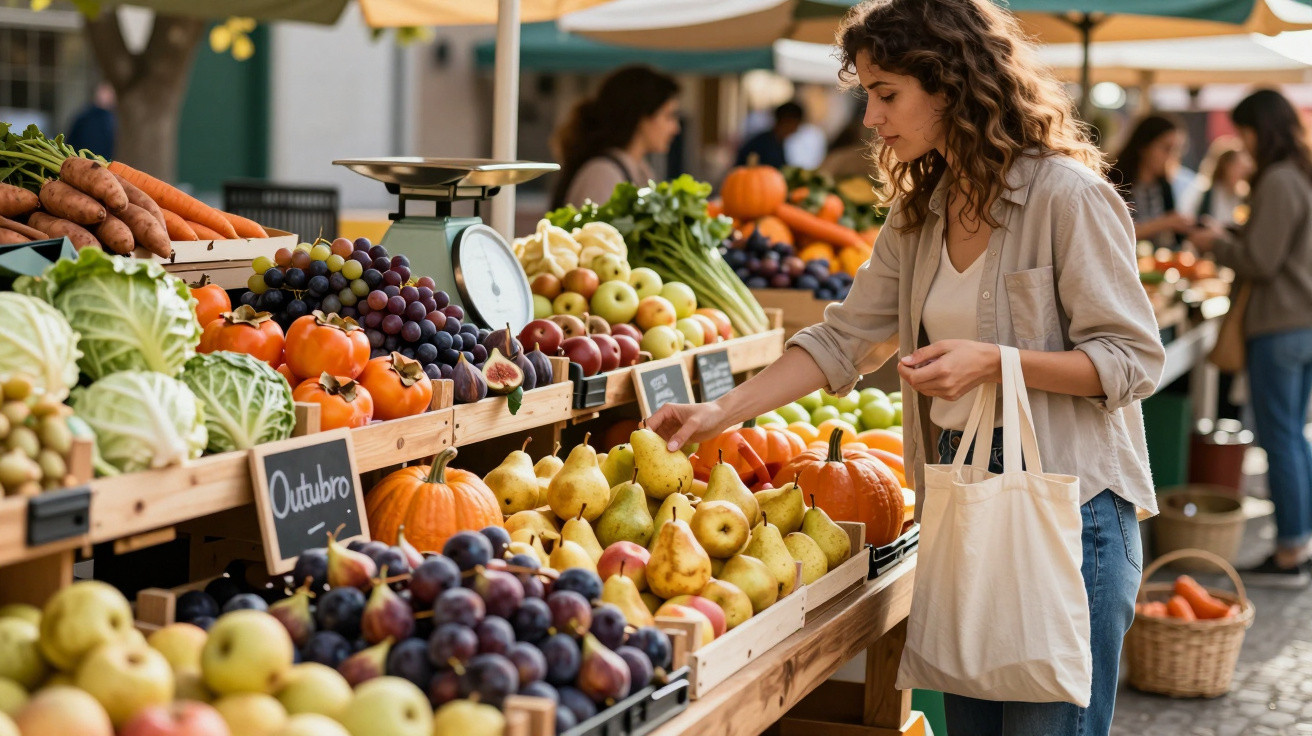
On an October Saturday, the market has that gently golden light that makes you want to fill your basket without thinking twice. Between crates of apples still beaded with freshness, knobbly squashes and bunches of grapes, you can almost taste the slow-cooked meals to come. We all know that moment of hesitation in front of an unfamiliar vegetable, before instinctively reaching once again for the same tomatoes or courgettes. Yet October brings a remarkable abundance, often cheaper than produce shipped from afar. The stalls change, and so do our cravings: steaming soups, rustic tarts, roasted pears and mushroom sautés. What if the best anti-inflation habit were simply hidden in the season’s colours?
In October, market stalls take on a new look - and prices often follow
With the first chilly mornings, summer fruit and vegetables gradually leave centre stage. Aubergines, tomatoes and melons may still be available from some growers, but their season is drawing to a close, while squashes, cabbages and leeks take over. The change is tangible: vegetables become heartier, more filling and easier to cook in generous quantities. Soup for two evenings, a family gratin, homemade compote… October encourages straightforward cooking. Sometimes, a well-chosen basket is all it takes to make you want to get back to the hob.
Prices often tell the same story as the colours on the stalls. When produce grows naturally nearby and arrives in plentiful supply, the costs of transport, heated greenhouses and storage are generally lower. A whole squash bought for a few pounds can provide several meals, whereas a bag of pre-chopped vegetables may be gone in one evening. At a local greengrocer’s, for instance, a family could use one potimarron squash in a velouté, a quiche and even a soft sponge cake. It is a small everyday win, not a culinary revolution.
Eating seasonally does not automatically mean paying the lowest price: an unusual variety, organic produce or crops grown in small quantities may still be expensive. However, the seasonal calendar offers a simple guide, especially when budgets are tight. Fruit and vegetables harvested when ripe also often taste better, as they have travelled less and spent less time in cold storage. Let us be honest: nobody manages this perfectly every day. The aim is not to hunt down every out-of-season strawberry, but to bring a few useful reference points back to the shopping basket - and avoid paying a premium for something that sometimes has no flavour at all.
The full list of fruit and vegetables to favour in October
For fruit, October is a generous month in mainland France. Apples lead the way, with dozens of varieties offering very different textures: crisp, tart, floury or fragrant. Pears, grapes, quinces, the last figs and certain plums continue the flavours of late summer. Chestnuts, walnuts and hazelnuts also deserve a place in the basket, although they are often overlooked in the fruit section. Depending on the region and the weather, persimmons may begin to appear. Citrus fruit, meanwhile, is still overwhelmingly imported at this time of year.
When it comes to vegetables, the choice becomes truly impressive: squashes, pumpkins, potimarron squashes, butternut squashes, carrots, beetroot, turnips, parsnips and celeriac create a vibrant store of colour. Leeks, spinach, Swiss chard, fennel, chicory, autumn lettuces and cabbages arrive with plenty of character. Cauliflower, broccoli, green cabbage, red cabbage, kale and Brussels sprouts may seem repetitive, but they do not all serve the same purpose. Cauliflower can be roasted, red cabbage can be eaten raw or slowly braised, and kale can be added to a sauté. Cold weather is far from monotonous.
The list may vary slightly between the Mediterranean coast, northern France, Alsace and mountain areas, which is precisely what keeps it interesting. Here are the most common pointers for choosing local, seasonal produce in October:
“The right seasonal product is not necessarily the most photogenic one: it is often the one that smells good, feels heavy in the hand and makes you want to cook it that very evening.”
- October fruit: apples, pears, grapes, quinces, late-season figs, late plums, persimmons depending on the region, chestnuts, walnuts and hazelnuts.
- October vegetables: pumpkin, potimarron squash, butternut squash, spaghetti squash, pattypan squash, carrot, beetroot, turnip, parsnip, swede, Jerusalem artichoke, salsify, black radish, celeriac, celery, leek, onion, garlic, shallot and potato.
- Add without hesitation: cauliflower, broccoli, green cabbage, red cabbage, savoy cabbage, kale, Brussels sprouts, Swiss chard, spinach, chicory, fennel, lettuce, lamb’s lettuce, rocket, mushrooms and the last French courgettes.
A common mistake is to buy an enormous squash without knowing what to do with it, then let it decorate the worktop for ten days. It is better to choose a squash that suits your routine: potimarron squash can be cooked with its skin on, butternut squash is sweet and easy to peel, while spaghetti squash delights children with its strands. For cabbages, roasting them with a drizzle of oil and a few spices often wins over even the most doubtful eaters. October vegetables rarely require complicated techniques; above all, they need a little time and one good idea.
To spend less, the most useful approach is to start with one main vegetable and build several meals around it. A kilogram of leeks can become braised leeks, soup and a tart; slightly bruised apples can be turned into compote rather than thrown away. Buy fruit at different stages of ripeness too: a few pears ready to eat, and some firmer ones for later in the week. Markets near closing time sometimes offer attractive prices, particularly for slightly imperfect crates. A battered apple is still an apple, and it will make an excellent tart.
Make October more flavoursome without turning food shopping into a mission
Perhaps October’s real pleasure lies in this less hurried kind of cooking: food that fills the flat with fragrance and brings people together without any grand speeches. Carrot and lentil soup, roasted cauliflower, baked pears with a little cinnamon - these modest dishes offer something comforting as the days grow shorter. They also make it easier to include more plant-based food in meals without chasing impossible perfection. A basket containing three vegetables, two fruits and a handful of nuts is already enough to transform the week.
Checking the country of origin on a label, chatting for two minutes with a market gardener or comparing prices per kilogram may seem ordinary. Yet these small habits give food shopping a different value: we better understand what we eat, discover forgotten varieties and waste less. Seasonality is not a rigid rule, still less a way to judge other people. It is a practical thread to follow when inspiration is lacking, and a valuable one when the receipt starts becoming too long.
October vegetables also encourage a sense of freedom. There is no need to follow a recipe to the gram: a handful of spinach in an omelette, celeriac in mash, or a few cubes of apple in a red cabbage salad can be enough. Flavour is often created from what is already in the fridge. And when an idea works, it deserves to be written down, shared or simply made again the following week. Seasons pass quickly; some flavours, however, stay in the memory for a long time.
| Key point | Detail | Added value for the reader |
|---|---|---|
| Choose the month’s produce | Apples, pears, grapes, squashes, cabbages, leeks, root vegetables and autumn salads are at the heart of the season. | Simpler, tastier and often more affordable food shopping. |
| Plan several uses | The same squash, a bunch of leeks or a kilogram of apples can be used for several meals. | Less waste and more ideas for pressure-free cooking. |
| Embrace imperfections | Slightly marked fruit and vegetables are still ideal for soups, compotes, gratins and tarts. | Better control of the budget without giving up the pleasure of eating well. |

















Comments
No comments yet. Be the first to comment!
Leave a Comment