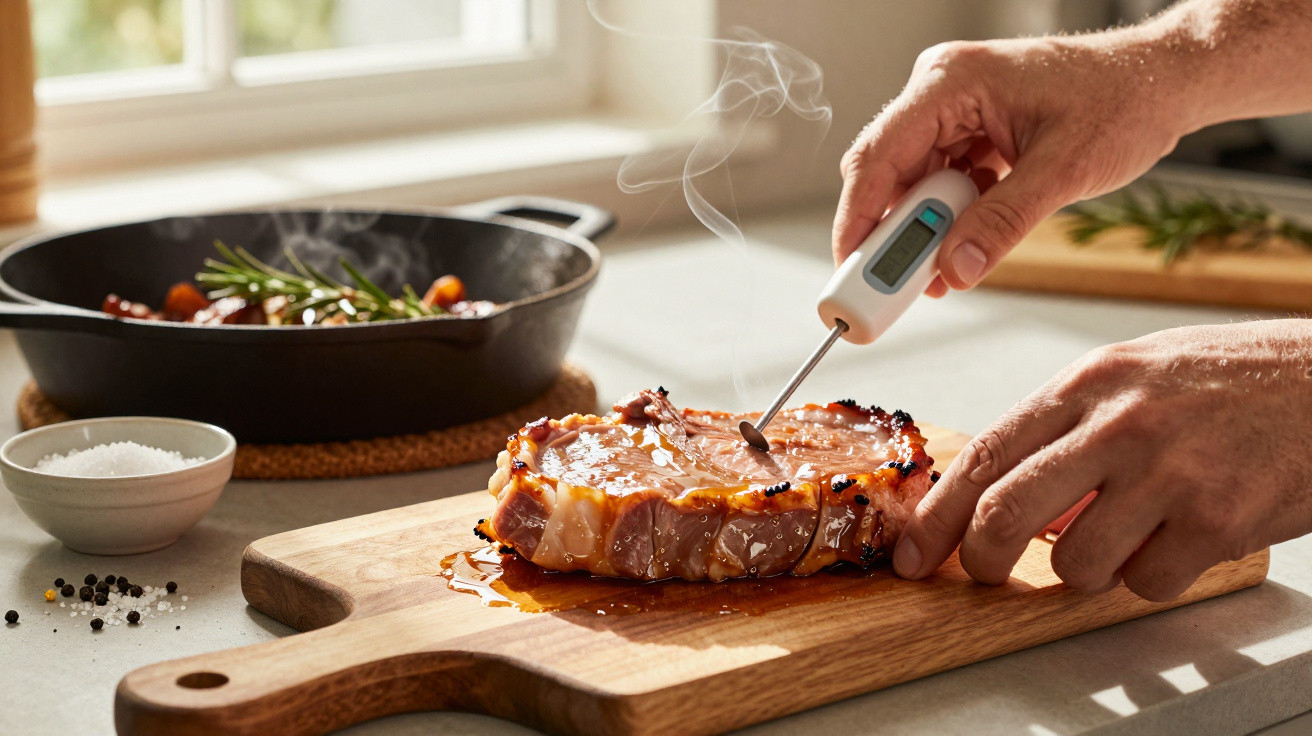
The steak sizzles in the frying pan, the guests are waiting, and sometimes everything comes down to thirty seconds. We all know that moment of hesitation: should you turn it one last time, leave it to rest, or quietly cut into it to check? Overcooked meat can quickly become dry, while a cold centre disappoints even those who enjoy blue steak. The real indicator is neither the colour of the outside nor the timing stated in a recipe: it is at the centre of the cut, where its temperature precisely reveals the level of cooking. A thermometer can transform many dinners.
Blue, rare and medium steak: what temperature really tells you
At home, steak is often judged by touch, comparing its firmness with the palm of the hand. It has a certain charm, but this technique is imprecise, particularly when the cut is thick or has just come out of the fridge. Core temperature, on the other hand, does not lie: a blue steak sits at around 45 to 48°C, with a well-seared exterior and a red, barely warm centre.
Rare steak, the great bistro classic, usually reaches a core temperature of 50 to 52°C. The middle remains red, juicy and tender, releasing that grilled beef aroma that draws the neighbours into the kitchen. For a 250-gram sirloin steak measuring 2.5 centimetres thick, this often means two minutes on each side in a very hot frying pan, although the timing varies according to the heat and the equipment used.
For medium steak, the temperature rises to between 55 and 58°C: the centre turns pink and the texture firms up without becoming dry. Above 60°C, the meat is well done and the fibres contract further, forcing out some of their juices. A steak is not unsuccessful because it is well done; it is unsuccessful when it does not match the preference of the person eating it.
The right technique at the right time for even cooking
The most reliable method is to insert a probe thermometer into the middle of the steak, entering from the side if the cut is thin. Take the meat off the heat two to three degrees before it reaches the target temperature: it will continue cooking while resting, a process chefs call residual cooking. Aim for 43 to 45°C to serve blue, 48 to 50°C for rare, and 53 to 55°C for medium.
One common mistake is to put chilled meat, straight from the fridge, into a scorching frying pan. The crust browns too rapidly while the centre stays cold, leading to repeated turning in the hope of putting things right. Let the steak stand at room temperature for twenty to thirty minutes, pat it dry carefully, then season with salt immediately before or after cooking, according to your usual practice: nobody really does this every day, but the difference is noticeable.
The frying pan should be hot, rather than smoking like a chimney, and the steak needs sufficient room to sear properly. A knob of butter added at the end of cooking, together with a clove of garlic and some thyme, is often enough to create that subtle restaurant flavour people seek without always knowing how to describe it.
“Perfect cooking is not a matter of minutes: it is a matter of temperature, thickness and attention,” says a well-known principle in professional kitchens.
- Blue: 45 to 48°C at the core, with a red, warm centre.
- Rare: 50 to 52°C at the core, with a hot red centre that is very juicy.
- Medium: 55 to 58°C at the core, with a pink centre and a firmer texture.
- Well done: from 60 to 65°C, with a brown-grey centre and tighter fibres.
Resting steak: the detail that changes everything on the plate
Resting can feel almost frustrating when the steak has just left the frying pan and its smell fills the room. Yet five minutes beneath a loosely placed sheet of foil allows the juices to redistribute through the fibres. Cut it too soon and they spread across the plate; wait a little and every mouthful becomes more tender.
A thermometer takes nothing away from the enjoyment of cooking; quite the opposite. It removes the small anxiety behind that first cut, which can spoil a fine crust simply to see what is inside. After two or three attempts with your own frying pan, usual thickness and favourite cut, the reference points become almost instinctive.
There is still room for personal preference: some enjoy the very red centre of a flank steak, while others prefer a distinctly pink rump steak or a medium rib-eye. Next time a steak is on the heat, simply note the temperature reached and the reaction around the table. That is often how the best cooking habits begin.
| Key point | Detail | Benefit for the reader |
|---|---|---|
| Core temperature | Blue: 45–48°C; rare: 50–52°C; medium: 55–58°C | Choose a precise level of cooking without relying on time alone |
| Removing from the heat | Take the steak off the heat 2 to 3°C before the desired temperature | Allow for residual cooking and avoid overcooked meat |
| Resting time | Leave to rest for around 5 minutes after cooking | Retain the juices and achieve a more tender texture |

















Comments
No comments yet. Be the first to comment!
Leave a Comment