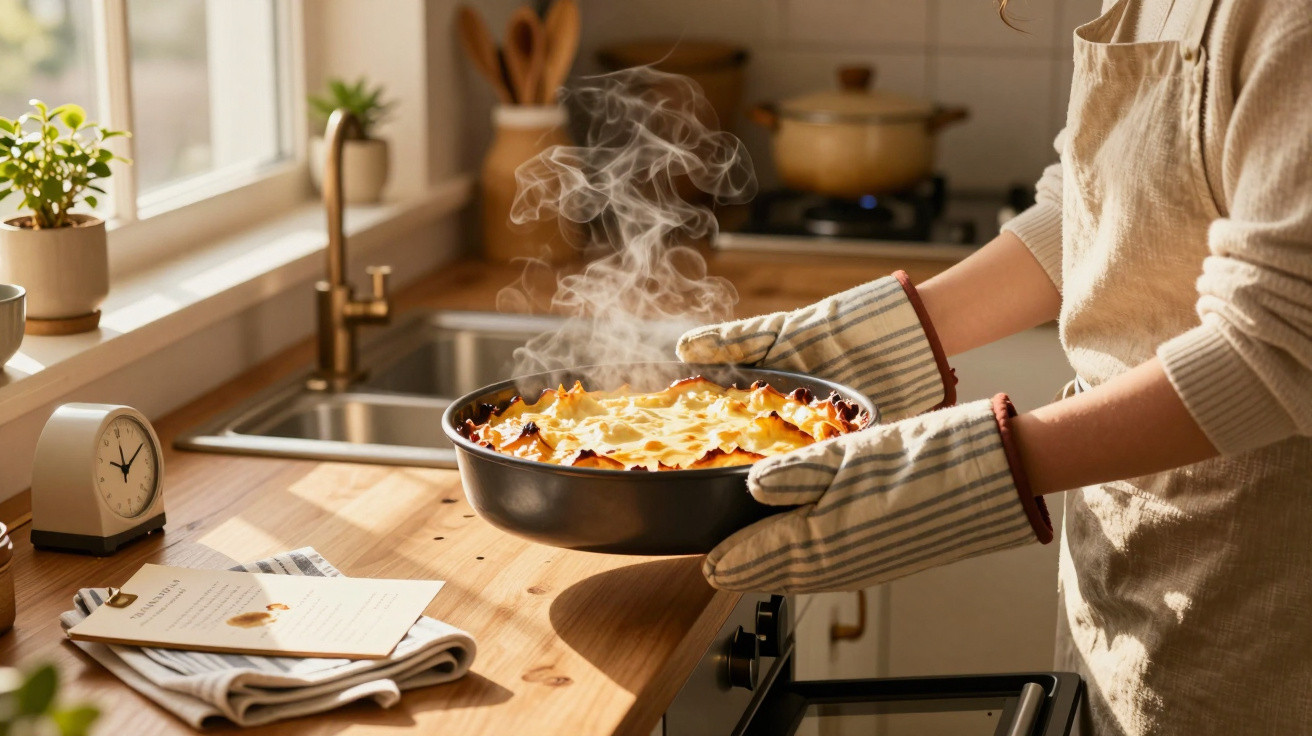
The other evening, I opened the fridge and felt that familiar surge of weary annoyance. There was half-wilted spinach, a single carrot and three different cheeses looking back at me as though they were awaiting a decision. After the day I’d had, my mind had no space whatsoever for creativity. I didn’t want anything “inspired”. I wanted something hot, comforting and 99% certain to turn out well.
So, as I do on evenings like that, I reached for the same chipped ceramic dish, gathered the same small collection of ingredients and began my no-surprises bake: the recipe that never puts up a fight.
Once the oven began its quiet hum and the scent started to spread through the kitchen, my shoulders eased by a good two centimetres. I knew precisely how the evening would end.
At times, that sort of certainty feels like its own small magic.
The comfort of a recipe that never lets you down
Some recipes belong in a category all of their own: they make no claim to transform your life. They simply put supper on the table, steadily and without fuss, while you scroll on your phone or reply to that final irritating email. My dependable warm bake belongs firmly in that category. It is an uncomplicated layered oven dish of tender potatoes, onions, pieces of whichever tasty cheese I have to hand and perhaps leftover chicken or roasted vegetables, all covered with a speedy seasoned mixture of cream and eggs.
It sounds straightforward because it is. That is exactly why it works. When the rest of the day has offered enough surprises, dinner does not need to introduce any plot twists.
One Wednesday, everything seemed to unravel at the same time. A delayed train, childcare trouble and a message from my bank beginning with “unusual activity”. By 7:30 p.m., one more tiny setback might have reduced me to tears. When I arrived home, I put down my bag and, rather than ordering an expensive takeaway I could not really justify, arranged potatoes on the chopping board. Thin slices. A repeatable motion.
As the dish cooked, my child did their homework at the table and asked the sort of questions that normally irritate me when I am exhausted. That evening, they did not. The steady pattern of “cut, layer, pour, bake” had already brought me back into myself.
This recipe succeeds because it removes choices. There is no need to judge your worth by how many pans you can keep going at once. Use what is available: potatoes or sweet potatoes, cream or milk, Cheddar or the unidentified cheese lurking at the back of the fridge. The framework never changes.
There is a subtle psychological comfort in knowing that, if you can slice, season and wait 30–40 minutes, you will have a soft-centred, bubbling dish with a browned top that tastes like a hug. A predictable outcome in a messy day is harder to find than you think.
How the no-surprises bake works
This is the loose method I keep in my head, rather than on an immaculate recipe card. I heat the oven to about 190°C. As it comes up to temperature, I cut 4–5 medium potatoes into slices as thin as my patience permits. You do not need flawless mandoline technique. I butter the baking dish rather casually, add an initial layer of potatoes, then season with salt, pepper and perhaps a little garlic powder or smoked paprika.
Next comes something with character: grated cheese, leftover roasted vegetables, shredded chicken or even cooked lentils when I am trying to feel virtuous. I continue building layers until the dish is nearly filled.
In a jug, I whisk 2–3 eggs with roughly 250–300 ml of cream or milk, a small handful of grated cheese and a pinch of nutmeg when I happen to remember it. I tip this over the layers, letting the liquid find its way into the spaces. If it falls short of the top, I pour in a small extra splash of milk. Cover with foil and bake for 25–30 minutes, then take off the foil and leave it to brown for a further 10–15 minutes.
Honestly, no one measures every element of this on every ordinary day. You keep an eye on the edges. You follow the smell.
The errors are gentle and easy to forgive. Add too much liquid and it becomes closer to a gratin custard; use too little and the upper layer turns a little crisp. Either way, it remains perfectly edible.
This type of dish is often made more complicated than it needs to be, with people chasing the ideal Instagram-worthy slice. It is easier to think of it as three basic controls: starch (potatoes, pasta, rice), richness (cheese, cream, butter) and flavour boosts (onions, herbs, bacon, roasted garlic). If one is in short supply, lean more heavily on another.
What you’re really baking is not just food, it’s a sense of control. On a difficult day, that can be worth more than even the most elaborate recipe.
Sometimes I think of this dish as the opposite of all those glossy “one-pan miracle” recipes. Those promise transformation; this one promises exactly what you expect. And when you’re exhausted, consistency beats excitement every single time.
- Base: finely sliced potatoes or leftover cooked carbohydrates (pasta, rice, quinoa)
- Binder: eggs + milk/cream + a handful of cheese
- Flavour: onion, garlic, herbs, smoked paprika, mustard or leftover roasted vegetables
- Optional protein: shredded chicken, ham, beans, cooked sausage
- Texture boost: breadcrumbs on top, extra cheese during the final 10 minutes
Why this kind of recipe quietly saves the week
There is a reason so many households rely on a “default” bake or casserole nearly every week. It provides a modest anchor amid appointments, screens and unexpected emergencies. Everyone knows that moment of opening the cupboard while your mind simply says, “Not tonight.” This sort of recipe responds: “Don’t think. Just layer.”
It doesn’t need your best self to succeed. It manages perfectly well with the version of you that is a little hungry, a little irritated and checking the weather forecast as if it might solve everything.
Over time, a dish like this becomes an understated record of everyday life. One week, it is packed with spinach and leeks because you bought too much at the farmers’ market. The next, it is chiefly potatoes and cheese because payday remains a few days away. You begin to recognise the seasons not from the calendar, but from whatever is tucked between those slices.
There is something personal in that. This is not cooking for display; it is cooking to make it through the evening intact, with something warm in your bowl and fewer dishes waiting in the sink.
Perhaps you already make your own version of this recipe without ever having given it a name. It might be a baked pasta you can assemble half-asleep, or a tray of roasted vegetables and chickpeas that always turns out reasonably well regardless of the seasoning. Think of this as permission to appreciate that “boring” dish.
Give yourself permission to repeat it, refine it, lean on it. Ask your friends for their no-surprises recipe and you may be surprised by how many people quietly depend on the same principle: one dish, familiar steps and dependable comfort.
The world will continue to deliver surprises. Your supper need not do the same.
| Key point | Detail | Value for the reader |
|---|---|---|
| Simple structure | Base + binder + flavour, layered repeatedly | Makes it easier to improvise with whatever is in the fridge |
| Low decision load | The method stays the same, while ingredients remain flexible | Lessens stress on busy or exhausting days |
| Reliable comfort | A warm, creamy baked dish with a browned top | A predictable, comforting meal that still feels homemade |

















Comments
No comments yet. Be the first to comment!
Leave a Comment