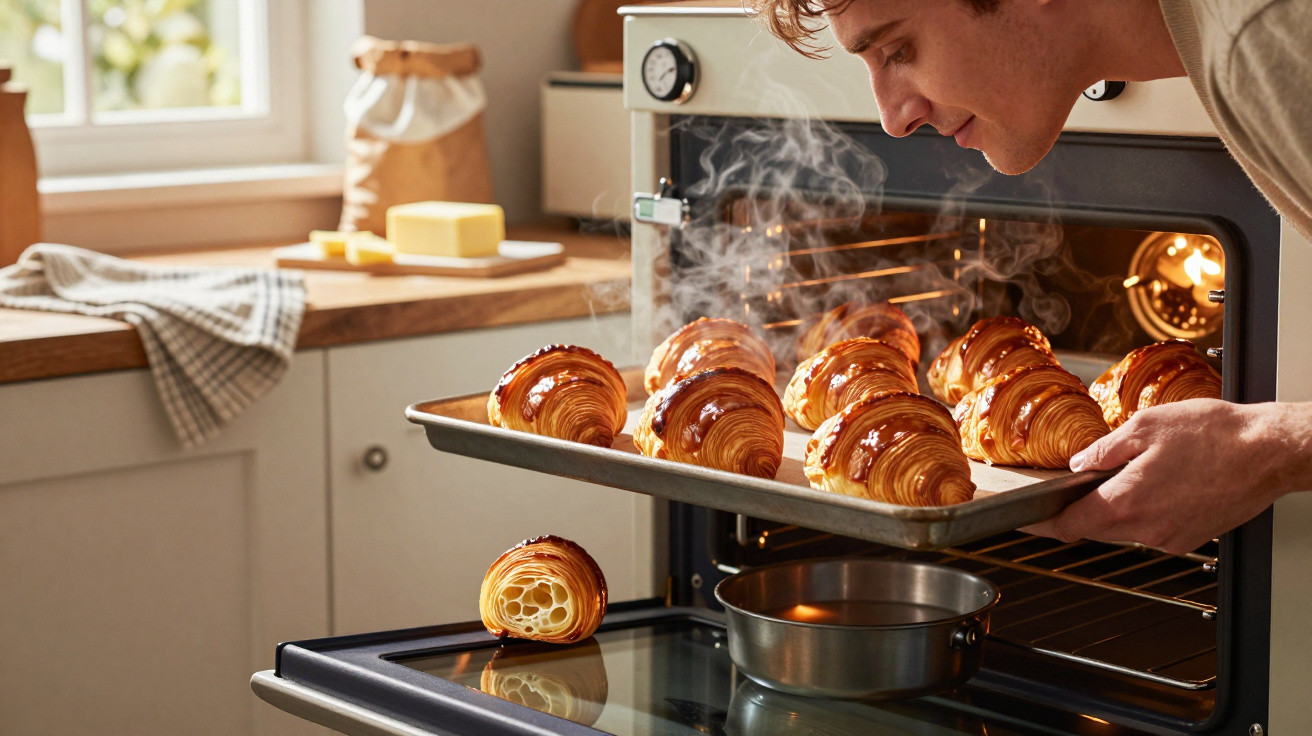
Saturday morning: no alarm, a coffee warming your hands.
You lift a tray of homemade croissants from the oven, golden and triumphant – then take a bite.
They taste good, certainly, yet something is missing. There is less crackle, less aroma and less of that “How is this even bread?” sensation you get from the bakery round the corner.
You used the recipe, gave the dough time to rest and even treated yourself to quality butter. Yet the croissant from the boulangerie down the road still seems like an entirely different creature.
There is a reason.
It lies in a baking technique that most domestic ovens cannot quite reproduce.
The unseen secret: heat that works like a professional oven
Step into a small local bakery at 6.30 a.m. and glance towards the back room. You will usually see a huge oven humming away, its door opening for only a moment as trays are moved in and out.
The scent is extraordinary, but the most important factor is invisible.
That oven is not merely hot. It delivers powerful, steady heat from every direction, often with steam and, in some cases, rotating shelves to ensure an even bake. The air, metal and stone inside it all work as one.
Your oven at home attempts to do the same thing. Most of the time, though, it is only a very approximate version.
A professional deck or convection oven can maintain its temperature to the exact degree. A baker can press a button, load 60 croissants at once, and the temperature will not suddenly fall by 40°C as a domestic oven often does when its door opens. Consistency is built into the equipment.
Some bakery ovens also introduce steam at the beginning of the bake. This light mist keeps the dough’s surface pliable for just long enough to let the layers open up, producing dramatic volume and a paper-thin crust. In many home ovens, steam amounts to a tray of water that never delivers the same result.
Ask a baker to show you the base of a croissant. Its colour, crunch and tiny air bubbles reveal the oven’s influence even more than the recipe does.
So, if your croissants emerge slightly dense or unevenly browned, it is rarely a case of “you’re terrible at baking”. The physics of your oven are simply working against you.
Professional ovens strike the dough with intense heat underneath, measured heat above and balanced airflow all around. That allows the butter in every laminated layer to melt and turn to steam in a precise manner, forcing the dough apart like countless tiny balloons inside it.
At home, hot spots, insufficient preheating and heat lost when the door is opened can undermine that effect. The same dough, baked in two different ovens, can taste like two different recipes. What you taste in the bakery is the flavour of accurately controlled heat.
The “cold-butter, hot-oven” choreography for bakery croissants
If the oven is the stage, butter takes the leading role. Bakery croissants taste superior because the butter within them is handled with almost obsessive precision.
In a quality bakery, the butter block is rolled to an exact thickness before being enclosed in dough that is cold yet still flexible. The acceptable temperature range is narrow: butter that is too soft smears into the dough, while butter that is too hard breaks apart.
Those crisp, separate layers of butter are why a croissant bursts into flakes when torn open. They will only rise as intended when they meet a genuinely hot oven that has been thoroughly preheated. Cold butter and a hot oven are an unspoken agreement.
At home, it is easier for that agreement to break down. You may be rolling dough on a warm worktop while the radiator is running, with hands that are quite literally 36.5°C. Each turn warms the butter a little further.
Then the tray goes into an oven that its indicator light says is “at temperature”, although it may actually still be heating up or cycling through cooler patches. Rather than steaming between the layers, the butter begins to escape. Small pools of sizzling fat appear on the tray, and the croissants look greasier than those from the bakery.
Most of us know that moment: the kitchen smells wonderful, but the first mouthful feels unexpectedly heavy.
Bakers counter this with a discipline bordering on stubbornness. The dough is refrigerated between turns, work surfaces are kept cool, and butter is selected for a particular fat content and level of plasticity.
Next comes proofing: the quiet period in which yeast expands the layers. In a bakery, this is done in a proving cabinet set to a controlled temperature and humidity. At home, it happens wherever there is a reasonably warm spot – on top of the fridge, by a window or beneath a tea towel.
That distinction is enormous. Croissants that are overproofed collapse, while those that are underproofed fail to rise properly. Honestly, almost nobody manages this perfectly every single day. Professionals do, however, and that is why their crumb can seem almost unfairly good.
Bringing bakery magic into your own kitchen
You cannot transform a domestic oven into a £20,000 deck oven, but you can adjust a few things in your favour. Begin with the stage many people hurry through: preheating.
Allow your oven at least 30–40 minutes to heat completely, even when the indicator claims it is ready. Place a baking steel or a thick, dark baking tray on the middle shelf as it preheats. This heated surface works like a miniature bakery floor, driving heat directly into the bottom of each croissant.
Just before baking, refrigerate your shaped croissants for 10–15 minutes. This brief chill firms the butter again, helping it puff rather than leak. Think of it as one final deep breath before the heat arrives.
You can also imitate steam. Put a cast-iron pan or sturdy metal tray on the lowest shelf while the oven preheats. Once you load the croissants, pour a cup of very hot water into that pan and shut the door quickly.
The sudden steam helps the dough stretch and expand, creating more volume along with a finer, shinier crust. It is not the same as professional steam injection, but it is far more effective than a lone ramekin of water in one corner.
Proofing matters too. Locate the most reliably warm place in your home, often an unheated oven with only its light switched on. Give the croissants time until they appear swollen and jiggly, and the tray feels as though it holds almost weightless pastries when nudged.
Some bakers have a simple mantra: “Respect the butter, respect the heat.” Croissants aren’t really complicated food – they’re just extremely sensitive to laziness in those two areas.
Chill between turns
Refrigerate the dough for 20 minutes whenever it begins to soften. This reduces smearing and preserves more layers.Use a heavy baking surface
A preheated steel or thick tray focuses heat beneath the croissants, improving their lift.Control proofing
Look for dough that is puffy rather than doubled in size. Layers that have inflated too much will collapse in the oven.“Over” preheat the oven
Leave it longer than seems necessary. Reliable heat is better than a misleading temperature light.Choose higher-fat butter
European-style butter containing around 82% fat generally produces cleaner steam, better flavour and more distinct layers.
Why bakery croissants still come out on top – and why that is fine
Even after trying every trick, one reassuring fact remains: your kitchen is not a bakery, and your routine is not a baker’s routine. Bakers begin work while the town is still asleep, repeat identical movements before every dawn and use machines calibrated like musical instruments.
The croissant you buy across the counter is the product of repetition and fixation, rather than a strong recipe alone. That is why its crust crackles more loudly and its centre tastes more fermented, more buttery and more… inevitable. If your croissants do not match it, you have not failed; you simply do not have the same tools or hours of practice.
There is another factor as well: calibration. If bakery croissants are the first ones you eat, your brain decides that they are the “correct” version. Anything softer, denser or less layered can seem wrong, even when it is genuinely delicious.
Homemade croissants have a flavour of their own, though: the slightly uneven rolling, the unusually large one at the edge of the tray and the corner that browned too deeply because you checked your phone. They taste of a weekend rather than a production timetable.
At times, that is precisely the flavour you want.
So why do bakery croissants so often taste better than homemade croissants? Behind that flawless flaky mouthful sits a complete system: managed heat, disciplined timing, professional-quality butter and years of muscle memory. You can borrow parts of that system – a hotter baking surface, a steam method and colder dough – and your croissants will move up an entire level.
You are unlikely to recreate your favourite Paris visit in a rented kitchen, and that is alright. What you can make is something different: a flaky, imperfect version that is completely yours and carries your Sunday morning through the whole day. And if you eventually make a batch that truly rivals the bakery down the street, do not be surprised if its magic feels a little less mysterious.
| Key point | Detail | Value for the reader |
|---|---|---|
| Oven behaviour | Bakery ovens provide stable, powerful heat and steam, unlike most domestic ovens | Explains why texture and rise can differ despite using the same recipe |
| Butter handling | Cold, clearly layered butter enters a very hot environment and steams between the layers | Gives readers a practical aim for lighter, flakier croissants |
| Simple upgrades | Longer preheating, chilled dough, a steam pan, and a heavy tray or steel | Straightforward adjustments that visibly improve homemade croissant quality |
FAQ:
- Question 1 Why are my homemade croissants dense instead of flaky? Usually, the butter became too warm during lamination, or the dough was underproofed or overproofed, preventing the layers from rising in the oven.
- Question 2 Can I get bakery-style croissants with a normal home oven? You can come very close by fully preheating the oven, using a hot baking steel or thick tray, chilling shaped croissants and making steam with a pan of hot water.
- Question 3 Does the type of butter really matter that much? Yes. Higher-fat, European-style butter with good plasticity creates better layers, flavour and steam expansion than very soft, low-fat butters.
- Question 4 How do I know when my croissants are proofed enough to bake? They should look noticeably larger, feel light and wobbly when you gently shake the tray, and slowly spring back when touched.
- Question 5 Why do bakery croissants have a stronger aroma? Professional ovens, fermented dough schedules and high-quality butter work together to release more complex aromas while baking.

















Comments
No comments yet. Be the first to comment!
Leave a Comment