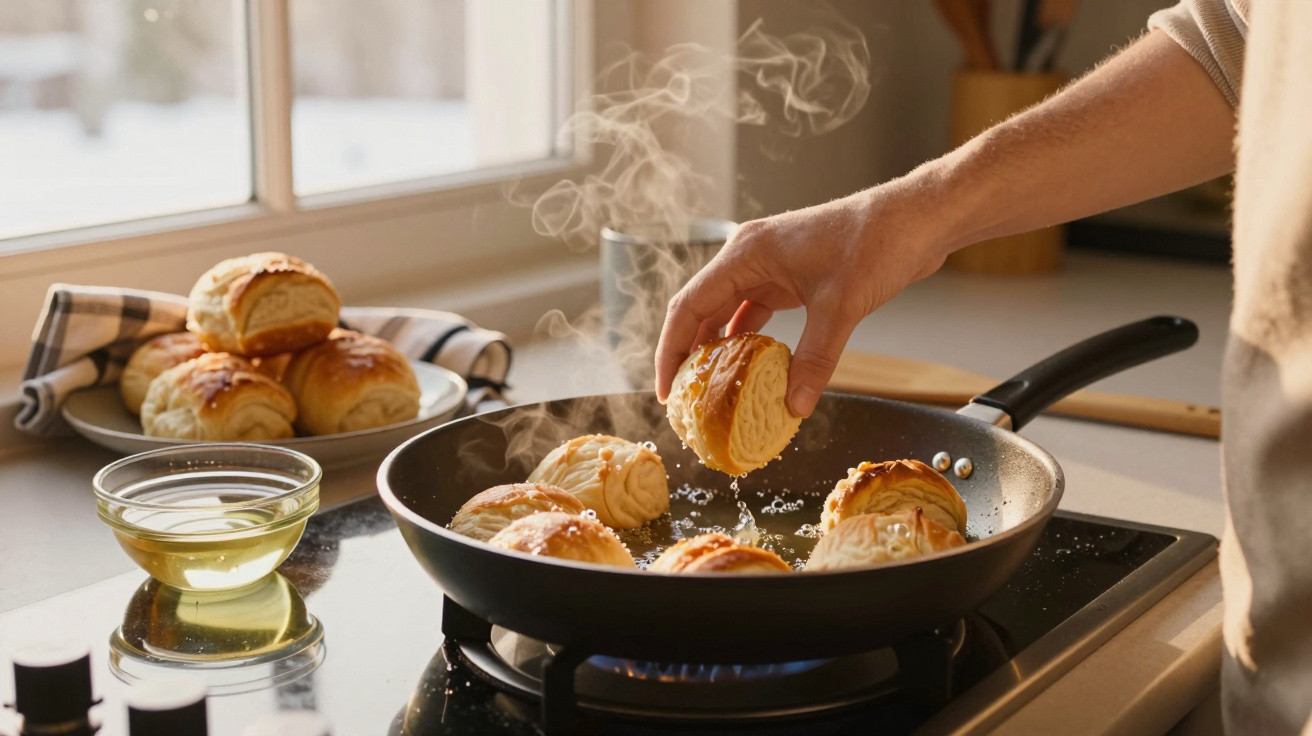
In a compact kitchen, a frying pan takes on the role normally reserved for an oven. There are no baking trays, no preheating and no timer ticking away in the background. Instead, there is the gentle sizzle of dough meeting hot oil and the small pleasure of seeing little flat rounds swell into golden, fluffy bread rolls before your eyes.
You pull one apart with your hands, far too impatient to reach for a knife. A puff of warmth escapes, faintly sweet and almost buttery, even before any butter is added. Its crust is fine and soft, while the middle is as airy as a freshly plumped pillow.
Pan-fried bread rolls might sound like campsite fare or a student shortcut. In reality, they are a modest winter miracle, particularly when you are hungry, worn out and do not have time to treat the oven as an option. The real trick happens well before the dough ever reaches the pan.
The comforting appeal of bread with no long wait
Cold evenings bring a very specific sort of hunger. You are not looking for a salad or something made for Instagram. You want warmth that can be held in both hands, with a smell that suggests someone is taking care of you.
That is exactly where pan-fried bread rolls come in. There is no need to switch on an oven that consumes half an hour of your evening. You do not have to wait for dough to rise like a contestant on a baking programme, either. All you need is a bowl, a frying pan and a dependable hob.
Their appeal lies in the contrast of textures. The exterior offers a mild, slightly chewy bite, while the inside remains remarkably airy and soft. It provides all the comfort of newly baked bread without the extended, patient process usually attached to it. It is winter food reduced to its essentials.
In smaller flats, where ovens may be undersized or unreliable, a recipe like this can become a quiet lifesaver. I met a young couple living in a 22-square-metre flat in Leeds who cook pan-fried rolls almost every Sunday evening. They say that the sound of dough touching hot oil has become their sign that the week has properly ended.
They began making them because the old oven in their rented home scorched everything on one side. After searching for “bread without oven”, they found a homemade flatbread video and continued adapting it until they had these plump little rolls. Now they fill them with leftover roasted vegetables, scrambled eggs or simply a generous spread of salted butter.
They are far from the only ones. Fresh-bread shortcuts are booming across social media: quick, yeast-free, no-knead and no-rise recipes gather tens of millions of views, with likes from people who confess that they “never bake” yet still want that first tear of warm bread in their hands. These rolls satisfy the same urge: they are quick, genuine and just a little bit magical.
There is, however, a straightforward piece of kitchen logic behind that magic. Traditional bread needs time for yeast to ferment, produce gas and develop its airy structure. These winter rolls commonly leave yeast out altogether. Baking powder, or a combination of baking powder and yoghurt, does the work instead, expanding the dough almost at once when heat is applied.
With a lid on, the frying pan acts as a miniature oven. It holds in steam, which raises the dough from within so that it puffs up rather than remaining flat and heavy. Heat from beneath forms a delicate crust, while the retained moisture preserves a tender centre. This is not traditional bakery science so much as useful home chemistry for tired people.
In this way, you avoid the slow stage of bread making without sacrificing that comforting texture. The goal is not artisanal perfection; it is the moment when everyone around the table reaches for “just one more”.
Pan-fried bread rolls: the smart technique for a fluffy, oven-free result
The core technique is almost surprisingly easy. Combine flour, a pinch of salt, baking powder and a wet, tangy ingredient such as yoghurt or buttermilk. The dough should be soft and a little tacky, rather than a firm, neat ball. That softness quietly points towards the fluffiness to come.
Leave it on the worktop for only 5–10 minutes as the pan heats up. It does not need an hour, let alone an afternoon: just enough time for the gluten to loosen slightly and for the baking powder to activate. Next, portion the dough into small pieces and either roll or press them into thick rounds.
The crucial element is the pan-and-lid combination. Use a medium frying pan over low-to-medium heat, with either a light coating of oil or a dry non-stick surface, plus a lid that fits properly. Put in the dough rounds, cover them and watch as they gradually rise into domes. Turn them once to colour the other side, and they are ready. There is no fuss, no second prove and no oven door to open.
At first, most people encounter the same three problems: excessive heat, dough that is too dry and impatience with the lid. When the heat is too high, the outside browns before the middle can rise. Dry dough produces something more like a cracker than a bread roll. And when you lift the lid every thirty seconds, the steam needed for the rolls simply disappears.
The dough ought to be soft enough to cling slightly to your fingers, without becoming gluey. If it seems too firm, an extra splash of yoghurt or water will usually solve it immediately. Keep the heat low to medium and allow the first side several undisturbed minutes. Small bubbles will appear on the surface before the whole roll expands like a little cushion.
If the first batch looks strange, you are in good company. Let’s be honest: nobody really makes this every day. By your second or third attempt, you will begin to understand the feel of it. It is kitchen practice, not an exam you can fail.
“The first time my grandmother showed me pan bread, she said, ‘We’re not baking, we’re improvising.’ That changed everything. It stopped being about technique and became about feeding people fast.”
Treat these rolls as a technique rather than an unchanging recipe. Grated cheese can be worked into the dough, their tops can be brushed with garlic butter after frying, or sesame seeds can be scattered over them before they go into the pan. They are also excellent when split and used as miniature sandwich rolls.
When hunger and tiredness make it hard to think, this is the genuinely useful short checklist:
- Soft dough: neither firm nor runny
- A 5–10 minute rest
- A warm pan over low-to-medium heat
- Keep the lid on to create steam and lift
- Turn once and do not hurry the browning
Why this small winter ritual feels so satisfying
As the days darken and everybody feels a little worn thin, the smallest routines begin to matter more. On an ordinary weeknight, spending thirty seconds bringing dough together in a bowl can feel unexpectedly grounding. Your hands are occupied rather than your screen, and you are shaping something you will eat in under twenty minutes.
There is also a quiet pleasure in seeing inexpensive, everyday ingredients become something that feels like a treat. Flour, a spoonful of yoghurt, a little oil and salt can suddenly become warm, fluffy bread with a scent that is part bakery and part home. It is comfort that requires no special occasion.
At a deeper level, these no-wait rolls solve a distinctly modern problem. We want food to feel “homemade”, yet our schedules rarely allow for slow proving and lengthy baking. Pan-fried rolls offer a loophole. They deliver the emotional reward of proper fresh bread without requiring you to reorganise your whole evening.
On a bitterly cold Sunday, you might make a large stew and feel rather accomplished. On a Wednesday, when your mind is foggy and the fridge seems empty, pan rolls topped with a fried egg and grated cheese can genuinely feel as though you have outsmarted the universe. They are not elaborate, but they can be quietly perfect.
We have all had the moment when there is supposedly “nothing to eat”, despite flour still sitting in a jar. This recipe gently challenges that claim. Flour plus a frying pan equals dinner, or at least something warm enough to carry you through the evening with a little more kindness towards yourself.
The task can be shared, too, without becoming a production. A child can roll tiny balls of dough, a partner can keep an eye on the pan, and a friend can grate cheese over the finished rolls. It is the sort of cooking that draws people in without demanding performance or effort.
Perhaps that is the real appeal: it is not about proving that you are a good cook, but about having one dependable, forgiving technique ready whenever winter starts to feel endless.
Once you have tried it, the method stays with you. You start wondering, “What else can I turn into a pan bread?” Perhaps leftover mashed potato, chopped herbs or a spoonful of caramelised onions left from the previous evening’s meal. The basic dough becomes a gentle canvas for whatever has been overlooked in the fridge.
Since there is no extended fermentation or precise shaping involved, there is little pressure. You can experiment freely. One evening, make them thinner for a result closer to naan; another, leave them small and plump so that they are ideal for splitting and filling with hot stew.
These rolls will not collect bakery awards, and that was never their purpose. They are meant to rest in cold hands for a moment before being torn open, releasing that small burst of steam against your face. They belong on everyday weeknights, not only at celebrations.
| Key point | Detail | Benefit for the reader |
|---|---|---|
| Fast, oven-free method | Frying pan, lid, soft dough, 10–15 minutes from bowl to plate | The feeling of fresh bread on busy evenings, with no lengthy preparation |
| Fluffy, comforting texture | Baking powder + gentle heat + steam create a soft, puffed crumb | Provides the warm, hand-held winter comfort everyone craves |
| Flexible and forgiving | Works with yoghurt, buttermilk or milk; easy to customise | Adapts to your fridge, ability and mood, with little risk of failure |

















Comments
No comments yet. Be the first to comment!
Leave a Comment