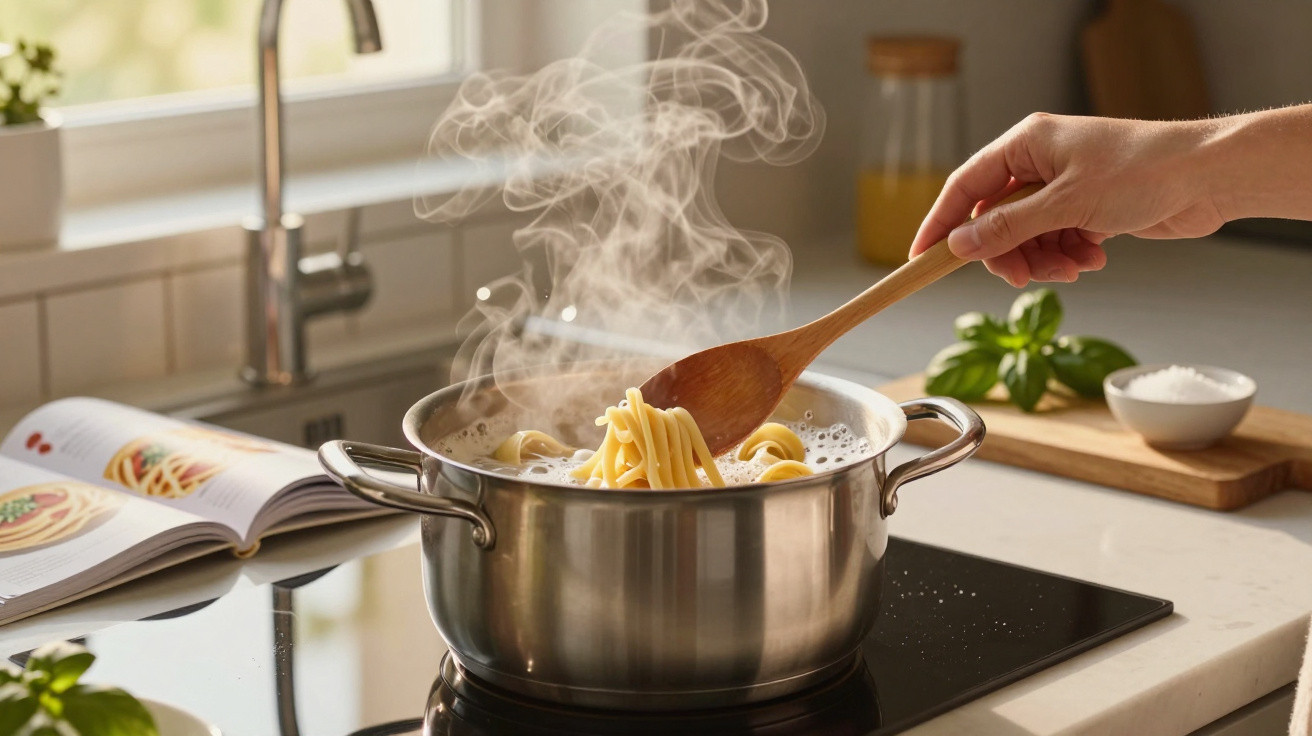
It takes only a second of distraction: you turn away to grate Parmesan, reply to a message, and the pasta water starts rising like eager white foam. It slips beneath the lid, spills across the hob and leaves that slightly acrid smell that signals the cleaning to come. In many kitchens, one response is almost automatic: place a wooden spoon across the saucepan. The commotion appears to settle, sometimes seemingly by magic. This old habit, passed on by a grandmother, flatmate or a video watched between recipes, does have an explanation. It is not entirely miraculous, nor does it remove the need to watch the cooking. But it reveals something very practical about bubbles, starch and heat. A simple spoon can make a real difference at the hob.
Why pasta water suddenly rises to the rim
We all know the moment when a saucepan seems calm, then turns into a miniature volcano as the pasta begins releasing its starch. Boiling water constantly produces bubbles, while the starch slightly thickens the liquid and helps create foam that is more stable than that in a pan of plain water. This foam gathers on the surface, traps steam and looks for a way out. When the heat is high and the pan is already quite full, it needs very little time to reach the rim. A lid fitted too closely can even become its greatest ally.
In a medium-sized saucepan filled to three-quarters and heated at full power, an overflow can occur in under a minute once the water returns to the boil. This is common with spaghetti or tagliatelle: they lower the temperature when added, then prompt a vigorous rise again a few moments later. On a weekday evening, you think there is time to lay the table; when you return, the hob is covered in sticky water. It is not a lack of attention; rather, it is an entirely ordinary physical reaction, intensified by our desire to get things done quickly.
A wooden spoon first works as a small boundary placed in the foam's path. The larger bubbles rising to the surface meet the wood, burst more readily and lose some of their structure. The material is not magical: at first, it is simply cooler than the metal saucepan, and its uneven surface disrupts the foamy film. Foam does not much like being disturbed. As long as the boil remains moderate, that contact can sometimes make the surge subside before it escapes.
The wooden spoon: a useful habit, but no absolute guarantee
To make this trick work as effectively as possible, choose a sufficiently long wooden spoon or spatula and lay it across the saucepan's diameter, with no closed lid above it. Let one end extend well beyond the pan so you can remove it without burning yourself. As soon as the water boils again after adding the pasta, turn the heat down one setting: the water should simmer strongly, not leap violently. The spoon then becomes discreet support, rather than a bodyguard expected to solve everything. A wide, adequately tall saucepan remains your best safeguard against mishaps.
A common mistake is to think you can turn the heat up to maximum, fill the saucepan almost to the rim and forget about it because a spoon has been placed on top. Let us be honest: nobody really does that every day, especially when dinner is being made between other commitments. Even so, wood has its limits. If it is soaked with water, very hot after several minutes, or the foam is especially abundant, it will no longer slow much down. The right response remains straightforward: briefly lift the pan off the heat or reduce the power as soon as the foam nears the rim.
A clean wooden spoon is therefore valuable help, provided you treat it as much as a visual cue as a barrier. Its presence draws your eye, helping you notice the water rising sooner and step in before disaster strikes.
“The wooden spoon can break up some of the bubbles, but it never replaces keeping an eye on the saucepan,” a basic principle of home cooking often reminds us.
To reduce overflows without making dinner more complicated, remember above all to:
- use plenty of water without filling the saucepan right to the rim;
- remove the lid or leave it ajar when the boil becomes vigorous;
- lower the heat slightly once the pasta has been added;
- stir at the start of cooking to disperse the starch.
A small step that also changes the way we cook
Placing a wooden spoon over a saucepan ultimately says something about our relationship with small pieces of kitchen know-how: the kind that require neither expensive equipment nor spectacular technique. The tip has travelled through generations because it works often enough to be remembered, and because it offers the reassuring sense of regaining control over an irritating everyday detail. It does not override the laws of boiling, but it encourages you to watch what is happening in the saucepan instead of waiting for an alarm. Between the caution of moderate heat and that piece of wood laid across the pan, dinner suddenly becomes a little less chaotic.
| Key point | Detail | Added value for the reader |
|---|---|---|
| The foam mainly comes from starch | Pasta releases starch into the water, stabilising the bubbles and creating foam that can rise quickly, particularly in an overfilled saucepan or one heated too strongly. | Understanding the cause of the phenomenon prevents you from thinking an overflow is unavoidable or caused by poor-quality pasta. |
| Wood disrupts the bubbles | A spoon laid across the pan creates an obstacle for bubbles and the foamy film. Its temperature and surface help burst some of the foam on contact. | Readers can use this tip easily, while knowing it is an aid rather than foolproof protection. |
| Moderate heat remains the real solution | Once the water returns to the boil, lowering the heat, leaving the lid open and stirring during the first few minutes limit overflows far more effectively than a single object placed on the pan. | These steps also reduce splashes on the hob and make cooking calmer, even on rushed evenings. |

















Comments
No comments yet. Be the first to comment!
Leave a Comment