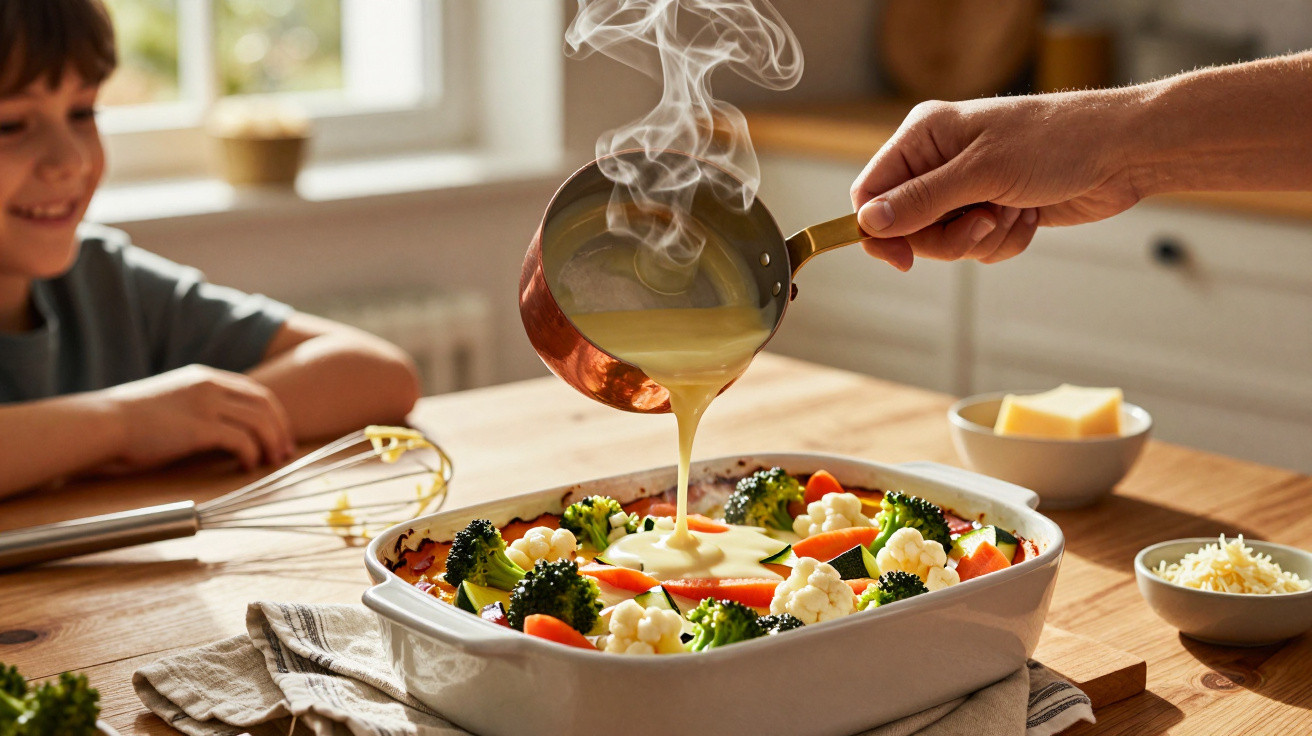
You may think you have mastered gratins because you can make a beautifully smooth béchamel. But what if another ultra-simple sauce, much loved by chefs, could change everything? Mornay sauce has that special quality which turns a slightly uninspiring vegetable dish into a genuinely enjoyable meal.
This article shows how a handful of everyday ingredients can transform cauliflower, Swiss chard or even chicory. There is nothing difficult about it, yet the result makes a real difference.
Why Mornay sauce makes all the difference
Mornay sauce is essentially a cheese béchamel. It starts with the same foundation, then egg and cheese are added to make it even creamier and more indulgent. It is a longstanding star of classic French cooking, while still being remarkably easy to prepare at home.
Its appeal comes down to two things. First, the white sauce coats the vegetables generously and gives them a soft, velvety quality. Then there is the melted cheese, bringing the deep, almost comforting flavour everyone loves in a gratin. An ordinary vegetable dish suddenly feels almost celebratory.
Another benefit is that this sauce is highly versatile. You can swap the cheeses, alter the consistency, or make it lighter or richer to suit your preference. In short, you can create a chef-style sauce in your own kitchen without any complicated technique.
Easy homemade Mornay sauce recipe
Here is a straightforward version, perfect for a large gratin serving 4 people. Everything is made in one saucepan.
Ingredients for around 600 ml of Mornay sauce
- 50 g butter
- 50 g plain flour
- 500 ml whole or semi-skimmed milk
- 1 medium egg
- 80 g grated cheese (for example, 50 g Gruyère + 30 g Parmesan)
- 1 pinch of nutmeg (optional but recommended)
- Fine salt, to taste
- Freshly ground black pepper, to taste
Step-by-step method
Melt the 50 g butter in a saucepan over a medium heat. Once melted but not browned, add all 50 g of flour at once. Stir with a whisk or wooden spoon until you have a smooth paste: this is the roux.
Cook the roux for 1 to 2 minutes, stirring continuously. Do not allow it to brown. This removes the raw flour flavour and gives the sauce a smoother taste.
Gradually pour in the 500 ml milk, whisking constantly. The mixture will thicken very quickly at first, which is perfectly normal. Keep adding the milk in stages until it has all been incorporated.
Turn down the heat and allow the sauce to thicken gently for 3 to 5 minutes. Whisk regularly to prevent lumps. It should have the consistency of thick pouring cream and coat the back of a spoon.
Season lightly with salt and pepper, then add the pinch of nutmeg if desired. Take the saucepan off the heat.
Beat the egg in a small bowl. While whisking, add one tablespoon of the hot sauce to the egg. This tempers it, stopping it from cooking too suddenly.
Tip the egg-and-sauce mixture back into the saucepan, whisking briskly. Return it to a very low heat for 30 seconds to 1 minute. The sauce will become even silkier.
Finally, stir in the 80 g grated cheese. Mix until fully melted. Taste and adjust the seasoning. Your homemade Mornay sauce is ready for gratins.
Gratins that the whole family will love
Now that the sauce is ready, all that remains is to pair it with pre-cooked vegetables. This is where the real transformation happens.
Basic vegetable gratin idea (4 people)
- 800 g vegetables of your choice (cauliflower, broccoli, Swiss chard, chicory, leeks, courgettes...)
- 600 ml Mornay sauce
- 40 to 50 g grated cheese for the topping (Gruyère, Comté, Emmental...)
Preheat the oven to 200 °C, using the fan setting if possible.
Cut the vegetables into evenly sized pieces. Pre-cook them for 8 to 12 minutes by steaming or in salted boiling water. They should be tender while still retaining a little firmness.
Drain them thoroughly. This is essential if you want to avoid water collecting at the bottom of the dish.
Arrange the vegetables in an ovenproof gratin dish and pour the Mornay sauce over them. Stir very gently so they are well coated without being crushed.
Scatter over the 40 to 50 g grated cheese.
Bake for 20 to 30 minutes, until the top is attractively golden and the sauce is bubbling around the edges. Finish with 2 to 3 minutes under the grill for an especially crisp crust.
The contrast is remarkable. The top has a slight crunch, while the middle is wonderfully meltingly soft, almost like a savoury cream filled with pieces of vegetables. Even the most reluctant diners often go back for seconds.
Chef tips for a perfect Mornay sauce gratin
A few small techniques make a huge difference. These details are often what separate a merely average gratin from one people ask for again.
- Always pre-cook the vegetables: raw vegetables release water and remain hard. In most cases, 8 to 12 minutes of steaming is enough.
- Drain thoroughly: leave the vegetables in a colander for 5 minutes, or even pat them dry with kitchen paper. Less water means more flavour.
- Temper the egg: never add it straight to boiling sauce, or you will end up with small pieces of scrambled egg. The small bowl and spoonful of hot sauce are essential.
- Adjust the consistency: if the sauce seems too thick, add 2 or 3 tablespoons of milk and warm it gently. If it is too runny, leave it over a low heat for 1 or 2 minutes longer.
- Experiment with the crust: combine a little fine breadcrumbs with the grated cheese for an extra-crisp topping.
Other uses and variations
Mornay sauce is not limited to vegetable gratins. It is a brilliant base for many everyday dishes.
- Grilled croque monsieur: rather than simply topping it with a slice of cheese, spread a thin layer of Mornay sauce over the croque monsieur. Bake it for a creamy version in the style of a Parisian brasserie.
- Pasta bake: combine 300 g cooked macaroni with a bowl of Mornay sauce, a little ham or vegetables, then cheese on top. Put it in the oven and it is done.
- Creamier lasagne: replace some of the béchamel with Mornay sauce. The cheese already melted into the sauce creates a truly indulgent texture.
When it comes to cheese, almost anything works. For a mild version, choose Gruyère, Emmental or mild Cheddar. For a more pronounced flavour, use Comté, Beaufort, or a Comté-and-Parmesan mix. Leftover raclette cheese or Reblochon can also work wonderfully.
Helping children enjoy vegetables
If your children turn their noses up at vegetables, Mornay sauce could become your best ally. Its cheesy flavour feels reassuring, while its texture envelops the vegetable pieces and makes the whole dish more familiar.
One simple approach is to start with mild vegetables such as cauliflower or broccoli. Serve a small portion without making too much of the vegetable’s name. Let the sauce do the convincing.
You can also add some crunch on top. For example:
- 2 tablespoons breadcrumbs browned in a little butter
- 1 handful lightly toasted flaked almonds
- A few chopped hazelnuts, for older children
This combination of textures - golden crust, creamy centre and small pieces of vegetables - creates a particularly enjoyable experience. You can almost forget you are eating a dish packed with vegetables.
Storage and reheating
You can make Mornay sauce slightly ahead of time. Store it in an airtight container in the fridge, where it will keep for up to 48 hours.
To reheat it, pour it into a small saucepan and warm over a low heat. Add a splash of milk, around 1 to 2 tablespoons, to restore a smooth consistency. Whisk gently to stop the cheese from catching.
Vegetable gratins will also keep in the fridge for 1 to 2 days. To reheat them, use the oven at 180 °C for 15 to 20 minutes rather than the microwave. This keeps the topping crisp and the sauce pleasant.
Try it this evening
Next time you spot a lovely cauliflower or a bunch of Swiss chard at the greengrocer’s, remember this Mornay sauce. With around twenty minutes of preparation, you can create a complete, comforting dish that is often much better received than a simple pan-fried vegetable dish.
You will notice the difference: there is a clear before and after. Between an acceptable béchamel and a properly cheesy Mornay sauce, the difference on the plate is enormous. Why not try it this evening and watch the plates come back empty?

















Comments
No comments yet. Be the first to comment!
Leave a Comment