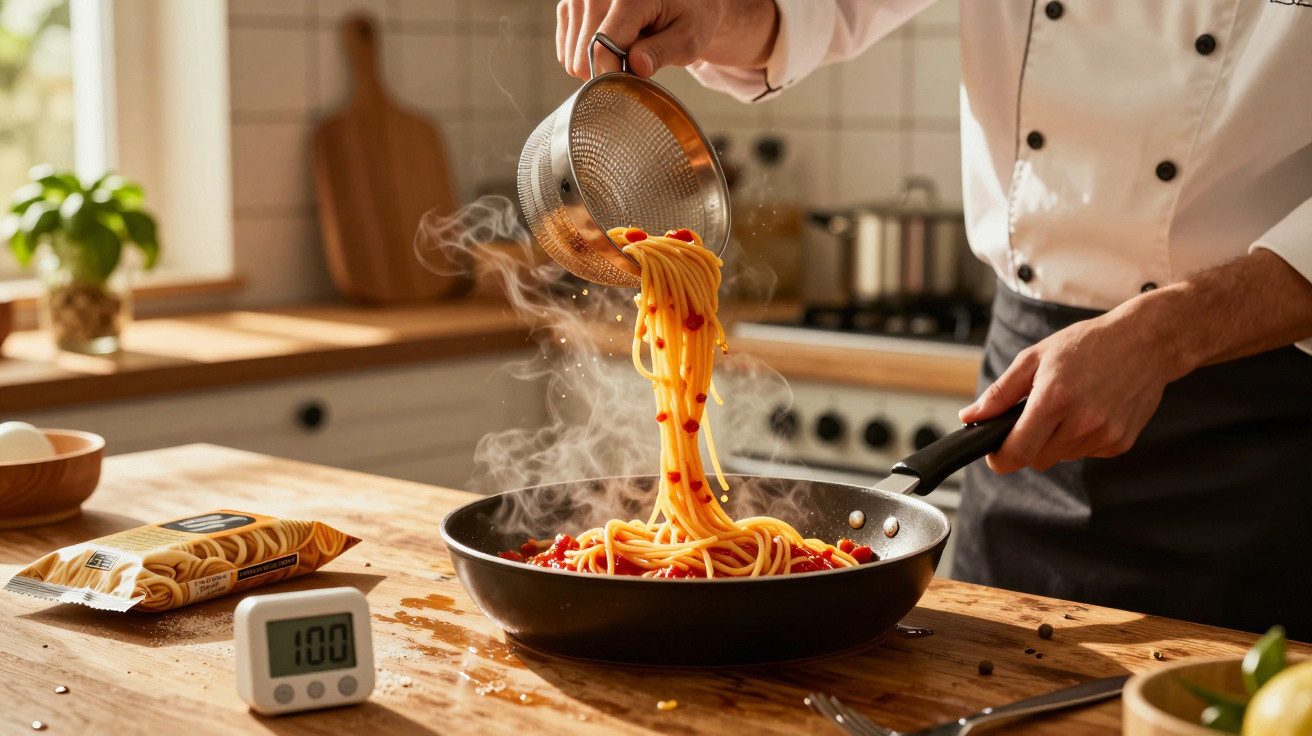
By Thursday evening, the water is already boiling too fiercely, tomato sauce is reducing in the pan beside it, and someone is asking whether the pasta will be ready soon. We follow the instructions on the packet almost automatically: 10 minutes, no longer. Then we drain it, toss it together, and the first mouthful delivers the verdict: soft, slightly heavy and almost sticky. We all know that moment when a simple supper loses some of its appeal because of one extra minute. Italians have a habit that makes all the difference: taking pasta off the heat before the stated cooking time is up. It is not about being purist; it lets the cooking finish where it matters most, in the pan with the sauce. A minute may sound insignificant. It is not.
The cooking time on the packet is not an absolute rule
On a packet of spaghetti, penne or small pasta shells, the cooking time can look like an exact instruction. In reality, it is primarily a guide based on ideal conditions: plenty of water, a steady boil, a suitably sized pan and pasta added at the right time. At home, those details can quickly vary. The heat drops when the pasta goes in, the lid stays on for too long, or you are making the sauce at the same time while glancing at your phone. As a result, the minutes never tell the whole story.
A label stating “11 minutes” often means the manufacturer is aiming for a pleasant texture when the pasta is eaten straight after draining. Yet pasta carries on cooking on its way from the pan to the plate, particularly if it sits in a warm colander or a covered bowl. Taking one minute off the timer prevents that very quick shift from firm to mushy. With thin spaghetti, even 30 seconds can alter the texture in the mouth. Timing is more delicate than it seems.
This approach works because starch, heated in water, gradually turns the dry centre of the pasta into something tender. When you remove it a little early, the middle retains a slight bite: that classic al dente texture, which is not the same as undercooked pasta. Your teeth meet a lively texture rather than one uniform mass. Good pasta should still have something to say when you bite into it. That firmness also helps short shapes hold their form, even after several minutes in a very hot sauce.
The missing minute happens in the pan, not the colander
The easiest method is to set a timer for one minute before the minimum time shown on the packet. Taste a piece straight away, before it cools: it should be soft on the outside, with a centre that is just slightly firmer. Drain it while reserving a small cup of cooking water, then tip it immediately into the sauce. Toss it over a low heat for 30 seconds to one minute. This is where the cooking gently finishes, surrounded by flavour.
Many people drain pasta until the final drop has gone, put it into a serving dish and spoon the sauce over the top. Naturally, this is no disaster: a weekday meal does not need to feel like a competition. Let us be honest: nobody really does everything perfectly every day. Still, a few spoonfuls of starchy cooking water make a sauce smoother and glossier, without having to drown the plate in cream, oil or cheese.
Another common mistake is rinsing pasta under cold water to “stop” it cooking when it is going to be served with a hot sauce. Rinsing removes the surface starch, which is exactly what helps tomato sauce, pesto or lemon butter cling to it.
“Pasta should not wait for the sauce: the sauce should wait for the pasta,” Italian cooks often say.
- Take the pasta off the heat one minute before the stated cooking time.
- Ladle out some cooking water before draining it.
- Finish cooking the pasta in the pan with the hot sauce.
- Serve it without letting the pasta sit in the colander.
This routine may seem precise, but it only requires a little attention at the right moment. Above all, it creates a more satisfying result: sauce that truly coats every piece and a texture that still holds up after the first few mouthfuls.
A small pasta habit that transforms the flavour of the dish
Removing one minute from the stated time is not an inflexible rule set in stone. Fresh pasta, wholewheat pasta, large twists and tiny shells do not all respond in the same way, and the quality of the semolina matters too. The point is instead to regain control of a movement that has become automatic. Tasting, watching and adjusting: these three habits often do more for a dish than the most sophisticated recipe in the world.
There is something reassuring about this quiet precision. A watch and a saucepan will not turn a rainy Wednesday into a trattoria supper, but they can prevent the familiar disappointment of overcooked pasta that absorbs everything while holding on to nothing. Shorter cooking also helps pasta shapes stay neat in a bake or salad, where residual heat continues doing its work. Children sometimes prefer them this way too, even if they would never describe it in those terms.
The next time the water boils and the packet says nine, 11 or 13 minutes, try this small adjustment. Taste the pasta one minute before the end, toss it with its sauce rather than covering it at the last second, and see what happens around the table. Perhaps nobody will notice the technique. Perhaps someone will simply ask why the pasta tastes better tonight. That is often how lasting cooking habits begin.
| Key point | Detail | Added value for the reader |
|---|---|---|
| Remove one minute | The packet time is a guide, not a strict requirement. | Firmer pasta and less risk of overcooking. |
| Keep the cooking water | Its starch helps the sauce become smooth and cling to the pasta. | A better-bound sauce without adding too much fat. |
| Finish in the sauce | Pasta continues cooking once it is out of the pan. | A tastier dish, closer to a restaurant result. |

















Comments
No comments yet. Be the first to comment!
Leave a Comment