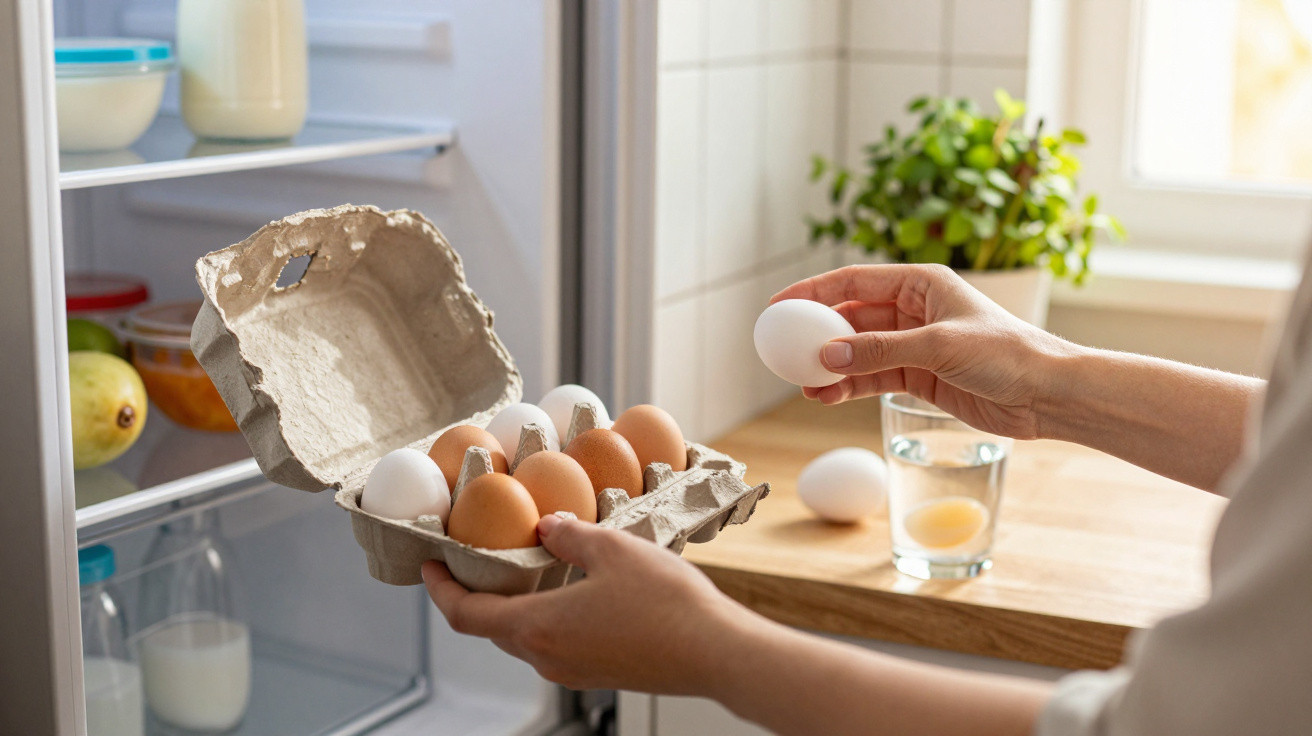
On a Sunday morning, just as you are about to make an omelette, the same question often crops up: should eggs be kept quietly in the cupboard or in the fridge door? In some homes, the carton stays on the worktop, just as it did at the grandparents’ house. In others, it goes straight into the cold as soon as the shopping is unpacked, almost automatically. With family habits, advice heard on the radio, and supermarket shelves where eggs are not chilled, it can be hard to know what to do without getting it wrong. One thing is certain: where you store eggs is not a minor detail.
Why are eggs not always sold chilled?
In French supermarkets, egg cartons are usually displayed on shelves at room temperature. That can appear inconsistent with the advice to refrigerate them once you get home. The explanation lies in the shell: when it has not been washed, it retains a thin natural protective coating called the cuticle. This layer limits the entry of bacteria, including salmonella, while still allowing the egg to breathe.
France, like many European countries, does not routinely wash eggs before they are sold. The approach is different in the United States: eggs are washed, their natural protection is removed, and refrigeration is essential from the outset. This distinction accounts for much of the confusion. We have all experienced two people close to us giving completely opposite instructions, each based on genuinely held experience.
The main issue is not temperature alone, but repeated temperature changes. A cold egg left on the table for a long time may develop condensation on its shell; this moisture can make it easier for microorganisms to pass inside. An egg copes better with a steady temperature than with repeated trips between the fridge and the kitchen. That is why specialists place more emphasis on consistency than on one blanket rule applied without thought.
Fridge or cupboard: practical expert advice for eggs
At home, French food-safety guidance clearly favours storing eggs in the refrigerator, ideally at about 4 °C. Keep them in their original carton, which protects them from knocks, odours and possible contamination. Put the carton on an internal shelf rather than in the door, as that area undergoes temperature changes every time the fridge is opened.
If your eggs have already been kept at room temperature and your kitchen is cool, dry and away from heat sources, the risk is not automatically high. The key is to avoid moving them back and forth repeatedly. Let us be honest: hardly anyone manages that perfectly every day, especially after a large shop or when the fridge is already full. The principle is straightforward: select a suitable place, then keep them there until you use them.
Eggs should be handled sensibly, without turning every breakfast into a source of worry.
“The best habit is to keep eggs cool and avoid temperature fluctuations, which weaken their natural protection,” food-safety recommendations relayed by health authorities remind us.
A few simple steps make a real difference:
- do not wash eggs before putting them away;
- discard immediately any egg that is cracked or has a sticky shell;
- crack each egg into a separate bowl before adding it to a dish.
Freshness cannot be judged by the date on the carton alone
The best-before date shown on the carton is normally 28 days after laying. It is a useful guide, but it does not replace observation. A carton forgotten at the back of the fridge may still contain perfectly acceptable eggs, while an egg exposed to heat may be questionable before the printed date. The smell, the appearance of the white and the condition of the shell remain valuable indicators.
The glass-of-water test, often handed down through generations, can help estimate an egg’s age. If it lies flat on the bottom, it is very fresh; if it stands upright, it is older; if it floats, it is best not to eat it. This is not an absolute food-safety test, but it illustrates a simple fact: the air pocket inside an egg grows over time.
For vulnerable people - young children, pregnant women, older adults or people with weakened immune systems - extra caution is advisable. Choose thoroughly cooked eggs and avoid raw or lightly cooked dishes, such as homemade chocolate mousse, fresh mayonnaise or tiramisu. Cooking remains the most reliable protection against any bacteria that may be present. A runny yolk is a pleasure, but it requires a very fresh product and careful storage.
| Key point | Detail | Benefit for the reader |
|---|---|---|
| Choose a stable temperature | Experts generally recommend the domestic refrigerator, at about 4 °C, particularly after purchase. If eggs are kept at room temperature, the location should be cool, dry and stable, away from an oven, a window or a radiator. | Avoiding temperature changes reduces the likelihood of condensation on the shell and helps retain the egg’s natural barrier. |
| Keep the original carton | The carton reduces knocks, prevents eggs from absorbing strong fridge odours and keeps the best-before date visible. Its compartments also allow eggs to be stored point-down. | An ordinary but effective storage method: less breakage, better traceability and a practical habit when cooking. |
| Adapt recipes to those eating them | A poached egg, raw mayonnaise or a dessert containing uncooked eggs requires impeccable freshness. For vulnerable groups, it is better to opt for thorough cooking or pasteurised eggs. | Readers can continue making favourite dishes while simply adjusting the level of precaution to their circumstances. |
Ultimately, the fridge-or-cupboard question also reflects how we approach everyday habits: we often repeat what we have seen others do without always knowing where the rule came from. Keeping eggs cool in their carton, without washing them or taking them out unnecessarily, remains the most reassuring option for most households today. That does not erase traditions, nor does it mean eggs cannot stay for a few days in a cool kitchen. Instead, it encourages you to consider your actual surroundings: how warm the home is, how quickly the eggs will be used and who will eat them. The right habit is not dramatic; it is consistent. In your home, are eggs already waiting behind the fridge door or on the worktop?

















Comments
No comments yet. Be the first to comment!
Leave a Comment