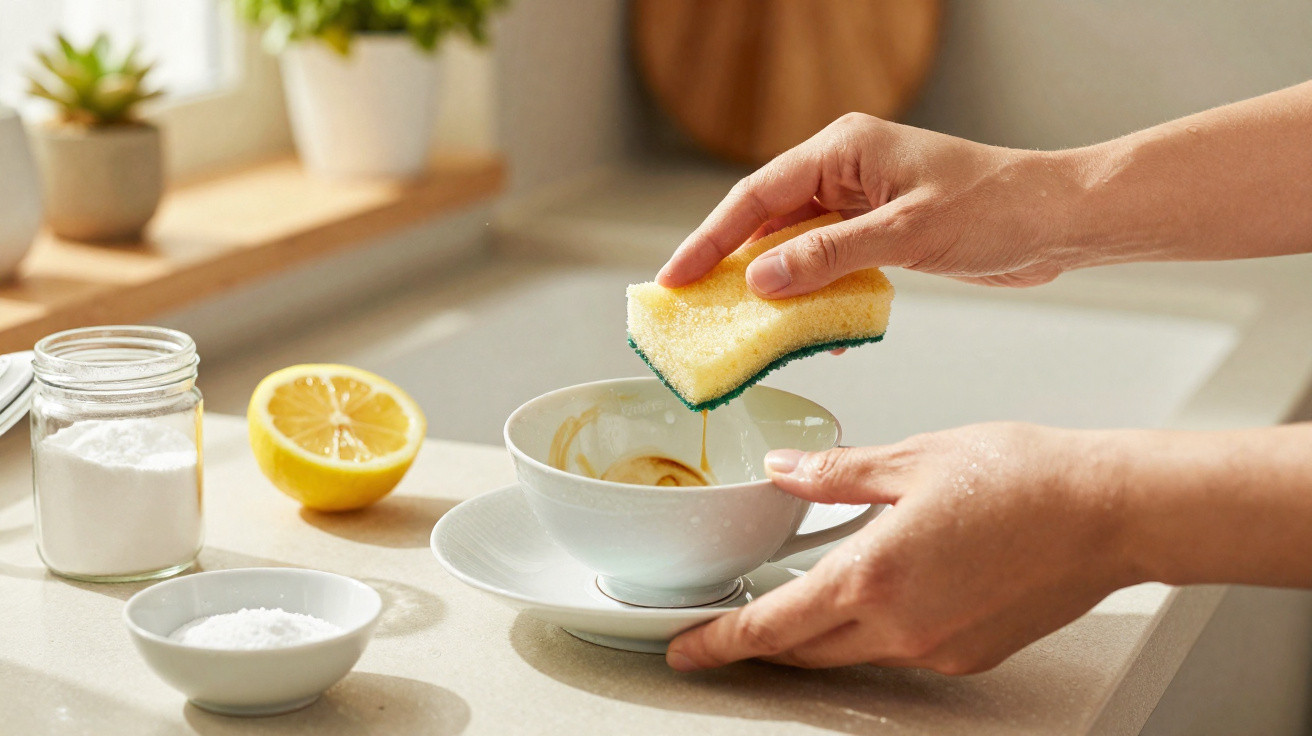
The cup sat on the kitchen table like a small betrayer. Delicate cream on the outside, with that brown oval inside still staring back cheekily after its third wash. The morning was already too short, the tea had long gone cold, and suddenly it was no longer about caffeine but dignity. How can something as innocent as black tea leave such stubborn marks? You scrub with a sponge, leave it to soak, try washing-up liquid in every possible way – yet the shadow remains, declaring: “I’ve been here for quite some time.”
We all know that moment when visitors are coming and we hope nobody looks inside the cup. All at once, the stains seem like a character assessment of the household. And there is always the underlying question: am I simply untidy, or is tea genuinely this mean?
That is where things become interesting.
Why tea stains are so stubborn – and what is actually happening
Tea stains seem as harmless as a minor mishap. A few cups a day, a little ring, a touch of convenience. Then, weeks later, there is a firmly established patina that no longer suits the cosy Instagram kitchen. Pale cups show everything: every sip, every pause, every “I’ll wash that later”. On dark-blue stoneware, it might not matter. On white porcelain, it becomes a test of character.
Anyone who has watched a favourite brand-new cup develop a brown interior after just two weeks knows how frustrating it can be. You scrub until your fingers crack and think: this cannot be normal. Tea stains are like those quiet housemates nobody invited but who stay anyway. Let us be honest: nobody thoroughly cleans every single cup straight after the final sip. Between video calls, the laundry basket and “What shall we have for dinner?”, a mug can easily slip through the net.
The chemistry behind it is unremarkable but unforgiving. Tea contains tannins: compounds that settle as a thin film across smooth surfaces. Especially on slightly rough ceramic or glazed porcelain interiors, they gradually form something like an ultra-thin layer of varnish. The hotter and stronger the tea, and the longer it sits in the cup, the thicker that layer becomes. Washing-up liquid removes grease, but tea stains behave more like baked-on paint. That is why ordinary washing-up can feel so powerless. Eventually, warm water and good intentions are not enough.
Removing tea stains with simple household remedies
The classic solution that many people try far too late is bicarbonate of soda or baking powder. Put a small spoonful into the damp cup, spread it briefly with a finger or soft cloth, wait two or three minutes, then rub gently. The brown film suddenly comes away like eraser crumbs, and that “Oh wow” moment can become almost addictive. It works so unassumingly that you wonder why you ever struggled with washing-up liquid alone.
If there is no bicarbonate of soda at home, try salt with a little lemon juice. Sprinkle some salt onto the damp bottom of the cup and add a few drops of lemon juice until it makes a coarse paste. Rub in small circles, rinse once, and in many cases the cup will look almost new again. For especially stubborn marks, mix bicarbonate of soda with a drop of washing-up liquid and warm water. Leave it briefly, rinse it away and admire the result.
Many people feel almost guilty once they realise how long they have ignored the stains. “I could have done this much sooner,” they think, suddenly looking at the other cups in the cupboard differently. There is a hidden pressure involved: a tidy home, a clean kitchen, flawless cups. The truth is that tea stains have nothing to do with being “dirty” in the usual sense. They are more a combination of chemistry and everyday inertia. Anyone who drinks a lot of tea will get them. Full stop. Small routines help; perfectionism does not.
One common mistake is attacking delicate porcelain with abrasive scouring sponges or rough metal pads. It may work in the short term, but in the long run it makes matters worse because it roughens the surface, allowing tannins to cling even more easily. Chlorine cleaners and harsh bathroom cleaners can also be tempting, but they may damage glazes and leave unpleasant smells behind. A calm, almost kind approach to your cup usually achieves more than battle mode.
“I always thought my light-coloured cups were simply ‘past it’ after two years,” a friend once told me, “until someone showed me bicarbonate of soda. I rescued every one of them – in a single evening.”
To stop the everyday issue of tea stains becoming a recurring mini-crisis, this short mental checklist can help:
- Give the cup a quick rinse with clean water after the last sip – even if you will wash it properly later.
- Treat your cups to a weekly clean with bicarbonate of soda or baking powder.
- Avoid harsh scouring sponges, particularly for fine porcelain and favourite cups.
- For severe stains, soak briefly in a bicarbonate of soda solution rather than scrubbing for hours.
- Keep an eye on light-coloured cups in daily use, so you notice early when a film starts to form.
When tea stains tell a story beyond tea
In the end, tea stains are only stains. Yet they often provoke more than we admit. They bring to mind long, lonely evenings with too much black tea, rushed mornings and unwashed mugs amid home-working chaos. Sometimes a discoloured cup triggers the feeling of losing control: if I cannot even keep my cup clean, how will I manage everything else? In reality, it merely shows that we live, work, drink and forget.
Anyone who deliberately spends a few minutes rescuing an old, stained cup often feels an almost ridiculously strong sense of satisfaction. Suddenly there is that clarity, that rich white surface you had already given up on. It is a small, visible success in the microcosm of the kitchen. Many people say afterwards that they automatically feel more like drinking from that cup again, instead of always moving only the “reasonably clean” ones to the front. Small acts of care can work like mini resets – not only for porcelain, but for the mind as well.
Perhaps that is the hidden appeal of these modest household tricks: for a moment, they take us out of the constant flow and give us a task that can be completed within minutes, with a clear before-and-after effect. You could say tea stains are the most honest witnesses to everyday life. Yes, you can wipe them away. But you may also remember them. And perhaps the next nearly gleaming, formerly stained cup will tell a new story – about someone who has learned to handle small things a little more gently.
| Key point | Detail | Benefit for the reader |
|---|---|---|
| Tea stains are caused by tannins | These compounds settle like a film on the cup’s surface | Explains why normal washing-up is often insufficient |
| Bicarbonate of soda/baking powder as the main trick | Leave it to work, rub briefly, and stains lift without force | Provides a simple, inexpensive and gentle method |
| A gentle routine rather than perfectionism | Quickly rinse after drinking and give cups an occasional cleaning treatment | Helps prevent stains over time without becoming overwhelming |

















Comments
No comments yet. Be the first to comment!
Leave a Comment