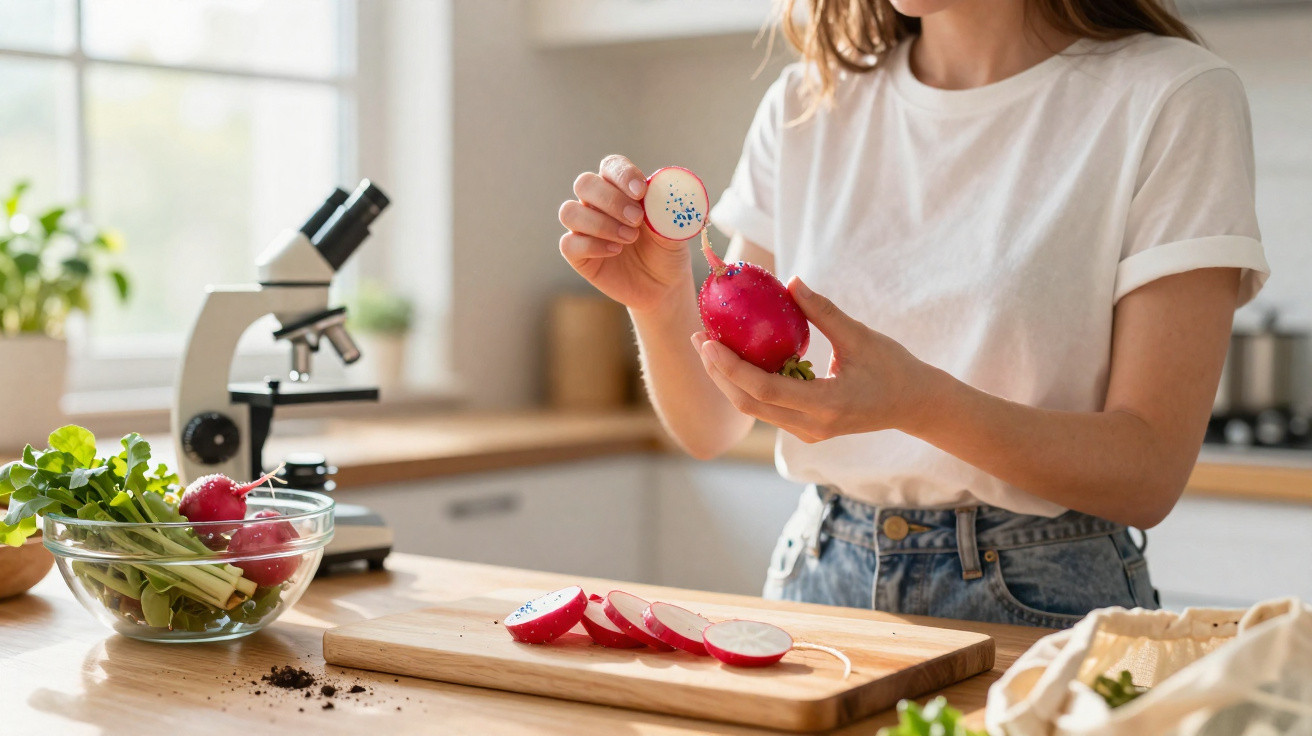
Radishes, lettuce and cucumber may arrive on the plate fresh and crisp, yet still contain minute pieces of plastic. A British research team has shown for the first time that even plants’ natural protective barriers can fail, allowing plastic particles to travel into the edible parts of vegetables.
Plastic in vegetables: what the new study actually reveals
The widely cited research was carried out at the University of Plymouth in England and published in the scientific journal Environmental Research on 23 August 2025. The researchers set out to determine whether plastic particles suspended in soil or water can enter food crops – not merely settling on their surfaces, but reaching deep inside them.
They chose radishes as their model plant because they grow quickly and have clearly defined root and bulb structures. In laboratory conditions, the plants were exposed to extremely small plastic particles, known as nanoplastics, in a nutrient solution. These particles are so tiny that they are difficult to identify even under a microscope.
“Nanoplastic is around a thousand times smaller than the diameter of a human hair – yet it still finds its way into our food.”
The experimental design initially appeared straightforward. For five days, only the radishes’ inedible root sections were exposed to nanoplastics. The bulb that would later be eaten remained externally “clean”. The researchers then examined the plant tissue layer by layer.
The findings were clear: particles were detected not only on the root surface but also within the plant and, ultimately, in the edible bulb. Within no more than five days, nanoplastic particles had reached the portion of the vegetable that people actually eat.
How plastic can enter plants in the first place
Plants would ordinarily be expected to have a sophisticated defence system. Their roots contain what is known as the Casparian strip, a form of biological border control. It ensures that only certain dissolved substances, such as minerals, enter the plant’s transport system, while potentially harmful substances are largely kept out.
For a long time, this boundary was considered so effective that solid particles were thought to have little chance of passing through it. The Plymouth study now indicates that this assumption no longer holds for nanoplastics.
The particles appear to be small enough to move through spaces between cells or through tiny “holes” in cell walls. From there, they can enter the plant’s vascular tissue and be carried through it in much the same way as nutrients.
“The roots’ natural filtration system appears to work only to a limited extent against nanoplastics – which is what makes the finding so alarming.”
When plastic exists as bottles or carrier bags, it can be avoided or collected. Once it has broken down into microplastics and eventually nanoplastics, however, it appears where nobody expects it: in soil, groundwater, air and rain – and now demonstrably in plant tissue.
Radishes as a warning sign for the entire food system
Although the experiment used radishes, the researchers consider the result relevant to many other crops. The structure and operation of roots are similar across numerous vegetable varieties and cereal crops.
This raises the possibility that, in theory, any vegetable could be affected if it grows in contaminated soil or is irrigated with polluted water – from carrots grown in an allotment to commercially cultivated lettuce.
- Vegetables absorb nanoplastics through their roots.
- The root’s protective barrier can be crossed by extremely small particles.
- The particles reach the edible section of the plant.
- This process can happen within a matter of days.
- In principle, many commonly eaten vegetables could be affected.
The study therefore highlights an issue that is not confined to individual locations. Plastic reaches soils on a large scale through litter, tyre wear, artificial turf, textiles, sewage sludge and contaminated water. Even remote areas are not spared, as particles can be transported further by air and water currents.
What does this mean for consumers?
Perhaps the most uncomfortable message is that lettuce which looks flawless and smells fresh may still contain such particles, with no change in taste. Washing, peeling and cooking can remove dirt and some microplastic from the surface, but nanoplastic inside the plant cannot be eliminated in this way.
Reliable data on the health risks posed by these quantities are still largely lacking. Researchers know that nanoparticles can pass through cells in the body and accumulate in organs. Whether they cause long-term harm, and at what level of exposure, remains unresolved.
“The fact is: we take in plastic through air, water, fish, meat – and now demonstrably through vegetables as well. The total amount is rising.”
Medical experts are therefore particularly concerned about long-term exposure. It is not a matter of accidentally consuming one piece of plastic once a year; people are likely to ingest the smallest quantities every day from numerous sources. The question is increasingly not “whether”, but “how much” and “with what consequences”.
Why research is now going further
The Plymouth study is intended as a starting point. It demonstrates that plastic particles can genuinely travel into food crops. The next stage, which several teams around the world want to investigate, includes:
- which plant species absorb how much plastic;
- whether particular soils or cultivation methods increase the risk;
- how much artificial fertiliser, plastic sheeting, drip irrigation or sewage sludge contribute;
- whether organic farms actually show lower levels;
- what effects nanoplastics have in the bodies of humans and animals.
As these connections become clearer, rules and countermeasures can be designed more precisely. Possible measures could include tighter requirements for spreading sewage sludge on fields, limits on plastic in agricultural films, or new filtration systems at wastewater treatment plants.
What we can do ourselves despite the invisible risk
The idea that even healthy vegetables may contain plastic is frustrating. Even so, there are several ways to at least reduce personal exposure and lower the overall amount entering the environment:
- Buy less single-use plastic: Every piece of packaging avoided reduces potential future sources of plastic in soil.
- Support local growers: Smaller producers may be able to provide more transparent information about irrigation and fertilisation.
- Look for organic certification: It is not a guarantee, but sewage sludge and plastic sheeting are often used less extensively.
- Use compost rather than plastic in the garden: Avoid plastic sheeting where possible and use mulch made from natural materials.
- Apply political pressure: Call for stricter rules on microplastics and recycling.
A home vegetable garden may initially seem like a safe space. Yet plastic can arrive there too, for example through contaminated compost, watering water or wear from plastic materials. Using as little plastic as possible in the garden and choosing clean sources of compost can at least reduce part of the problem.
Nanoplastics and microplastics: what is the difference?
The two terms are often used together, despite referring to very different things. Microplastics are particles measuring up to 5 millimetres. They result from the breakdown of larger waste items or are deliberately used as granules, for instance in industry or, formerly, in cosmetics.
Nanoplastics represent the next and far smaller stage. These particles measure no more than 100 nanometres, or one ten-thousandth of a millimetre. At this scale, substances behave differently: they can cross biological barriers, adhere to cell membranes and influence chemical reactions.
| Term | Size range | Example |
|---|---|---|
| Microplastics | up to 5 mm | Fibres from clothing, wear from car tyres |
| Nanoplastics | up to 0.0001 mm | Heavily degraded plastic residues in water or soil |
It is precisely this extreme smallness that makes nanoplastics so problematic for plants and animals. Material that can no longer be seen, filtered or easily removed spreads unnoticed through ecosystems – and ultimately into the human body.
How much is plastic changing our idea of “healthy”?
Vegetables have long been an unambiguous recommendation: plenty of them, in a range of colours and ideally every day. The study does not fundamentally alter that advice, but it does show how deeply plastic has already entered the foundations of our lives. Even people who shop consciously, eat little meat and choose fresh food can only avoid exposure to a limited degree.
The real scandal lies less in an individual radish than in the realisation that a wholly human-made material is appearing everywhere: in the air, the sea, fish, drinking water, mammals – and now demonstrably in vegetables. Each new study, such as the one from Plymouth, brings one question further to the fore: how much plastic are we, as a society, willing to accept before production, recycling and consumption genuinely change?

















Comments
No comments yet. Be the first to comment!
Leave a Comment