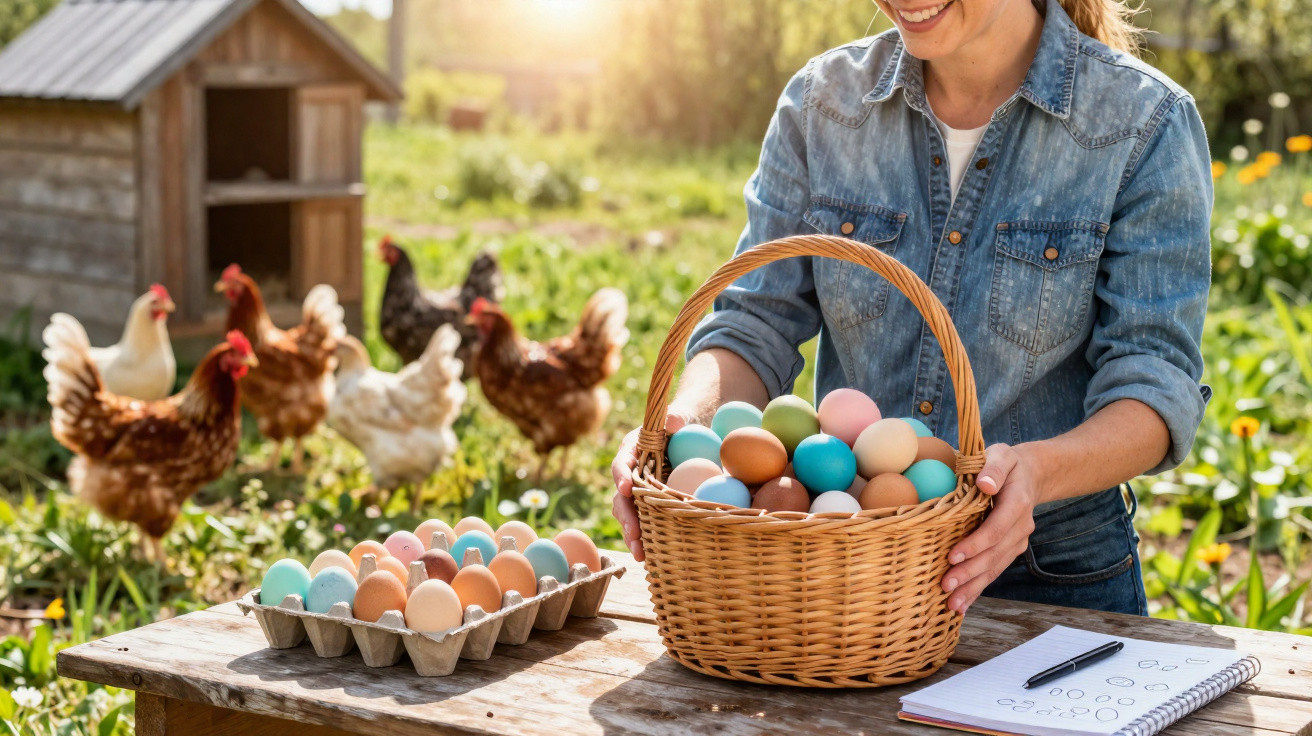
If you are planning a hen house in the garden, you will probably picture brown or white eggs. Many backyard keepers are surprised when they later see photographs of turquoise or olive-green eggs and wonder whether they are internet fakes or the real thing. In fact, several chicken breeds lay naturally coloured eggs day after day – with no food colouring or Instagram filters involved.
Why some hens lay blue and green eggs
An egg's shell colour is not random; it results from a clearly defined biological process. As each egg travels through the hen's oviduct, her body deposits pigments into the shell while it is still soft. The pigments involved are determined by genetics.
Two pigments are particularly important:
- Biliverdin (oocyanin): colours the shell blue all the way through, including beneath the surface
- Protoporphyrin: creates brown through to rusty-red shades
Where only biliverdin is deposited, the result is sky-blue or pastel-blue eggs. If the body then applies protoporphyrin over a shell that is already blue, the egg becomes a rich green or olive green. When pigments are present in lighter quantities, eggs can appear pinkish or cream-coloured.
The colour is almost entirely contained in the shell and does not affect the yolk colour, flavour or nutritional value.
The egg itself – both yolk and white – remains the same whether a hen lays white, brown or mint-green eggs. Differences in flavour are more closely linked to feed, living conditions and freshness than to shell colour.
Other factors that affect shell colour
Genes establish the base colour, but the exact shade can vary slightly. Three factors are especially relevant:
- Age of the hen: Younger birds generally lay smaller, slightly paler eggs. As they mature, both shell and colour become stronger, although they often fade somewhat again later in a hen's life.
- Health and stress: Noise, pecking-order disputes, parasites and illness can disrupt shell formation. Colours may then look duller, while shell quality and egg shape can also suffer.
- Feed: A feed mix cannot change the shell into a different colour. However, a balanced diet rich in minerals helps pigments to be deposited properly and keeps the shell strong.
So, anyone wanting a rainbow of eggs in their basket first needs suitable breeds, followed by calm and good-quality keeping conditions.
Popular chicken breeds for blue eggs
Araucana: the original bird with turquoise eggs
Originally from South America, the Araucana is regarded as the classic among ‘colourful’ chickens. Depending on the breeding line, it lays around 140 to 200 eggs annually, ranging from pale sky blue to delicate green.
- Egg production: moderate to good, suitable for backyard keepers
- Eggshell colour: blue to bluish-green
- Temperament: lively, hardy and keen to range
Beards and feather tufts around the head are typical features, and some lines have no tail base. Keepers of pure Araucanas often find that their egg basket contains an especially intense shade of blue.
Ameraucana and comparable breeding lines
Further lines developed from the Araucana in North America, including the Ameraucana, which tends to lay pastel-blue eggs. Similar breeding types are found under different names in Central Europe; all are intended to combine dependable blue eggs with solid egg production.
Hybrid hens such as ‘Azur’ and Cream Legbar
Many backyard keepers choose hybrids because they produce comparatively large numbers of eggs and are easier to find. Common examples include commercial types sold under names such as ‘Azur’, as well as the Cream Legbar.
- Egg production: often more than 200 eggs per year
- Eggshell colour: pale blue to vivid turquoise
- Advantage: combines colourful shells with high productivity
For beginners, these hybrids offer a straightforward introduction to colourful eggs, provided they understand that they are often purpose-bred crosses rather than traditional breeds.
Green and olive-green eggs: made possible by crosses
Olive Egger: when blue and brown combine
Breeders usually use so-called Olive Eggers to produce olive-green eggs. This is not one standardised breed but a breeding type created by crossing chickens carrying the blue-egg gene with brown-egg-laying breeds.
A typical pairing is an Araucana, or a similar blue-egg layer, with a dark-laying breed such as the Marans. The resulting hens produce greenish to olive-coloured eggs, often with a somewhat stronger shell structure.
Olive Eggers are genetic lucky dips: egg colour and pattern can vary slightly from one bird to another.
Some lines lay pale green eggs, while others produce shells that are almost khaki. This range is precisely what makes them appealing to backyard keepers.
Pink, cream and ‘chocolate eggs’
Alongside blue and green, some hens lay eggs that resemble lightly tinted white, including shells with an almost pink appearance. Typical examples include:
- Faverolles: large, calm chickens that lay cream to pinkish eggs
- Barred Rock (barred Plymouth Rock): lays pale-brown to cream eggs, often with a very even shell
- White Leghorn: produces snowy-white eggs with high laying potential
For a striking colour contrast, consider the French Marans breed. Its eggs are large, with shells that can range from deep rusty brown to almost ‘chocolate brown’, depending on the breeding line.
How to plan your own rainbow egg basket
Even if you only want to keep three or four hens in the garden, careful selection can still create a visually spectacular egg basket. One possible combination is:
- One Araucana or blue-egg-laying hybrid hen for blue eggs
- One Olive Egger for olive-green shells
- One Marans for dark ‘chocolate eggs’
- One Faverolles or Barred Rock for cream to pinkish eggs
A small flock like this can easily produce several hundred eggs in a typical garden year, in colours otherwise most often seen in boxes from farm shops or specialist holdings.
| Breed / type | Approximate eggshell colour | Annual production (guide) |
|---|---|---|
| Araucana | pale blue to greenish | 140–200 eggs |
| Cream Legbar / ‘Azur’ type | pale blue | 200+ eggs |
| Olive Egger | green to olive | 160–220 eggs |
| Marans | very dark brown | 150–200 eggs |
| Faverolles | cream to pinkish | 150–180 eggs |
| White Leghorn | pure white | 220+ eggs |
Keeping conditions: what coloured-egg-laying hens need
Breeds that lay coloured eggs do not generally have unusual or exotic requirements. They need the same essentials as any healthy laying hen:
- a dry, well-ventilated coop with perches
- a secure run protected from foxes and hawks
- nesting boxes with clean bedding
- complete layers' mash or grain feed with a mineral supplement
- fresh water and access to sand or dust baths
Sources of noise, such as machinery running constantly, loud music or a road immediately next to the garden, increase stress levels. Many keepers report that hens lay more consistently in a quiet corner of the garden and that shell shades remain more uniform.
What colourful eggs mean for diet and daily life
From a nutritional perspective, a blue egg differs very little from a brown supermarket egg. Laying hens with outdoor access and varied feed tend to have slightly more favourable fat and cholesterol levels, regardless of shell colour. Green forage, herbs and maize usually give the yolk a deeper yellow to orange colour.
In everyday life, colourful eggs mainly offer one thing: a talking point. Children take a greater interest in where their breakfast egg comes from, visitors ask about the breeds, and many people enjoy using coloured eggs for brunch buffets or as a natural highlight at celebrations. They can be used for baking and cooking in exactly the same way as any other egg.
One final point: anyone deliberately planning a flock of different breeds should understand the terms ‘pure breed’ and ‘hybrid’ before buying. Pure breeds pass on their traits relatively consistently. Hybrids often lay more eggs, but pass their distinctive characteristics to offspring only to a limited extent. That is perfectly adequate for a family garden, but anyone pursuing long-term breeding aims should look more closely.

















Comments
No comments yet. Be the first to comment!
Leave a Comment